EPR Annual Return Filing: A Practical, Ground-Level Guide for Producers, Importers, and Brand Owners
If you are a Producer, Importer, or Brand Owner (PIBO) operating in India, chances are this question has crossed your mind more than once:
- “Have we actually complied with EPR, or are we just uploading numbers and hoping for the best?”
You are not alone. EPR annual return filing in India has quietly become one of the most misunderstood regulatory obligations. On paper, it looks straightforward—log into the portal, upload data, submit returns. In reality, it is a compliance minefield where incorrect data, mismatched credits, or casual assumptions can trigger notices, penalties, or even suspension of EPR authorization.
Let’s slow this down and break it apart—not theoretically, but the way regulators, auditors, and enforcement teams actually see it.
By the end of this article, you will clearly understand:
- What EPR annual return filing really means?
- Who must file, and under which waste categories?
- How annual returns are calculated (not guessed)?
- Where companies go wrong—repeatedly?
- How to file defensibly, not just digitally?
What Exactly is EPR Annual Return Filing (Beyond the Portal Upload)?
At its core, EPR annual return filing is the government’s way of asking a simple question:
“You put material into the Indian market—what happened to it after consumption?”
Under Extended Producer Responsibility (EPR), PIBOs are legally responsible for the post-consumer waste generated from their products and packaging. The annual return is not a formality. It is a performance report that demonstrates whether you met your assigned recycling or recovery obligation for a financial year.
The filing is done through the centralized EPR portal managed by the Central Pollution Control Board (CPCB), and it applies to multiple waste streams:
- Plastic Packaging Waste
- E-Waste
- Battery Waste
- Tyre Waste (in specific cases)
Each stream has its own logic, credit mechanism, and compliance expectations.
Who Must File EPR Annual Returns?
One of the biggest mistakes companies make is assuming EPR applies only to manufacturers.
In reality, EPR annual return filing India applies to:
- Producers – Entities manufacturing products or packaging in India
- Importers – Bringing packaged goods or products into India
- Brand Owners – Selling under their brand name, even if manufacturing is outsourced
Here’s the nuance most blogs skip:
If your brand name appears on the packaging or product sold in India, EPR responsibility sticks to you, not your vendor.
This is where many FMCG brands, startups, and D2C companies slip—assuming their contract manufacturer or importer has “handled EPR.”
They usually haven’t.
Understanding the Legal Backbone Behind EPR Annual Return Filing
EPR annual return filing is not an advisory guideline. It is backed by enforceable rules under India’s environmental framework, such as:
- Plastic Waste Management Rules (amended periodically)
- E-Waste (Management) Rules
- Battery Waste Management Rules
These rules empower regulators to:
- Demand historical data
- Verify recycler authenticity
- Cross-check credits
- Impose environmental compensation (penalties)
Once your return is filed, it becomes part of a permanent regulatory record. Retroactive corrections are difficult and sometimes impossible.
How EPR Annual Return Filing is Actually Calculated?
This is where theory ends and operational reality begins.
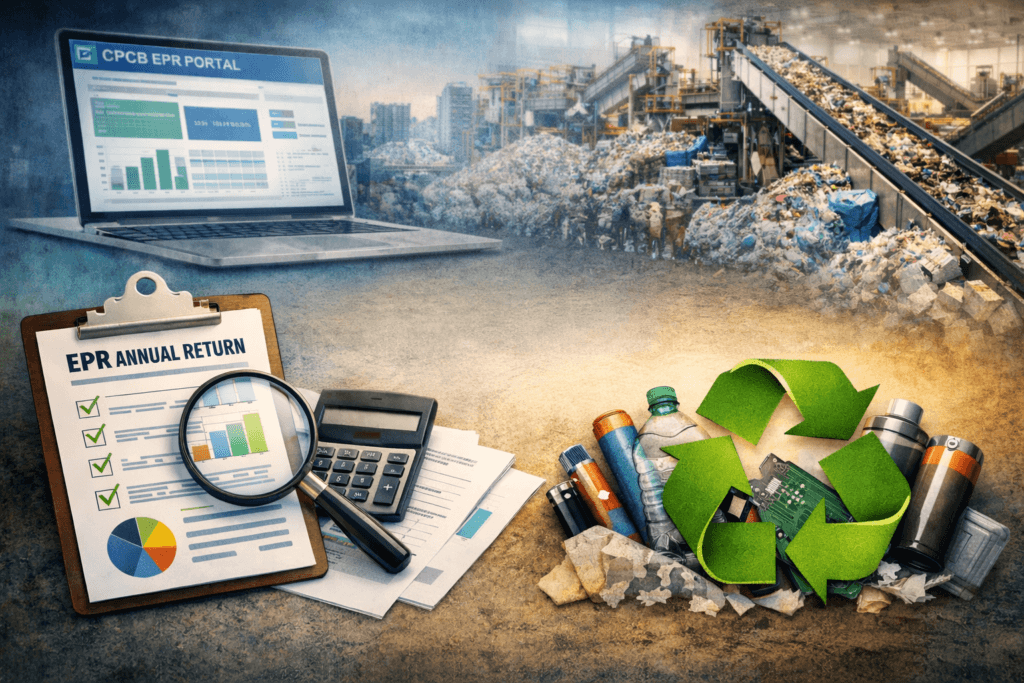
Your annual return is not based on assumptions or rounded numbers. It is calculated using three core datasets:
1. Quantity Introduced in the Market
This includes:
- Domestic sales
- Imports
- Online and offline distribution
- State-wise movement (in some cases)
Packaging weight matters. Guessing does not.
2. EPR Obligation Percentage
The rules specify what percentage of the introduced quantity must be recycled or recovered in that year. This percentage typically increases year-on-year, catching many companies off-guard.
3. EPR Credits Earned
Credits come from:
- Registered recyclers
- Valid processing certificates
- Waste actually processed (not just collected)
Credits must:
- Match your waste category
- Match the financial year
- Be traceable on the portal
A mismatch in any one of these invalidates the credit.
The Step-by-Step Reality of Filing EPR Annual Return
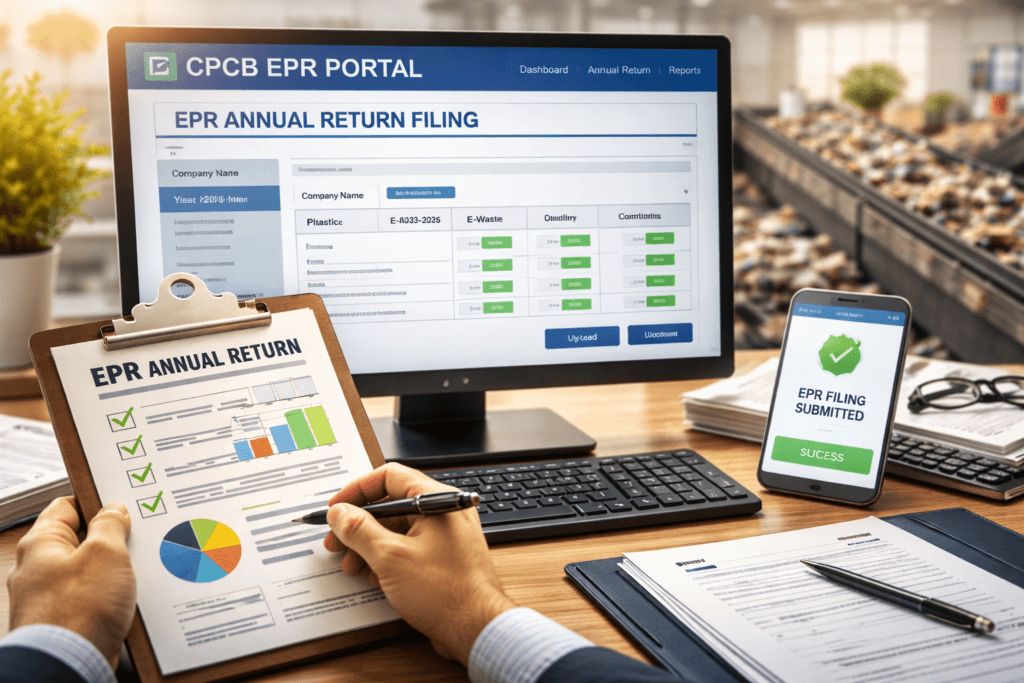
Let’s be practical. Filing EPR annual return India typically involves:
- Data consolidation from ERP, sales, and import records
- Material categorization (rigid plastic, flexible plastic, electronics, batteries, etc.)
- Credit mapping with authorized recyclers
- Portal entry with supporting documents
- Declaration and submission
Here’s the uncomfortable truth:
The portal accepts incorrect data far more easily than regulators forgive it later.
A successful upload does not equal compliant filing.
Common Mistakes That Trigger Notices and Penalties
After handling dozens of real compliance cases, certain patterns repeat themselves:
- Filing annual returns without reconciling credits
- Using unregistered or blacklisted recyclers
- Carrying forward credits incorrectly
- Declaring sales data that does not match GST or customs records
- Treating EPR as a one-time exercise instead of a continuous obligation
Regulators are increasingly using data triangulation — GST, import data, recycler reports—to identify inconsistencies.
What Happens If You Miss or Misfile EPR Annual Returns?
Non-compliance is no longer ignored.
Consequences may include:
- Environmental compensation (financial penalties)
- Suspension of EPR authorization
- Inability to sell products legally
- Scrutiny during funding, M&A, or ESG due diligence
For companies planning expansion, export, or institutional funding, unresolved EPR gaps become deal-breakers.
Why “Credit Purchase Only” is a Dangerous Shortcut?
Many vendors promise “quick EPR credits” with minimal paperwork. This is where companies unknowingly step into trouble.
If credits are:
- Backdated improperly
- Generated without actual processing
- Linked to invalid recyclers
…the liability ultimately falls on you, not the vendor.
Regulators do not penalize consultants. They penalize PIBOs.
How Smart Companies Are Approaching EPR Annual Return Filing Today?
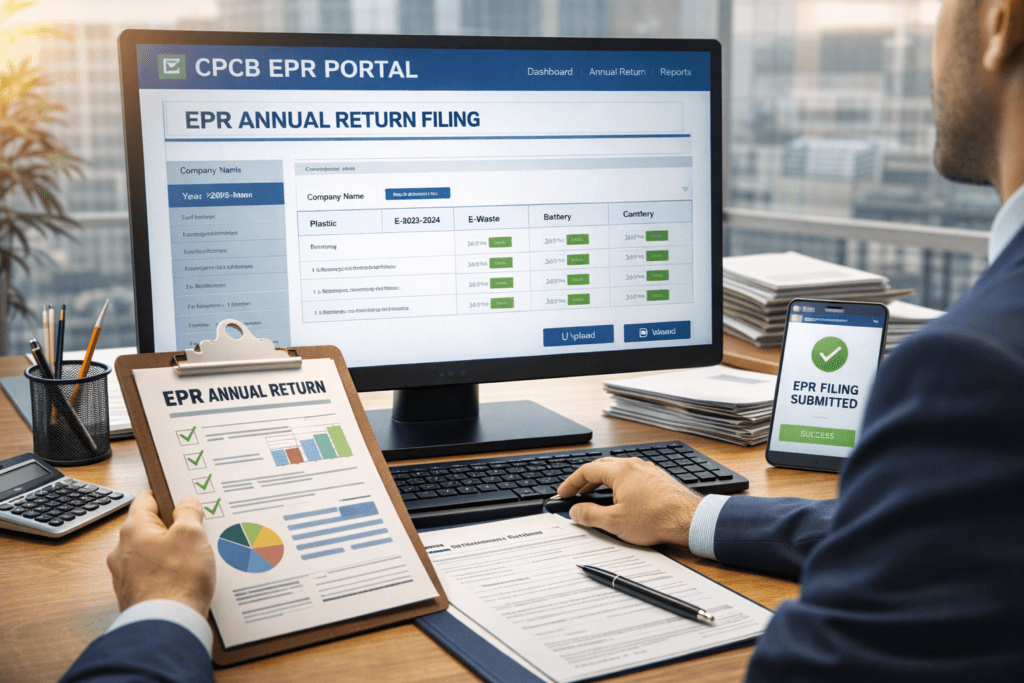
Forward-looking organizations are shifting from reactive filing to defensive compliance, which includes:
- Annual obligation forecasting
- Quarterly credit reconciliation
- Vendor due diligence
- Documentation trails built for audits, not just filing
This approach reduces cost shocks, avoids penalties, and builds regulatory confidence.
Conclusion: Filing is Easy. Defensible Compliance is Not.
EPR annual return filing is no longer about ticking a regulatory checkbox. It is about demonstrating accountability for environmental impact—backed by data, documentation, and traceability.
If your filing cannot withstand:
- A CPCB review
- A state pollution board notice
- An investor’s ESG audit
…then it is not truly compliant, no matter what the portal status says.
If you are unsure whether your EPR annual return filing truly reflects your obligations—or if you are relying on credits, recyclers, or data you did not independently verify—now is the time to act.
EPR ANNUAL RETURN FILING
Book Your Free, No-Obligation EPR Compliance Assessment
We offer a free, no-obligation EPR compliance consultation to:
- Review your current and past filings
- Identify gaps before regulators do
- Validate credits and recycler legitimacy
- Create a defensible filing strategy for the current year
Do not wait for a notice to force clarity. Claim your free EPR assessment today and fix risks before they turn into penalties.