How to Get Funding for Startup India? A Practical, Founder-Level Guide That Actually Works
If you are building a startup in India, chances are this question has already kept you awake at night: How to get funding for startup India?
You might have a solid idea. Maybe even a working product. But when it comes to funding, everything suddenly feels opaque. Investors want traction. Banks want collateral. Government schemes sound good on paper but feel hard to access. And advice online? Mostly generic.
Let’s slow this down and talk honestly.
In this guide, we will break down how Indian startups actually get funded — not theory, not hype, but what works on the ground. We will cover funding stages, instruments, real expectations from investors, common founder mistakes, and how to position yourself so funding becomes a process, not a gamble.
Understanding the Indian Startup Funding Landscape
Before asking how to get funded in India, you need clarity on who funds what and why.
Funding is not charity. It is a risk-adjusted capital deployment decision.
In India, startup funding broadly comes from five buckets:
- Bootstrapping / Founder Capital
- Government-backed schemes
- Bank & NBFC debt
- Angel investors
- Venture Capital & Private Equity
Each bucket aligns with a specific stage of business maturity. Most founders fail because they approach the wrong source at the wrong time.
Stage 1: Bootstrapping and Self-Funding (Where Most Indian Startups Begin)
Let’s be blunt.
In India, over 85% of startups begin with bootstrapping.
This includes:
- Personal savings
- Family contributions
- Early customer revenue
- Credit cards or personal loans (risky, but common)
Why bootstrapping matters:
- It proves founder skin in the game
- It forces discipline
- It creates early validation without dilution
Investors almost always ask:
“How much of your own money have you put in?”
Even a small amount matters. It signals conviction.
Practical Advice: Bootstrap until you achieve at least one of the following:
- A paying customer
- A repeatable pilot
- A working MVP with usage data
Without this, external funding is unlikely.
Stage 2: Government Funding and Startup India Recognition (Often Misunderstood)
India has one of the largest government-backed startup ecosystems globally. Yet, founders either overestimate or completely ignore it.
The starting point is Startup India recognition, issued by DPIIT.
What Startup India Recognition Actually Gives You
- Eligibility for government schemes
- Income tax exemption (Section 80-IAC)
- Faster patent and IPR filings
- Credibility with banks and investors
But here’s the truth:
Startup India does not automatically give you funding.
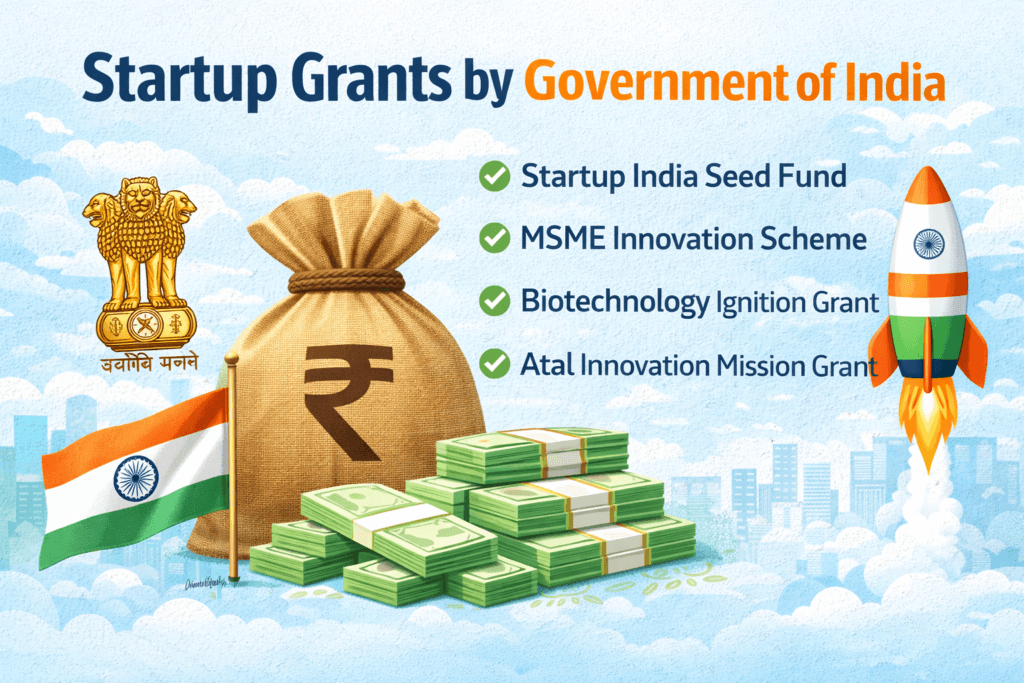
Funding comes through linked schemes, such as:
- Seed Fund Scheme
- SIDBI-backed funds
- State-level innovation grants
- Incubators and accelerators
These are milestone-driven, not idea-driven. Expect documentation, audits, and patience.
Best use case: Early-stage startups needing ₹10L–₹50L non-dilutive capital to validate technology or pilots.
Stage 3: Bank Loans, Mudra, and NBFC Funding
If your startup has:
- Revenue visibility
- Invoices
- Purchase orders
- Predictable cash flows
…then debt funding may be more appropriate than equity.
Common Debt Options in India
- Mudra Loans (up to ₹10L)
- CGTMSE-backed loans
- Working capital limits
- Invoice discounting
- Govt receivable financing
The mistake founders make? Applying too early.
Banks don’t fund ideas. They fund repayment capacity.
When debt works best:
- Services startups
- Manufacturing
- Govt vendors
- B2B companies with contracts
Used correctly, debt preserves ownership and signals financial maturity.
Stage 4: Angel Investors – The First External Believers
Angel investors are usually:
- Successful founders
- HNIs
- Industry veterans
They invest at pre-seed or seed stage, typically:
- ₹25L to ₹2Cr
- In exchange for 5–15% equity
What angels really look for:
- Founder clarity (not jargon)
- Market pain they personally understand
- Early traction or strong distribution logic
They are betting on you, not Excel models.
Key Insight: Most angel deals in India happen through warm introductions, not cold pitches.
If you don’t have access yet, build:
- Advisor relationships
- Incubator networks
- Founder communities
Stage 5: Venture Capital Funding
VC funding is where expectations change dramatically.
VCs invest in:
- Scalability
- Market size
- Speed
- Exit potential
They are not looking for profitability on Day 1. They are looking for asymmetric outcomes.
Typical VC funding stages:
- Seed
- Series A
- Series B and beyond
Each stage requires:
- Strong metrics
- Clean cap table
- Clear growth narrative
Hard Truth: Less than 1% of Indian startups raise institutional VC funding.
And that’s okay.
VC is not validation. It is a tool for scale.

What Investors Really Evaluate (Beyond Your Pitch Deck)?
Here’s what rarely gets said openly.
Investors subconsciously evaluate:
- Founder decision-making maturity
- Ability to handle setbacks
- Financial hygiene
- Regulatory awareness
- Coachability
Red flags that kill deals fast:
- No understanding of unit economics
- Inflated projections without logic
- Poor compliance or legal structure
- Confused go-to-market strategy
Funding failures are often process failures, not idea failures.
Common Mistakes Founders Make While Trying to Get Funded
Let’s call these out clearly:
- Chasing funding before validating the problem
- Approaching VCs with a seed-stage business
- Overvaluing too early and scaring investors
- Ignoring compliance, filings, and structure
- Treating funding as success instead of fuel
Money amplifies both strength and weakness.
How to Prepare Systematically to Raise Startup Funding in India?
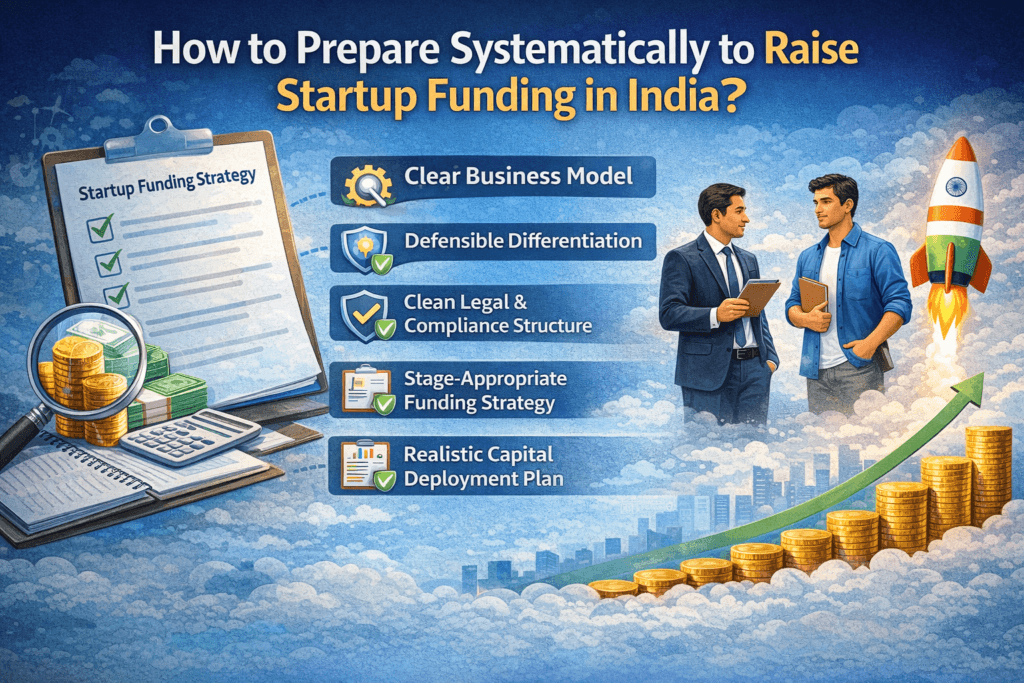
If you want funding to be predictable, not accidental, focus on these five pillars:
- Clear business model
- Defensible differentiation
- Clean legal and compliance structure
- Stage-appropriate funding strategy
- Realistic capital deployment plan
This is where many founders benefit from structured advisory, not random pitching.
Funding is a Process, Not a One-Time Event
So, how to get funding for startup India?
- By aligning your business stage with the right capital source.
- By building credibility before chasing capital.
And by treating funding as a strategic process—not a desperate milestone.
India has capital. What it lacks are well-prepared founders.
Be the exception.
If you are confused about which funding option suits your startup, struggling with investor readiness, or unsure why funding conversations are stalling, this is exactly where a short expert conversation helps.
NO-OBLIGATION STARTUP FUNDING CONSULTATION
Move from Confusion to A Clear Funding Roadmap
We offer a free, no-obligation startup funding consultation to assess:
- Your funding readiness
- The right funding route for your stage
- Immediate gaps blocking capital access
No sales pressure. No commitments. Just clarity.
Book your free startup funding strategy session now and move from confusion to a clear funding roadmap—starting today.