ESG Reporting Framework in India: A Practical, Board-Ready Guide for Companies That Want to Get It Right
If you are a CXO, compliance head, or sustainability lead in India, you have probably asked this question already: “We are doing ESG activities, but are we reporting them correctly?”
That confusion is more common than most people admit.
Over the last few years, ESG has moved from being a “nice-to-have” narrative in annual reports to a regulatory and investor-driven requirement. Boards are discussing it. Investors are scrutinising it. Regulators are formalising it. And yet, many Indian companies are still struggling to understand what exactly constitutes the ESG reporting framework in India.
Is it BRSR? Is it GRI? Does SEBI expect TCFD? Where does assurance fit in? And how do you ensure your ESG report does not look like marketing fluff?
Let’s slow this down and break it properly. By the end of this article, you will clearly understand how the ESG reporting framework works in India, how it has evolved, what regulators actually expect, and how companies can approach ESG reporting in a way that stands up to regulatory, investor, and audit scrutiny.
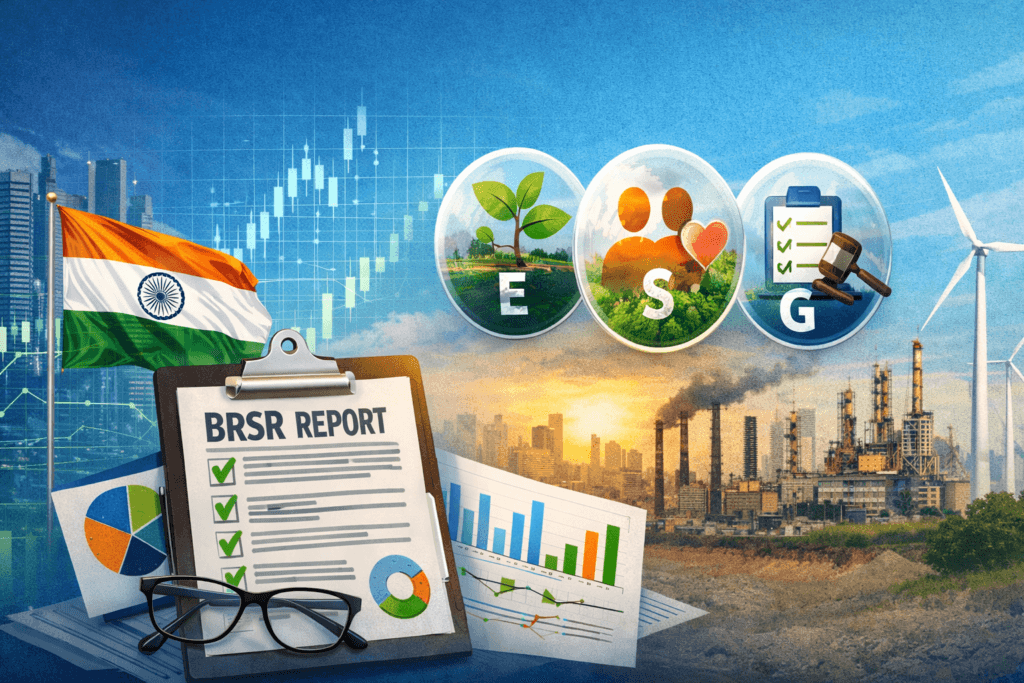
What ESG Reporting Really Means in the Indian Context?
Here’s the thing. ESG reporting in India is not a single framework. It is an ecosystem of regulatory requirements, global standards, and market expectations that overlap.
At its core, ESG reporting is about structured, measurable disclosure on:
- Environmental impact (energy, emissions, water, waste)
- Social responsibility (employees, communities, customers, supply chain)
- Governance practices (board structure, ethics, risk management, controls)
But unlike some jurisdictions where ESG disclosure is still largely voluntary, India has taken a more directive route—especially for listed entities.
The Indian ESG reporting framework sits at the intersection of:
- SEBI regulations
- Indian corporate law principles
- Global ESG standards adapted to Indian realities
- Investor-driven comparability requirements
Understanding this intersection is critical. Otherwise, companies either over-report irrelevant data or under-report what actually matters.
Evolution of the ESG Reporting Framework in India: From Voluntary to Mandatory
ESG reporting in India did not emerge overnight. It evolved in stages.
The Early Voluntary Phase
Initially, ESG disclosures in India were largely voluntary. Companies relied on:
- Sustainability reports
- CSR disclosures under the Companies Act, 2013
- Global frameworks like GRI for multinational alignment
These reports were often glossy, narrative-heavy, and inconsistent across companies.
Introduction of Business Responsibility Reporting (BRR)
SEBI introduced Business Responsibility Reporting (BRR) for the top 100 listed entities (later expanded). This was the first structured attempt to standardise non-financial disclosures.
But BRR had limitations. It was principle-based, qualitative, and left too much room for interpretation.
Transition to Business Responsibility and Sustainability Reporting (BRSR)
Recognising these gaps, SEBI replaced BRR with BRSR, making it mandatory for the top 1000 listed companies by market capitalisation.
This marked a decisive shift.
BRSR is not just a sustainability narrative. It is a data-driven ESG reporting framework, aligned with global best practices but tailored for Indian regulatory realities.

BRSR as the Backbone of ESG Reporting Framework in India
If we are being precise—and we should be—BRSR is the core ESG reporting framework in India for listed companies.
Let’s understand why it matters.
Structure of BRSR
BRSR is divided into three major sections:
- General Disclosures
- Management and Process Disclosures
- Principle-wise Performance Disclosures
These are mapped to the Nine Principles of the National Guidelines on Responsible Business Conduct (NGRBC).
What makes BRSR different is its insistence on:
- Quantitative metrics
- Standardised formats
- Year-on-year comparability
- Linkage between policy, process, and performance
In simple terms, you cannot just say “we care about sustainability.” You must show how, where, and with what measurable outcome.
BRSR Core and Reasonable Assurance
SEBI has gone one step further by introducing BRSR Core, which identifies key ESG KPIs that are subject to reasonable assurance.
This is a critical development.
It signals that ESG data is no longer “soft information.” It is moving closer to financial reporting discipline—controls, traceability, and audit readiness.

How Global ESG Standards Fit into India’s ESG Reporting Framework?
A common misconception is that BRSR replaces global frameworks like GRI, TCFD, or SASB. It does not.
Instead, Indian ESG reporting operates on a layered model.
Global Frameworks Commonly Used by Indian Companies
Many Indian organisations, especially those with global investors or overseas operations, align their ESG disclosures with:
- GRI (Global Reporting Initiative) for comprehensive sustainability metrics
- TCFD for climate-related financial risk disclosures
- SASB for industry-specific materiality
- UN SDGs for strategic alignment
These frameworks help with:
- International comparability
- Investor communication
- Cross-border reporting consistency
Practical Reality
In practice, companies use:
- BRSR for regulatory compliance
- GRI/TCFD/SASB for investor and global stakeholder communication
The challenge is alignment. Metrics must reconcile. Definitions must be consistent. Otherwise, discrepancies raise red flags during assurance or investor due diligence.

Materiality Assessment: The Weakest Link in Indian ESG Reporting
Let’s be blunt. This is where most ESG reports in India fall apart.
Many companies treat materiality assessment as a checkbox exercise. They copy peer matrices, run generic surveys, and move on. That approach no longer works.
Under the Indian ESG reporting framework, materiality must:
- Reflect sector-specific risks
- Align with NGRBC principles
- Connect directly to BRSR disclosures
- Stand up to board-level scrutiny
For example, water intensity is material for a manufacturing firm but may not be critical for a pure software services company. Yet many reports show identical materiality charts.
Regulators may not question this today. Investors and assurance providers already are.

ESG Data Governance: The Silent Risk No One Talks About
Here’s a question worth asking: Where is your ESG data coming from?
Most Indian companies collect ESG data through:
- Spreadsheets
- Email trails
- Decentralised department inputs
That may work for the first year. It does not scale.
As BRSR Core assurance becomes mandatory, companies need:
- Clear data ownership
- Defined calculation methodologies
- Internal controls
- Audit trails
ESG reporting is now as much a governance and risk management issue as it is a sustainability initiative.
Common Challenges Companies Face with ESG Reporting in India
Based on real engagements, the recurring issues are predictable:
- Lack of internal ESG ownership
- Inconsistent data definitions across departments
- Over-reliance on narrative disclosures
- Poor linkage between ESG strategy and business strategy
- Limited readiness for third-party assurance
None of these are unsolvable. But they require intent, structure, and expertise—not last-minute report drafting.
The Future Direction of ESG Reporting Framework in India
If you are planning ESG reporting only for compliance, you are already behind.
The direction is clear:
- Expansion of mandatory ESG disclosures
- Deeper assurance requirements
- Stronger linkage between ESG performance and access to capital
- Integration of ESG into enterprise risk management
India is aligning ESG reporting with economic growth, not treating it as a parallel exercise. Companies that adapt early will find ESG becoming a strategic advantage rather than a regulatory burden.

Key Takeaways: What You Should Remember
Let’s summarise without the jargon:
- ESG reporting in India is no longer optional for serious companies
- BRSR is the regulatory backbone of the Indian ESG reporting framework
- Global standards complement BRSR, they do not replace it
- Data quality, governance, and assurance readiness matter more than storytelling
- ESG reporting is moving closer to financial reporting discipline
If your ESG report cannot withstand regulator, investor, and auditor questions, it is not future-ready.
Struggling to align BRSR requirements with global ESG standards? Unsure whether your current ESG disclosures will hold up under assurance or investor scrutiny?
ACT NOW
Book Your Free ESG Reporting Consultation
We offer a free, no-obligation ESG reporting consultation to help you:
- Assess your BRSR and ESG reporting readiness
- Identify gaps in data, governance, and materiality
- Get a clear, actionable roadmap—without sales pressure
Book your free ESG reporting strategy session now and get clarity before regulatory timelines and investor expectations tighten further.