The Digital Personal Data Protection Act, 2023 (DPDP Act) is no longer just on the horizon—it’s here, and its enforcement is transforming how Indian businesses handle personal data. Central to this new regime is the Data Protection Impact Assessment (DPIA), a mandatory compliance tool designed to identify and mitigate data processing risks before they cause harm. For organizations aiming to build trust and avoid severe penalties, mastering DPDP DPIA compliance is not optional—it’s a strategic necessity. This is where Prgenix, a leader in India’s compliance landscape, brings unparalleled expertise to simplify and secure your journey toward full compliance.
What is a DPIA Under the DPDP Act?
A Data Protection Impact Assessment (DPIA) under the DPDP Act is a structured and systematic evaluation of how your organization processes personal data. Its primary goal is to foresee potential harms—like identity theft, discrimination, or financial loss—to individuals (called “Data Principals”) and implement safeguards to prevent them.
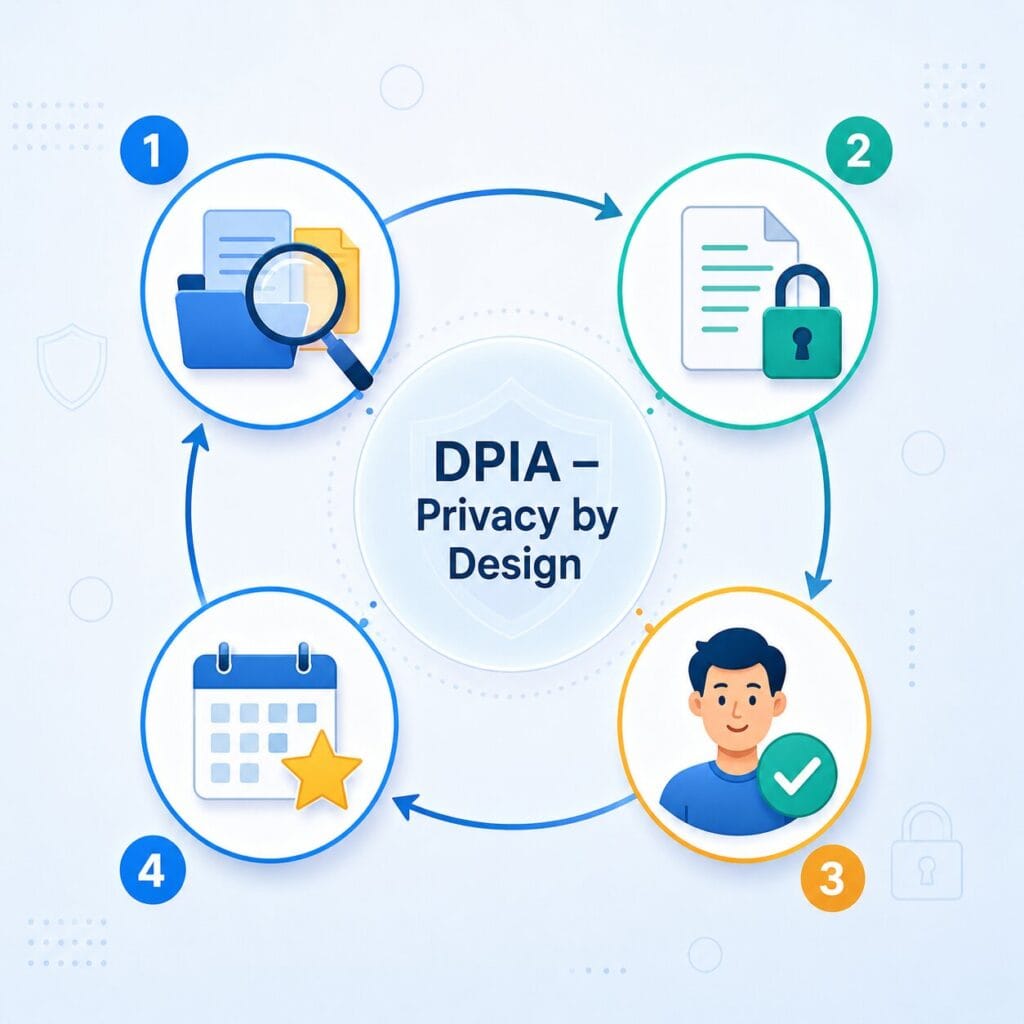
Rather than being a one-time checkbox, the DPIA is an ongoing process woven into the fabric of your operations. It forms the cornerstone of a “privacy by design” approach, ensuring data protection isn’t an afterthought but a fundamental component of your business strategy. A comprehensive DPIA typically includes:
- A detailed description of the personal data being processed and the purpose of processing
- An assessment of the lawful basis for processing, such as consent or legitimate use
- A thorough risk analysis identifying potential threats to Data Principals’ rights
- Proposed mitigation measures to address identified risks
- An evaluation of residual risks after safeguards are applied
Who Must Conduct a DPIA? Key Triggers and Timelines
While DPIA is mandatory for all Significant Data Fiduciaries (SDFs), the government may also prescribe specific categories of high-risk processing that necessitate a DPIA regardless of an entity’s SDF status.
Who Qualifies as a Significant Data Fiduciary (SDF)?
The government designates SDFs based on factors like:
- Volume and sensitivity of personal data processed
- Risk to the rights of Data Principals
- Impact on state security and public order
- Potential risk to electoral democracy
For example, a health insurer with 30 million policyholders automatically qualifies as an SDF, making DPIA mandatory.
When Should You Conduct a DPIA?
DPIA becomes mandatory when your organization:
- Is designated as a Significant Data Fiduciary (SDF) by the government
- Engages in prescribed high-risk processing activities, which may include:
- Processing of sensitive personal data (e.g., health, financial, biometric information)
- Large-scale profiling or automated decision-making
- Use of artificial intelligence in decision-making processes
- Plans to introduce any new technology or system that processes personal data in a novel or potentially risky way
If you fall into any of these categories, delaying your DPIA could expose your business to substantial legal and financial consequences.
🗓️ Key Compliance Timeline for Indian Businesses
The following table summarizes the phased compliance deadlines based on the DPDP Rules, 2025:
| Phase | Timeline | Key Compliance Actions |
|---|---|---|
| Phase 1 | Nov 2025 – April 2026 | Gap assessment, DPO appointment, consent architecture setup, privacy policy drafting |
| Phase 2 | May 2026 – Oct 2026 | Implement purpose registers, breach notification protocols, vendor agreements |
| Phase 3 | Nov 2026 – April 2027 | SDF determination, first DPIA conducted, annual compliance report filing |
Source: DPDP Rules 2025 implementation timeline
Penalties for Non-Compliance: The Real Cost of Ignoring DPIA
The DPDP Act enforces one of Asia’s strongest penalty regimes for data protection violations. Non-compliance is not just a legal risk—it’s a direct threat to your business’s financial health and reputation.
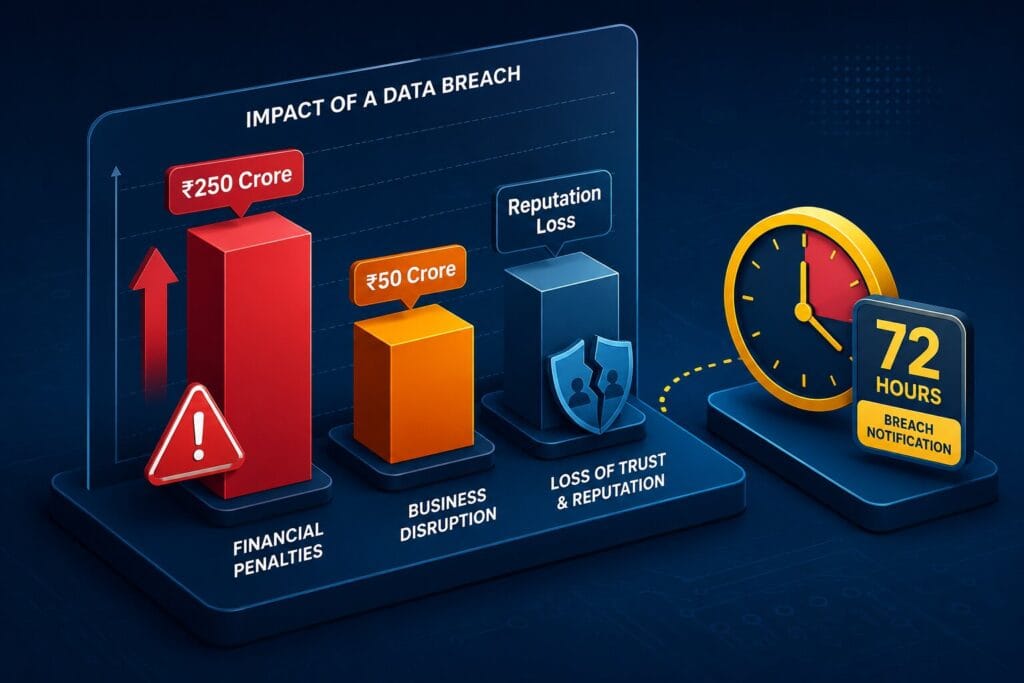
- Maximum Penalty: The law imposes a staggering penalty of up to ₹250 crore (approximately USD 28 million) for serious violations, including failure to conduct a mandatory DPIA or address high-risk processing adequately.
- Additional Liabilities: Beyond financial penalties, non-compliance can trigger mandatory breach notifications within 72 hours, reputational damage, loss of customer trust, potential legal suits from affected individuals, and increased regulatory scrutiny of your entire data ecosystem.
- Enforcement Reality: In the first quarter of 2025 alone, over 1,000 companies received audit notices from regulatory authorities. Many of these audits focused on data protection impact assessment readiness.
These penalties underscore why waiting for a regulatory notice before taking DPIA compliance seriously is a high-risk gamble.
The 8 Core Components of a Thorough DPIA (DPDP Act Edition)
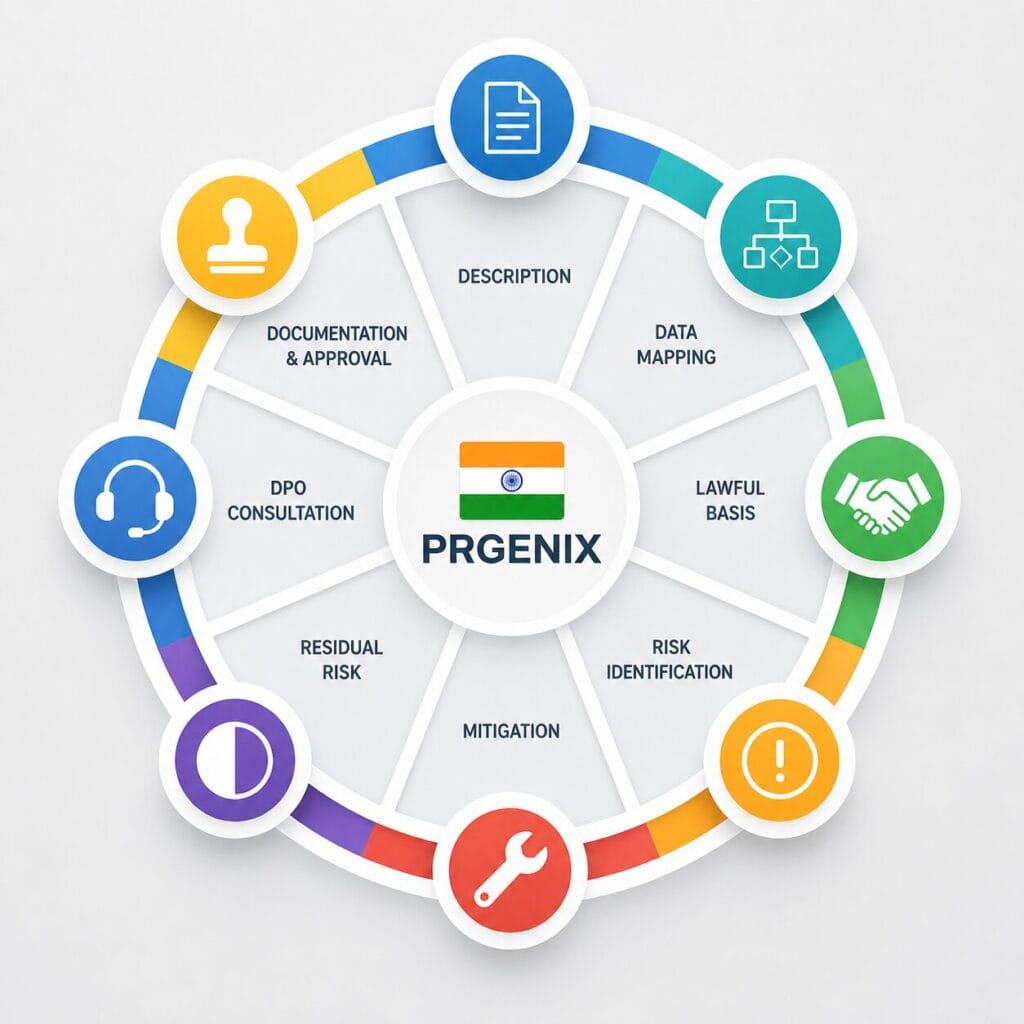
A robust DPIA is neither a superficial form nor an overly complex academic exercise. According to authoritative legal interpretations, the following eight components form the backbone of a compliance-ready DPIA:
| Component | Description |
|---|---|
| 1. Processing Description | Nature, scope, context, and purposes of data processing. |
| 2. Data Flow Mapping | Detailed visualization of how personal data moves through your systems. |
| 3. Lawful Basis Assessment | Verification of consent, legitimate use, or statutory requirement. |
| 4. Risk Identification | Systematic evaluation of potential harms to Data Principals. |
| 5. Mitigation Measures | Technical, organizational, and contractual safeguards. |
| 6. Residual Risk Evaluation | Assessment of risks remaining after all mitigations. |
| 7. Consultation with DPO | Mandatory review by the Data Protection Officer. |
| 8. Documentation & Approval | Formal sign-off and maintenance of audit-ready records. |
A DPIA is not a one-time event but a continuous process. When residual risks remain, the DPIA must document management’s justification for proceeding, including any contractual clauses or additional technical controls implemented to mitigate ongoing concerns.
Prgenix DPDP DPIA Compliance Service: Your Strategic Compliance Partner
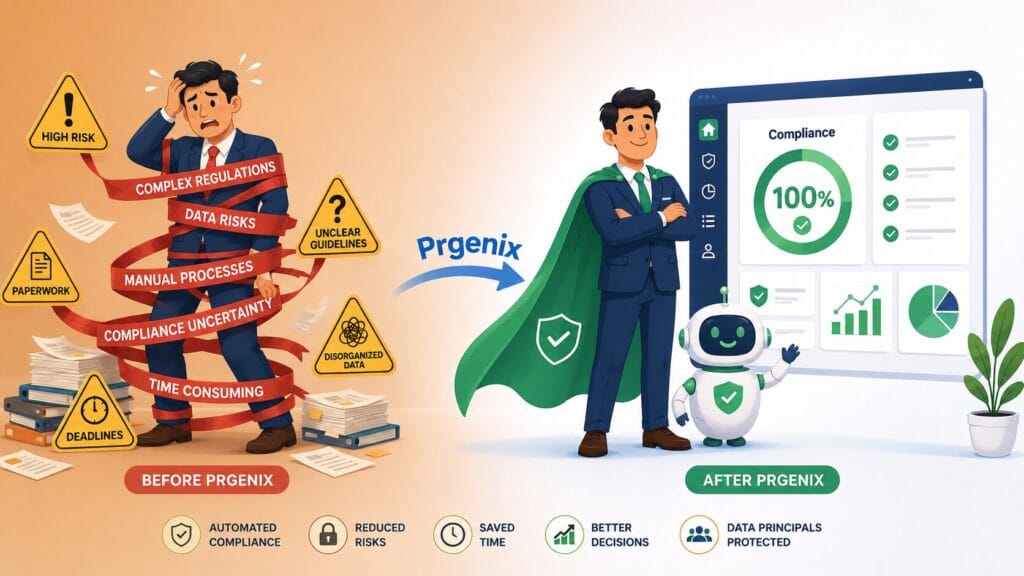
Prgenix has positioned itself as a pioneer in India’s regulatory technology and DPDP compliance space, moving beyond traditional consulting to deliver Compliance-as-a-Service (CaaS). Rather than leaving you with a 200-page report, we provide a plug-and-play compliance layer that integrates with your existing business operations.
The Prgenix Approach: Beyond Checklists
Prgenix is built on a philosophy that compliance should be an enabler for growth, not a bottleneck. They transform the DPIA process into a strategic advantage by:
- Proactive risk monitoring that identifies compliance issues before they become liabilities
- Integrated technology solutions that automate evidence collection and documentation
- Industry-specific expertise for sectors like HealthTech, FinTech, and E-commerce
- End-to-end support from initial gap assessment to final certification
- Dedicated compliance managers assigned per account for personalized attention
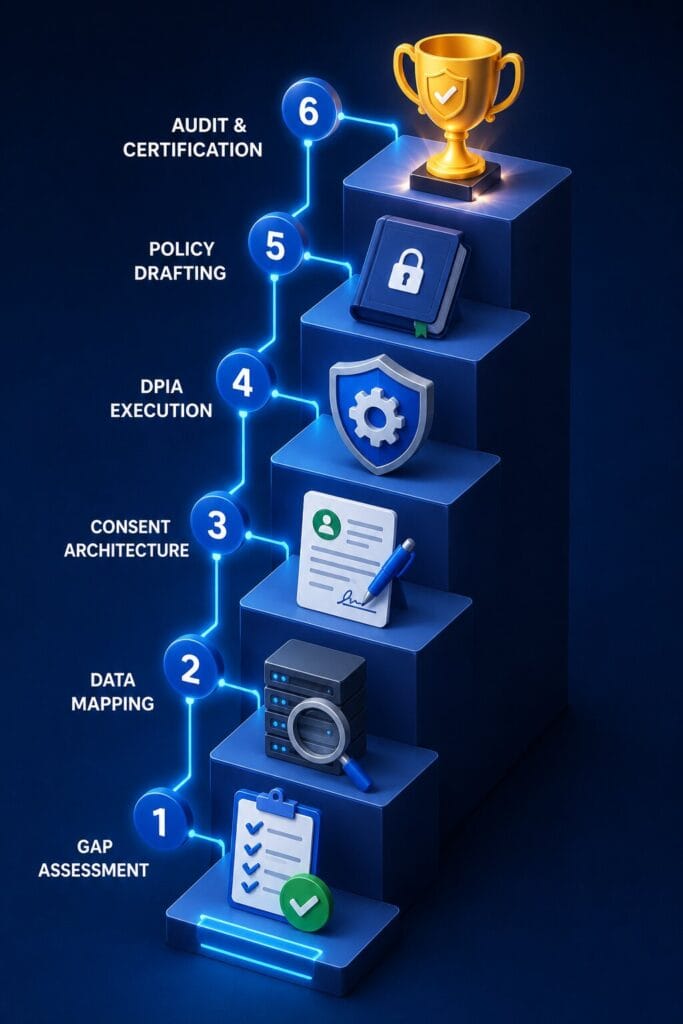
The Proven 6-Step DPDP Compliance Framework
Prgenix follows a systematic, field-tested methodology that has helped numerous clients achieve full compliance:
- Privacy Readiness Scorecard & Gap Assessment: The journey begins with Prgenix’s proprietary evaluation tool, which benchmarks your organization against DPDP Act requirements. Most clients score an average of just 39 out of 100 on their initial assessment—illustrating how far many businesses are from true compliance.
- Data Mapping & Risk Identification: Prgenix meticulously maps your entire digital ecosystem, documenting what personal data is collected, where it flows, who has access, and how long it’s retained. In one project, they discovered an exposed backend API leaking user birthdates in plain text logs—a critical vulnerability the client had no idea existed.
- Consent Framework & Architecture Design: The team redesigns all user-facing touchpoints—web forms, app permissions, chatbots—to capture explicit, granular, and revocable consent compliant with DPDP Section 6. They also integrate consent logs with CRMs like Zoho or HubSpot.
- DPIA Execution with Technical Assessment: Prgenix conducts a full-spectrum DPIA covering legal basis verification, risk analysis, and mitigation planning. The technical assessment evaluates encryption protocols, access controls, breach detection capabilities, and deletion mechanisms across databases, cloud setups, and mobile applications.
- Policy Development & Grievance Mechanism Setup: The team drafts human-readable privacy policies, internal standard operating procedures (SOPs), and grievance redressal frameworks as required under the DPDP Act.
- Audit Simulation & Compliance Certification: Finally, Prgenix runs mock audit drills to ensure full operational readiness before connecting you with neutral certifying bodies for final DPDP compliance certification.
Prgenix DPDP DPIA Compliance Pricing Framework
| Service Package | Ideal For | Key Deliverables | Investment Range |
|---|---|---|---|
| Essential | Startups & Small Businesses (≤50 employees) | Gap assessment, basic DPIA, simplified privacy policy | INR 2–4 Lakhs |
| Enterprise | Mid-market companies (50–500 employees) | Full DPIA, data mapping, DPO support, mock audit, certification readiness | INR 5–9 Lakhs |
| Custom | Large enterprises & SDF candidates (>500 employees) | Comprehensive audit, multi-system DPIA, ongoing CaaS, full certification | Custom quotes |
Note: Actual costs vary based on data volume, complexity, and industry requirements. Contact Prgenix for a personalized quote.
Industry-Specific DPIA Considerations
Different sectors face unique challenges when conducting DPIAs under the DPDP Act. Prgenix brings specialized expertise across key industries to address these nuances effectively:
🏦 FinTech & BFSI
DPIA considerations for financial services focus on KYC flows, transaction monitoring systems, profiling risks, and bias checks in algorithmic lending. Strong records and retention controls are particularly critical in this highly regulated sector.
🏥 HealthTech & MedTech
Healthcare processors require heightened safeguards for sensitive health information. Key controls include pseudonymization, strict access segregation, and thorough vendor diligence for clinical tools and platforms.
☁️ SaaS & Digital Platforms
Cloud-based platforms must address multi-tenant access controls, cross-border data transfer compliance, and robust incident response protocols. DPIA for SaaS environments also covers sub-processor management and data localization requirements.
🛍️ E-commerce & D2C Brands
Direct-to-consumer businesses must focus on consent architecture for marketing communications, data sharing with logistics partners, and retention policies for customer transaction histories.
DPDP DPIA vs. GDPR DPIA: Key Differences
Understanding the distinctions between India’s DPDP Act and the EU’s GDPR can help organizations that already operate under GDPR standards adapt their DPIA processes for Indian compliance:
| Aspect | DPDP Act (India) | GDPR (EU) |
|---|---|---|
| Mandatory Requirement | Only for Significant Data Fiduciaries (SDFs) | For all data controllers, but only for high-risk processing |
| Penalty for Non-Compliance | Up to ₹250 crore (approx USD 28 million) | Up to €20 million or 4% of global annual turnover |
| DPO Requirement | Required only for SDFs | Mandatory for public authorities and core activities |
| Cross-Border Provisions | Government may restrict transfers to certain jurisdictions | Standard contractual clauses and adequacy decisions |
| Enforcement Model | Data Protection Board of India | Individual EU member state supervisory authorities |
| Data Principal Rights | 8 specific rights (access, correction, erasure, etc.) | 8 rights with stronger data portability provisions |
For multinational organizations already complying with GDPR, adapting to DPDP requires careful mapping of existing DPIAs to Indian-specific requirements, particularly around consent management and breach notification timelines.
Step-by-Step Guide to Conducting a DPIA With Prgenix
Here’s what the end-to-end DPIA process looks like when you partner with Prgenix:
📌 Step 1: Initiation & Scoping
The process begins when you engage Prgenix. Their team conducts an initial consultation to understand your data processing activities, identify high-risk areas, and define the scope of the DPIA. This includes determining whether you qualify as a Significant Data Fiduciary or fall under prescribed high-risk processing categories.
📌 Step 2: Privacy Readiness Scorecard
Prgenix deploys its proprietary assessment tool across your organization, evaluating your current data protection posture across six key dimensions based on the DPDP Act Compliance Maturity Matrix framework.
📌 Step 3: Comprehensive Data Discovery & Mapping
Prgenix’s experts map your entire data ecosystem, documenting:
- What personal data is collected and from what sources
- Where data is stored (databases, cloud servers, third-party platforms)
- How data flows between systems, teams, and vendors
- Who has access to data and for what purposes
- How long data is retained before deletion
📌 Step 4: Purpose & Lawful Basis Verification
The team validates that all data processing has a clear lawful basis under the DPDP Act—whether through valid consent, legitimate use, or statutory requirement. For consent-based processing, they verify that consent notices are specific, informed, and revocable.
📌 Step 5: Risk Analysis & Scoring
Prgenix applies a calibrated risk heatmap methodology to score both the likelihood and impact of potential harms to Data Principals. Risks are categorized across dimensions such as:
- Loss of confidentiality (unauthorized access or disclosure)
- Unauthorized profiling or surveillance
- Exclusionary practices (e.g., AI bias in loan approvals)
- Identity theft or financial loss
- Reputational damage to individuals
📌 Step 6: Mitigation & Control Implementation
For each identified risk, Prgenix recommends and helps implement appropriate controls:
- Technical Controls: Encryption, pseudonymisation, access management, logging and monitoring systems
- Organizational Controls: Standard operating procedures, staff training, security policies
- Contractual Controls: Vendor agreements, data processing addendums, subcontractor management
📌 Step 7: Residual Risk Approval
After implementing controls, the remaining or “residual” risk is calculated. When residual risks persist, Prgenix documents management’s justification for proceeding, including any additional safeguards or business-specific considerations.
📌 Step 8: Documentation & Audit-Ready Record
Prgenix compiles a complete DPIA report pack containing:
- Executive summary and scope documentation
- India-centric data flow and system maps
- Notice text and consent/legitimate use analysis
- Risk scoring methodology and approvals
- Control implementation plan with owners and timelines
- Vendor diligence records and contracts
- Retention and deletion proofs
📌 Step 9: DPO & Board Review
The completed DPIA is submitted to your Data Protection Officer (DPO) for review, and if necessary, made available for potential review by the Data Protection Board of India (DPB). Prgenix supports DPO appointment, training, and ongoing advisory services.
Best Practices for Maintaining Ongoing DPIA Compliance
Achieving a compliant DPIA is just the first step. Here are proven best practices to ensure your compliance remains current and defensible over time:
🔄 Regular Review Cycles
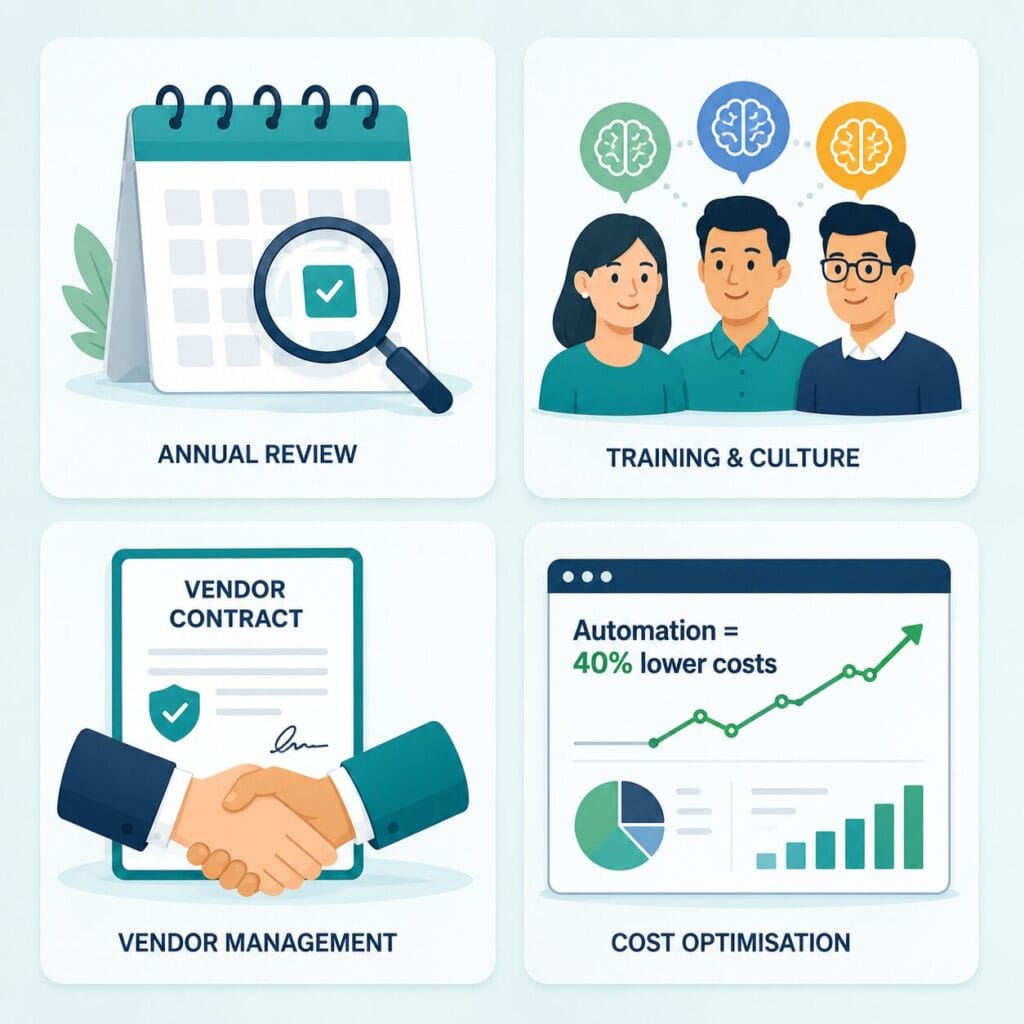
Your DPIA must be reviewed and, if necessary, updated at least annually or whenever there are significant changes to processing activities. For Significant Data Fiduciaries, DPIAs must be conducted every 12 months.
- Quarterly: Review data inventories and access logs
- Semi-annually: Update risk registers and mitigation plans
- Annually: Full DPIA refresh and independent audit
👥 Designate a Qualified DPO
If you qualify as a Significant Data Fiduciary (or anticipate doing so), appointing a Data Protection Officer is mandatory. Even for non-SDFs, have a designated privacy lead with clear responsibilities for DPIA oversight and regulatory liaison.
🤝 Integrate With Vendor Management
Extend your DPIA obligations to third-party vendors and processors. Ensure all vendor contracts include data protection clauses, require DPIA compliance evidence, and include audit rights. Your DPIA should document all sub-processors and their compliance status.
🎓 Continuous Training & Awareness
Create a culture of privacy through regular training. Only 8% of Indian businesses have reached advanced maturity levels (Level 4-5) where privacy is embedded across the organization. Make privacy training mandatory annually at a minimum, and consider designating department-level privacy champions.
📊 Leverage Technology for Automation
Organizations with automated privacy tools demonstrate 3.2x faster incident response and 40% lower compliance costs. Prgenix’s Compliance-as-a-Service model provides automated evidence collection, real-time risk monitoring, audit trail documentation, and integrated breach notification capabilities.
📈 Use the Compliance Maturity Matrix
Regularly assess your progress across the six critical dimensions: Data Governance, Technology & Systems, Data Management, Risk Management, Vendor & Third-Party Management, and Culture & Training. Most organizations need 12-18 months to progress from basic Levels 1-2 to Level 3 (compliant threshold).
Why Choose Prgenix for Your DPDP DPIA Compliance?
Trusted Expertise
Prgenix is recognized as a pioneer in India’s regulatory compliance and AI consulting sector. Their founder brings deep expertise in digital transformation, compliance, and sustainable business growth.
Proven Track Record
The Prgenix framework has successfully guided businesses across HealthTech, FinTech, E-commerce, and manufacturing sectors through full DPDP compliance including DPIAs. Their audit and certification processes are accepted by neutral certifying bodies and regulatory authorities.
End-to-End Service Offering
Unlike siloed consultants, Prgenix provides comprehensive coverage across:
- DPDP compliance audits & DPIAs
- DPO appointment and training
- Consent architecture & privacy policy drafting
- Mock audit drills & breach response testing
- Cross-border data transfer advisory
- Vendor compliance management
Cost-Effective & Scalable Solutions
Prgenix designs solutions appropriate for businesses of all sizes—from startups with fewer than 20 employees to large enterprises with complex distributed systems. Their Compliance-as-a-Service model provides predictable, subscription-based pricing that scales with your needs.
Actionable, Not Academic
Throughout this guide, you’ve seen the emphasis on practical deliverables—not just legal theory. At Prgenix, we “roll up our sleeves” to implement actual controls, not just point out gaps. Our 6-step framework is designed to deliver a shippable, audit-ready DPIA that protects you from penalties and builds genuine customer trust.
Frequently Asked Questions (FAQs)

Q1: Is DPIA mandatory for all businesses under the DPDP Act?
No. DPIA is mandatory only for Significant Data Fiduciaries (SDFs) designated by the government. However, the government may also prescribe specific categories of high-risk processing that require DPIA regardless of SDF status. Even if your business does not currently qualify, conducting a DPIA voluntarily is a best practice that demonstrates accountability and may reduce penalties in case of a breach.
Q2: How often must a DPIA be conducted?
For Significant Data Fiduciaries, the DPDP Act requires DPIAs to be conducted at least once every 12 months. Additionally, a DPIA must be conducted before any new high-risk processing activity is initiated, and updated whenever there are material changes to existing processing activities.
Q3: What are the penalties for failing to conduct a DPIA?
Non-compliance with DPIA requirements can result in penalties up to ₹250 crore (approximately USD 28 million). Additionally, the Data Protection Board may order cessation of data processing activities, impose compliance audits, and publicly disclose violations.
Q4: Does GDPR compliance automatically mean DPDP compliance?
No. While there are similarities between the DPDP Act and GDPR, significant differences exist in consent management, breach notification timelines, data localization requirements, and enforcement mechanisms. Organizations with existing GDPR compliance programs must still conduct a gap assessment and adapt their frameworks to meet India-specific requirements.
Q5: Do foreign companies operating in India need to comply with DPDP?
Yes. Any Data Fiduciary or Data Processor that processes personal data of Data Principals within India must comply with the DPDP Act, regardless of where the company is headquartered. Non-Indian entities collecting data from Indian residents are subject to the same penalties and enforcement provisions.
Q6: What is the difference between a DPIA and a Data Audit?
A DPIA is a proactive, preventive assessment conducted before or during high-risk processing activities to identify and mitigate potential harms in advance. A Data Audit is typically a retrospective review of existing processing activities to verify ongoing compliance. Both may be required for Significant Data Fiduciaries, with DPIAs being forward-looking and audits providing historical validation.
Q7: How long does it take to complete a DPIA?
The timeline varies based on your organization’s complexity, but a typical DPIA takes 4 to 8 weeks from initiation to final documentation when working with an experienced partner like Prgenix. More complex organizations with multiple data processing systems may require 8 to 12 weeks.
Q8: What happens if my DPIA identifies high residual risks?
When residual risks exceed acceptable thresholds, the DPIA should document why the processing activity proceeds despite identified risks. The organization must implement additional controls, accept the documented risk with executive sign-off, redesign the processing to reduce residual risk, or abandon the processing activity altogether. The DPIA serves as the documented justification for whatever decision is made.
Q9: Can small businesses afford DPIA compliance?
Yes. Prgenix offers Essential packages starting from INR 2–4 Lakhs designed specifically for startups and small businesses. For organizations with extremely limited budgets, Prgenix can provide scaled-down assessments focusing on your highest-risk processing areas, with a clear roadmap to full compliance.
Q10: What is the deadline for DPIA compliance?
The DPDP Rules, 2025 implement a phased timeline. All Significant Data Fiduciaries must conduct their first DPIA by April 2027 at the latest. However, if you are notified as an SDF earlier, or if you plan to engage in prescribed high-risk processing, your DPIA may be required much sooner. The safest approach is to begin your DPIA readiness assessment immediately.
DPDP DPIA COMPLIANCE WITH CONFIDENCE
Ready to Achieve DPDP DPIA Compliance With Confidence?
The DPDP Act represents a fundamental shift in India’s data protection landscape. With penalties reaching ₹250 crore, maintaining compliance is no longer a matter of “if” but “when.” More importantly, demonstrating robust data protection through a comprehensive DPIA is becoming a competitive differentiator—building customer trust, attracting investor confidence, and safeguarding your brand’s reputation.
Don’t leave your compliance to chance. Partner with Prgenix, India’s trusted compliance layer, to transform your DPDP DPIA obligations from a regulatory burden into a strategic advantage.
Don’t wait for a regulatory notice to take action. Secure your data, protect your customers, and future-proof your business with Prgenix’s DPDP DPIA compliance services.
Disclaimer: This article is for informational purposes only and does not constitute legal advice. Organizations should consult with qualified legal professionals for guidance specific to their circumstances. DPDP Compliance timelines and requirements are based on the DPDP Rules, 2025, as of the publication date and are subject to change based on subsequent notifications or amendments.