Fast-Track NABL ISO 17025 Accreditation for Testing & Calibration Laboratories
Prgenix helps testing, calibration, medical, food, and industrial laboratories achieve NABL accreditation faster through assessor-ready documentation, ISO/IEC 17025 implementation, internal audits, training, and complete end-to-end support.
Helping laboratories reduce accreditation delays, technical documentation gaps, and assessment non-conformities through structured ISO/IEC 17025 implementation.
100+ Labs Supported Across India | Former NABL Assessors | 98% First-Time Clearance Rate
Trusted by 100+ Testing, Calibration, Medical & Industrial Laboratories Across India






This Engagement is Best Suited For Laboratories That:
Our NABL accreditation consulting approach is designed for laboratories seeking structured implementation, technical compliance readiness, and long-term operational reliability — not just documentation delivery.
COMMON NABL IMPLEMENTATION CHALLENGES
Why NABL Accreditation Gets Delayed for Most Laboratories?
Many laboratories experience avoidable delays, repeated non-conformities, and failed assessments because technical implementation, documentation readiness, and assessor preparation are often incomplete before final NABL evaluation.
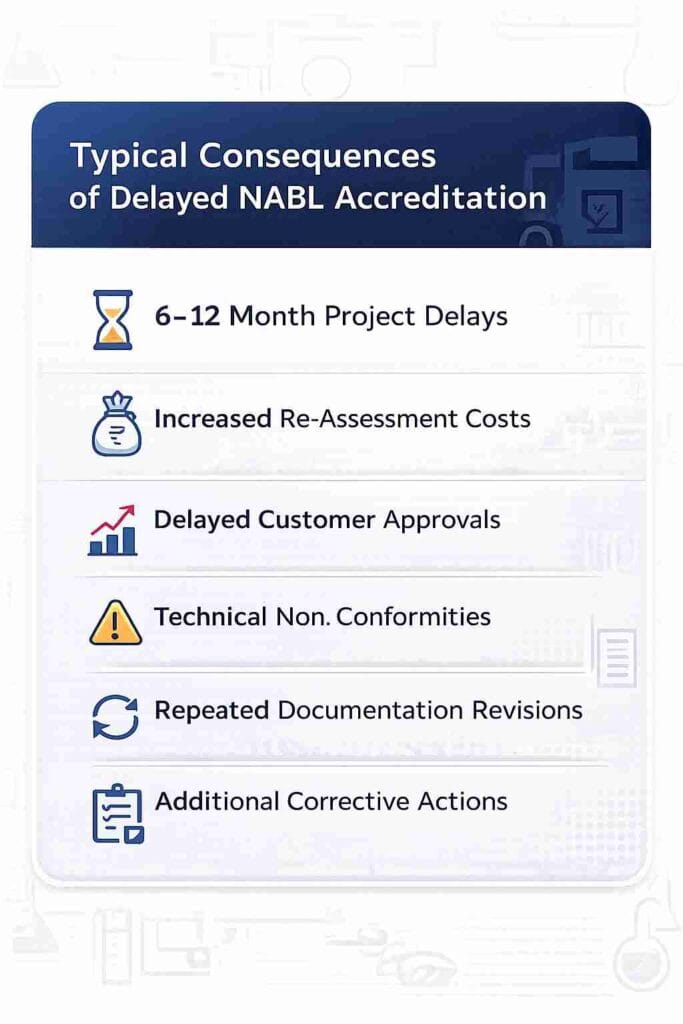
💡 One failed or delayed NABL assessment can typically result in a 6–12 month operational and accreditation setback.
Built for Assessment Readiness — Not Just Documentation Delivery
We prepare laboratories to face NABL assessments with technical confidence, operational readiness, and structured compliance systems — before the assessor arrives onsite.
What We Don’t Do?
What We Do?
Laboratories prepared through structured implementation and assessor-style readiness reviews typically experience significantly smoother NABL assessments and faster accreditation outcomes.
Assessment-Driven NABL Readiness Program
A structured ISO/IEC 17025 implementation and assessment-readiness framework designed to reduce avoidable non-conformities, strengthen technical compliance, and prepare laboratories before final NABL evaluation.
Phase 1 – Assessment Risk Mapping
Duration: Weeks 1–2
What We Do:
- NABL-aligned gap assessment mapped directly to assessor expectations
- Scope feasibility review (technical, manpower, equipment, calibration)
- Identification of assessment failure and delay risks
Deliverables:
✔ Assessment Risk Register
✔ Go/No-Go Readiness Recommendation
This phase determines whether immediate application is advisable or risk-reducing corrective actions are required first.
Phase 2 – System Build & Team Readiness
Duration: Weeks 3–8
What We Do:
- Custom Quality Manual and SOPs aligned to lab operations
- Technical records, validations, traceability & uncertainty support
- Internal audit and management review facilitation
- Staff preparation with assessor-style questioning
Deliverables:
✔ NABL-Ready Documentation and Evidence Pack
All systems and records are built to withstand assessor scrutiny, not just submission review.
Phase 3 – Pre-Assessment Simulation
Duration: Weeks 9–12
What We Do:
- Full mock NABL assessment under near-real conditions
- Assessor-pattern questioning and observation simulation
- Anticipation of likely non-conformities and closure strategy
Deliverables:
✔ Assessment-Ready Confirmation issued by Prgenix
Your team faces the formal NABL assessment with clarity, confidence, and minimal surprises.
Unlike documentation-only consulting approaches, the Prgenix methodology focuses on assessor expectations, technical evidence readiness, operational feasibility, and laboratory team preparedness before final assessment.
💡Laboratories entering NABL assessment with structured technical preparation and assessor-style simulation reviews typically experience significantly fewer non-conformities and smoother accreditation closure.
WHY PRGENIX
Why High-Readiness Laboratories Choose Prgenix?
Laboratories partner with Prgenix for structured assessment-readiness systems, assessor-aligned implementation, technical compliance strengthening, and predictable NABL accreditation outcomes.
Assessment Outcome Focus
We prepare laboratory systems, records, technical evidence, and personnel for real assessor expectations — not just documentation review.
Assessor-Driven Implementation
Our methodology reflects common assessor questioning patterns, evidence validation checks, and practical evaluation criteria observed during NABL assessments.
Advanced Pre-Assessment
Structured risk mapping and mock evaluations help identify technical and operational gaps before formal assessment.
Focused Client Engagement Model
We intentionally limit active engagements to ensure hands-on implementation support and accountability throughout the accreditation process.
Prgenix focuses on assessor-readiness, technical evidence strength, and operational implementation quality — helping laboratories reduce avoidable assessment risks and accreditation delays.
ENGAGEMENT MODELS
Indicative Engagement Investment
In most cases, the cost of structured assessment readiness is significantly lower than the operational, commercial, and compliance impact of a failed NABL assessment cycle.
Limited-Scope Laboratories
* ₹2.5 to ₹5.0 Lakhs
BEST SUITED FOR
For single or limited-scope laboratories applying for NABL accreditation with defined test parameters.
- Single-discipline or limited scope
- Standard instrumentation
- First-time NABL applicants
Multi-Discipline Laboratories
* ₹3.5 to ₹10 Lakhs
BEST SUITED FOR
Designed for hospitals and laboratories with multiple disciplines, departments, or broad testing scope.
- Multiple test disciplines
- Higher documentation & evidence volume
- Complex assessor interactions
Recovery & Fast-Track Engagements
Pricing After Evaluation
BEST SUITED FOR
For laboratories facing NABL delays, non-conformities, scope rejection, or failed assessments and needing rapid closure.
- Failed or delayed NABL applications
- NC closure & corrective action support
- Re-assessment readiness
- Time-critical cases
Note: Pricing is indicative and depends on scope complexity, current readiness, and the target assessment timeline. Documentation-only or template-based engagements are not undertaken.
CONFIDENTIAL READINESS EVALUATION
Schedule Confidential NABL Readiness Evaluation
This evaluation helps determine laboratory readiness, implementation gaps, assessment risks, and the recommended NABL accreditation pathway.
NABL READINESS QUESTIONS
Common Questions About NABL Accreditation & ISO/IEC 17025 Implementation – FAQs
These FAQs are intended for laboratories planning NABL accreditation, assessment readiness, implementation improvement, or corrective-action recovery support.
1. How long does NABL accreditation take?
The timeline depends on laboratory readiness, technical scope complexity, documentation maturity, and assessor preparedness. Laboratories with structured ISO/IEC 17025 implementation and assessment-ready systems generally progress faster. Laboratories that identify major gaps during formal assessment often experience delays of 6–12 months due to corrective actions, additional evidence requirements, and re-assessment cycles.
2. Do you guarantee NABL accreditation approval?
No. NABL alone grants accreditation and issues final approval. Our responsibility is to prepare laboratories for assessment readiness through technical implementation, assessor-aligned preparation, risk identification, non-conformity prevention, and structured ISO/IEC 17025 execution before formal NABL evaluation begins.
3. Do you provide documentation-only NABL services?
No. Documentation without operational readiness significantly increases assessment risk. Our engagements are focused on assessor-ready implementation, technical evidence preparation, laboratory team readiness, and structured compliance execution — not template-based documentation delivery.
4. What if our laboratory is not fully ready yet?
This is identified early through our readiness evaluation and assessment risk mapping process. If immediate application increases the likelihood of delays, non-conformities, or failed assessment outcomes, we recommend corrective actions and readiness strengthening before proceeding with formal NABL submission.
5. Can you help if our NABL assessment is delayed or non-conformities have already been issued?
Yes. We support assessment recovery engagements, including non-conformity analysis, corrective action planning, evidence strengthening, assessor response preparation, and re-assessment readiness for delayed or high-risk accreditation cases.
6. How involved does our internal laboratory team need to be?
Internal involvement is essential. NABL assessments evaluate not only documentation, but also laboratory operations, technical competency, evidence quality, and personnel preparedness. Management commitment and active participation from key laboratory personnel are necessary for effective assessment readiness.
7. What makes the Prgenix approach different from generic NABL consultants?
Most consultants focus primarily on documentation preparation. Our approach focuses on how NABL assessors evaluate technical evidence, question laboratory teams, verify implementation effectiveness, and identify operational risks during formal assessments. This assessor-aligned methodology helps laboratories reduce avoidable surprises, delays, and non-conformities.
8. How do we know if this engagement is suitable for our laboratory?
We begin with a structured NABL readiness evaluation to assess technical preparedness, implementation gaps, operational feasibility, and accreditation risks. If the timing, scope, or readiness level is not appropriate for immediate assessment, we communicate this transparently rather than encouraging high-risk applications.
9. What is the difference between ISO certification and NABL accreditation?
ISO certification generally evaluates management system compliance, while NABL accreditation evaluates laboratory technical competence, testing capability, calibration traceability, uncertainty estimation, method validation, and operational implementation under ISO/IEC 17025 or ISO 15189 requirements.
10. Is ISO/IEC 17025 mandatory for NABL accreditation?
Yes. ISO/IEC 17025 is the primary international standard used for NABL accreditation of testing and calibration laboratories. Medical laboratories seeking NABL accreditation typically follow ISO 15189 requirements.
11. What are the most common reasons laboratories fail NABL assessments?
Common causes include incomplete implementation, weak technical records, poor uncertainty estimation, inadequate method validation, ineffective internal audits, insufficient assessor preparedness, calibration traceability gaps, and non-conformities identified during final assessment.
12. Do you support internal audits and mock NABL assessments?
Yes. Internal audits and assessor-style mock evaluations form an important part of our readiness approach. These reviews help identify technical gaps, operational weaknesses, documentation deficiencies, and likely assessor observations before formal assessment begins.
13. Can existing operational laboratories upgrade to NABL-compliant systems?
Yes. We support both new and existing laboratories in strengthening systems, improving technical implementation, upgrading documentation structures, and aligning operations with ISO/IEC 17025 or ISO 15189 assessment requirements.
14. Do you support multi-location or multi-disciplinary laboratories?
Yes. We support complex laboratory environments including hospital laboratories, multi-disciplinary testing facilities, calibration laboratories, environmental laboratories, food testing laboratories, and multi-location operations with broader assessment scope requirements.
15. What happens after the readiness evaluation?
Following the evaluation, we provide a structured understanding of current readiness status, implementation gaps, likely assessment risks, recommended corrective priorities, estimated timelines, and the most suitable accreditation pathway for your laboratory.
💡Serious laboratories value early clarity more than late corrections.
CONFIDENTIAL READINESS DISCUSSION
Ready to Evaluate Your Laboratory’s NABL Readiness?
Focused Engagements | PAN India Support | Assessor-Driven Readiness Approach
Note: Laboratories that identify assessment gaps early typically avoid costly re-assessments, corrective delays, and accreditation setbacks.