
India’s digital landscape has fundamentally changed with the enforcement of the Digital Personal Data Protection (DPDP) Act, 2023. For businesses acting as Data Fiduciaries, compliance is no longer an option—it is a mandatory, board-level priority. At the heart of this new regime is a single non-negotiable requirement: educating your workforce.
In this comprehensive guide, we explore the DPDP Data Fiduciary Training service offered by Prgenix, why it is the cornerstone of compliance, and how you can transform legal obligations into a business advantage before the 2027 enforcement deadline.
What is the DPDP Act and Who is a Data Fiduciary?
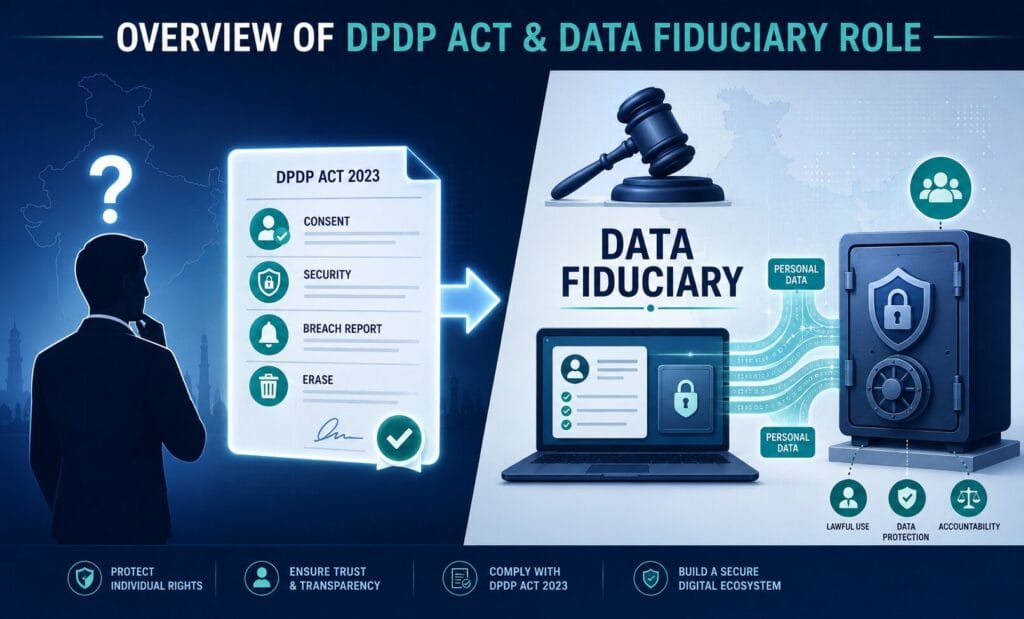
The Digital Personal Data Protection Act, 2023, was enacted by the Indian Parliament on 11 August 2023 to safeguard digital personal data. The law follows the SARAL approach—Simple, Accessible, Rational, and Actionable—using plain language to ensure businesses of all sizes can understand the rules.
A Data Fiduciary is any entity that, alone or in conjunction with others, determines the purpose and means of processing personal data. Under the act, you are a Data Fiduciary if your organization collects customer names, phone numbers, email addresses, or even tracks user behavior through cookies.
The act applies to all digital personal data collected in India or digitized from offline sources. Organizations outside India that offer goods or services to individuals within India are also subject to the DPDP Act, giving the law extraterritorial reach. If you process personal data of Indian residents, you fall under the purview of this legislation.
What Are the Core Obligations of a Data Fiduciary?
Before we discuss training, it is essential to understand exactly what the law demands. The DPDP Act and the Digital Personal Data Protection Rules, 2025 (notified on 13 November 2025) create a comprehensive framework of accountability.
A Data Fiduciary must:
- Obtain free, specific, and informed consent from Data Principals (individuals whose data is collected).
- Publish a clear and standalone privacy notice explaining data collection practices.
- Implement reasonable security safeguards, including encryption, masking, and access controls.
- Establish effective grievance redressal mechanisms.
- Erase personal data once the purpose of collection is fulfilled or consent is withdrawn.
- Report personal data breaches to the Data Protection Board of India (DPB).
- Comply with cross-border data transfer restrictions imposed by the government.
For entities designated as Significant Data Fiduciaries (SDFs)—those handling large volumes of sensitive data—additional duties apply, including appointing a Data Protection Officer (DPO), conducting independent Data Protection Impact Assessments (DPIAs), and undergoing annual compliance audits.
Why Data Fiduciary Training Is the Non‑Negotiable Foundation of DPDP Compliance
Most organizations focus on policies and technology when building compliance programs. While necessary, these are insufficient without a trained workforce. Compliance is no longer static; it requires dynamic monitoring of processes, staff trainings, and readiness for regulatory scrutiny.
Untrained staff represent your greatest compliance risk. A single employee failing to obtain proper consent, misplacing personal data, or delaying a breach notification can expose your organization to penalties up to ₹250 crore—a staggering amount that can cripple any business.
- Real‑world consequences are immediate. Gaps in consent management are already attracting regulatory notices. In one case, a business received a DPBI notice and a potential ₹2 crore penalty following a data breach.
- Training closes the gap between policy and action. Policies on paper mean nothing if your team does not understand how to apply them. Employees must recognize what constitutes personal data, how to respond to Data Principal requests, and when to escalate security incidents.
- It builds a culture of accountability. The law requires Data Fiduciaries to demonstrate compliance through actions, not just documents. A trained workforce provides this evidence during regulatory audits.
- Investors and customers demand it. Privacy‑friendly businesses gain competitive advantages. In a 2025 NASSCOM study, 90% of Indian companies were found unprepared for full audits—an alarming statistic that represents a massive market opportunity for those who act first.
Introducing Prgenix’s DPDP Data Fiduciary Training Service
Prgenix is a premier regulatory compliance and consulting partner in India, delivering industry-leading solutions for DPDP, ESG, FSSAI, NABL, and other frameworks. With a proven track record of helping Indian startups, SMEs, and enterprises navigate complex regulatory landscapes, Prgenix is the go-to partner for DPDP Act compliance.
The DPDP Data Fiduciary Training service by Prgenix is not a generic awareness program. It is a structured, role-based, and practice-oriented training module embedded within Prgenix’s broader 6‑step consulting framework, designed to ensure every individual in your organization—from frontline teams to C‑suite executives—understands their obligations under the DPDP Act and can implement them effectively.
While many training providers simply repackage GDPR content, Prgenix’s training is India‑specific, leveraging the firm’s deep expertise in the DPDP Act and its rules. The program is delivered by experts who blend legal and technical capabilities, helping organizations move from theoretical understanding to day‑to‑day operational compliance.
What the Prgenix Training Program Covers
The Prgenix DPDP data fiduciary training is designed to be comprehensive yet practical. It covers the entire lifecycle of data protection:
- Understanding the DPDP Act landscape. Learn the key provisions, definitions, and the three‑phased implementation timeline (immediate, 13 November 2026, and 13 May 2027 deadlines).
- Data fiduciary obligations in plain language. Break down Sections 6 (consent), 8 (security safeguards), 9 (grievance redressal), and 10 (additional duties for significant data fiduciaries).
- Consent management frameworks. Learn how to design consent notices, obtain explicit and granular consent, and implement consent withdrawal mechanisms that are as easy as giving consent.
- Data Principal rights handling. Train your teams on how to respond to requests for access, correction, erasure, and grievance filing.
- Security safeguards and breach readiness. Understand encryption, access control, breach detection, and the 72‑hour breach reporting window.
- Data mapping and lifecycle management. Learn to identify what personal data your organization holds, where it flows, who accesses it, and how long it should be retained.
- Vendor and third‑party management. Ensure that your data processors and vendors comply with DPDP obligations through contracts and audits.
- Mock audit and breach simulation. Practice responding to incidents and regulatory inquiries in a safe environment.
How Prgenix Delivers Training (The Prgenix 6‑Step Framework)
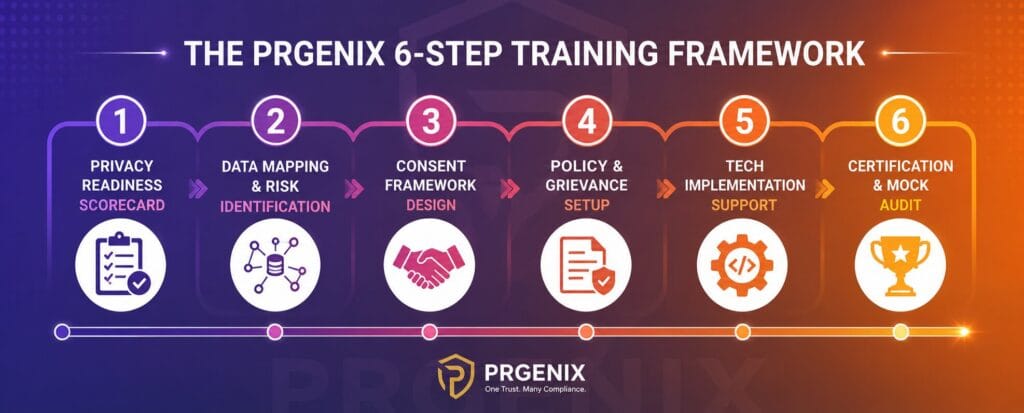
Prgenix does not treat training as a standalone event. Instead, it is woven into the firm’s proven 6‑step consulting framework, ensuring that training is always aligned with your organization’s specific risks and processes.
- Step 1 – Privacy Readiness Scorecard. Prgenix evaluates your current compliance status using a proprietary scorecard. Average client score on first check is only 39 out of 100, highlighting the urgent need for improvement.
- Step 2 – Data Mapping & Risk Identification. Prgenix documents every instance of personal data collection, storage, and transfer. This mapping forms the foundation for targeted training interventions.
- Step 3 – Consent Framework Design. User touchpoints are redesigned to capture explicit, granular, and revocable consent. Teams are trained on the new flows and the underlying consent logs integrated with CRMs.
- Step 4 – Policy & Grievance Setup. Human‑readable privacy policies and internal SOPs are drafted, and employees are trained on their specific roles and responsibilities.
- Step 5 – Tech Implementation Support. Prgenix works with your tech team to add encryption, access controls, and breach detection alerts. Technical staff receive hands‑on training on implementing these safeguards without breaking products.
- Step 6 – Certification & Mock Audit. After training and implementation, Prgenix conducts a full simulation of a DPBI audit and issues a certification of compliance. This final step ensures readiness for real‑world regulatory scrutiny.
Key Features & Benefits of Choosing Prgenix
- India‑specific expertise. Prgenix focuses exclusively on the DPDP Act and its rules, not generic GDPR clones. The team understands the nuances of the Indian regulatory environment and can explain key legal provisions in plain Hindi if needed.
- Blend of legal and technical capabilities. Compliance requires both legal frameworks and technical implementation. Prgenix offers both, ensuring that your training program is not just theoretical but actionable.
- Proven frameworks and sample audit reports. Prgenix provides clear deliverables at each stage, including audit‑ready documentation that demonstrates compliance.
- Experience across industries. From healthcare and finance to e‑commerce and SaaS, Prgenix has successfully helped businesses across diverse sectors become DPDP‑compliant.
- Flexible packages and long‑term support. Whether you are a lean startup or a large enterprise, Prgenix offers customizable training packages and ongoing DPO services.
- Demonstrated results. In a B2B SaaS HR tech case study, Prgenix helped a client pass a third‑party audit with 96% score and land new contracts worth ₹3.6 crore after implementing full DPDP compliance and co‑training the development, sales, and operations teams within three weeks.
The DPDP Compliance Timeline: Why You Must Act Now
The DPDP Rules were notified on 13 November 2025, activating a three‑phased compliance schedule.
- Immediate effect (13 November 2025): The Data Protection Board of India (DPB) is operational. Rules related to definitions, board powers, and investigations are in force.
- 13 November 2026: Registration and obligations of Consent Managers come into effect.
- 13 May 2027: All substantive obligations for Data Fiduciaries become enforceable, including notice and consent requirements, security safeguards, breach notification, data retention, verifiable consent for children, and obligations for Significant Data Fiduciaries.
Given the 18‑month window, businesses have limited time to prepare. However, preparing for DPDP compliance—especially training your workforce—is not a process that can be rushed at the last minute. The training needs to be embedded, tested, and refined well before the May 2027 deadline. Those who start early gain a competitive advantage, while late movers risk penalties, customer distrust, and operational disruption.
Frequently Asked Questions (FAQs)

1. Who in my organization needs DPDP data fiduciary training?
Everyone who handles personal data in digital form. This includes IT teams, legal and compliance staff, HR teams (who process employee data), marketing and sales teams (who collect customer data), customer support teams, and third‑party vendors and data processors. C‑suite and board members also need high‑level training to understand their accountability responsibilities.
2. Is data fiduciary training mandatory under the DPDP Act?
While the act does not explicitly require “training” by name, it imposes a duty on Data Fiduciaries to implement reasonable security safeguards and demonstrate compliance. Training is widely recognized as a core component of reasonable safeguards. Without training, an organization cannot prove that its employees understand their obligations, making it vulnerable to regulatory penalties.
3. What topics are covered in Prgenix’s DPDP training program?
Prgenix covers the DPDP Act landscape, data fiduciary obligations, consent frameworks, Data Principal rights handling, security safeguards (including encryption and breach detection), data mapping, vendor management, grievance redressal mechanisms, and mock audits. The training is role‑based and tailored to your organization’s specific data flows.
4. How long does the training program take?
Prgenix offers flexible training durations depending on the size of your organization and the scope of training required. For lean startups, full compliance (including training) can be achieved in approximately two weeks. For larger, infrastructure‑heavy organizations, the process may take two months or more.
5. Can we deliver training in‑house or must it be outsourced?
You can certainly deliver training in‑house if you have qualified privacy professionals on staff. However, most organizations lack the deep DPDP‑specific knowledge required to design and deliver effective training. Prgenix offers an efficient, expert‑led alternative that ensures your training program is accurate, up‑to‑date, and audit‑ready.
6. How much does Prgenix’s training service cost?
Costs vary depending on the size of your organization, the number of employees to be trained, and the depth of training required. For small to medium enterprises (SMEs), DPDP compliance consulting packages typically range from ₹50,000 to ₹3 lakhs. For enterprises, costs may be higher, but so are the risks of non‑compliance.
7. Does training help with international privacy laws like GDPR?
Yes. A good consultant can align your DPDP training program with global standards such as GDPR, HIPAA, or CCPA if your business operates in multiple jurisdictions. Prgenix can help you build a unified privacy training framework that satisfies multiple regulatory requirements.
8. What happens if we fail to train our employees and a breach occurs?
The consequences can be devastating. The DPDP Act imposes fines up to ₹250 crore for failure to maintain reasonable security safeguards. Beyond financial penalties, your organization faces reputational damage, customer churn, investor hesitation, and potential legal action from affected Data Principals.
9. Can Prgenix help us appoint a Data Protection Officer (DPO) after training?
Absolutely. Prgenix offers ongoing DPO services for SMEs, providing long‑term support beyond the initial training and compliance implementation.
10. What is the first step to getting started with Prgenix’s training program?
The first step is to schedule a consultation with Prgenix, where their experts will conduct a preliminary assessment of your organization’s privacy readiness using their proprietary scorecard. This assessment provides a clear baseline and a roadmap for training and compliance.
DPDP COMPLIANCE WITH PRGENIX
Take the First Step Towards Full DPDP Compliance with Prgenix
The Digital Personal Data Protection Act is not a distant regulatory concern—it is a present reality. The compliance clock is ticking toward the 13 May 2027 deadline. Every day your employees remain untrained is a day your organization faces unnecessary risk.
Do not wait for a DPBI notice or a data breach to force your hand. Be proactive. Be compliant. Be trusted.
Contact Prgenix today to schedule a free consultation and receive your Privacy Readiness Scorecard. Let Prgenix’s expert team design and deliver a role‑based DPDP Data Fiduciary Training program that transforms your workforce into your strongest line of defense.