NABL accreditation is the gold standard for testing and calibration laboratories in India. Whether you operate a medical diagnostic lab, an environmental testing facility, or a calibration center, achieving accreditation from the National Accreditation Board for Testing and Calibration Laboratories (NABL) demonstrates technical competence, reliability, and compliance with international standards.
This guide walks you through the complete NABL accreditation procedure, from understanding eligibility to maintaining your accreditation status. We reference NABL 100B — the authoritative “Accreditation Process & Procedure” document, with its current amendment dated 27 August 2025 — to ensure you have the most accurate and up-to-date information.
What Is NABL Accreditation?
NABL is an autonomous body under the Department of Science and Technology, Government of India. It provides laboratory accreditation services in accordance with ISO/IEC 17025 (for testing and calibration laboratories), ISO 15189 (for medical laboratories), and ISO/IEC 17043 (for proficiency testing providers).
NABL accreditation is a formal recognition that a laboratory is competent to carry out specific tests, calibrations, or measurements. It is not a one-time certification — it is an ongoing commitment to quality, traceability, and continuous improvement.
Key benefits of NABL accreditation include:
- Enhanced credibility with clients, regulators, and stakeholders
- International acceptance through mutual recognition arrangements (ILAC and APAC)
- Improved operational efficiency through standardized processes
- Regulatory compliance for government tenders and statutory requirements
- Reduced retesting and customer complaints
Who Can Apply for NABL Accreditation?
Any laboratory operating in India that performs testing, calibration, or medical diagnostics can apply for NABL accreditation. The eligibility criteria are straightforward but must be taken seriously:
Eligible Laboratory Types
| Category | Examples |
|---|---|
| Testing Laboratories | Food & water testing, environmental testing, construction material testing, electrical safety testing, textile testing |
| Calibration Laboratories | Dimensional, mechanical, thermal, optical, electrical, and radiological calibration |
| Medical Testing Laboratories | Pathology, biochemistry, microbiology, hematology, molecular diagnostics |
| Proficiency Testing Providers | Organizations that organize inter-laboratory comparisons |
Basic Requirements
Before initiating the NABL accreditation process, a laboratory must:
- Be a legally identifiable entity (proprietorship, partnership, company, or government organization)
- Have been operational for a minimum period (typically at least 6 months of documented activity)
- Possess the necessary infrastructure, equipment, and personnel for the scope sought
- Have a functioning Quality Management System (QMS) in place
- Be willing to participate in proficiency testing or inter-laboratory comparison (ILC) programs
NABL Accreditation Schemes
NABL operates multiple accreditation schemes tailored to different types of laboratories. Understanding which scheme applies to you is the first step in the NABL accreditation procedure.
1. Testing Laboratories (ISO/IEC 17025)
For laboratories that perform tests on materials, products, or environmental samples. This is the most common scheme and covers sectors like food safety, pharmaceuticals, construction, and chemicals.
2. Calibration Laboratories (ISO/IEC 17025)
For laboratories that perform calibrations of measuring instruments and reference standards. Calibration labs must demonstrate metrological traceability to national or international standards.
3. Medical Testing Laboratories (ISO 15189)
For clinical and diagnostic laboratories. This scheme emphasizes not just technical competence but also patient safety, ethics, and communication with clinicians.
4. Proficiency Testing Providers (ISO/IEC 17043)
For organizations that design and operate proficiency testing schemes for other laboratories.
5. Reference Material Producers (ISO 17034)
For laboratories that produce certified reference materials used in testing and calibration.
NABL Accreditation Procedure — Step by Step
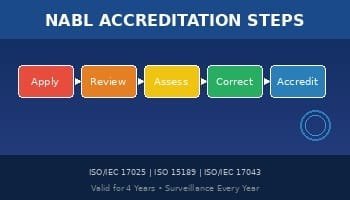
The NABL accreditation procedure is a structured, multi-stage process designed to rigorously evaluate a laboratory’s competence. Based on NABL 100B (amended 27 August 2025), here is the complete step-by-step breakdown.
Step 1: Scope Selection
The foundation of a successful NABL application procedure is selecting the right scope of accreditation. This defines exactly which tests, calibrations, or parameters your laboratory will be accredited for.
Key Considerations:
- Start with your core competencies — do not overextend
- Ensure you have validated test methods for every parameter
- Verify that equipment and reference standards are available and calibrated
- Check that your personnel have documented training and authorization records
- Review NABL’s “Specific Criteria” documents for your field (e.g., NABL 112 for chemical testing, NABL 141 for medical testing)
Pro Tip: Begin with a limited scope and expand after gaining experience with the accreditation process. A broad scope increases assessment duration and cost without proportional benefit.
Step 2: Quality Management System Implementation
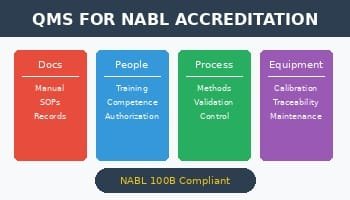
A robust Quality Management System (QMS) is mandatory for NABL accreditation requirements. The QMS must be documented, implemented, maintained, and continually improved.
Essential QMS documents include:
| Document | Purpose |
|---|---|
| Quality Manual | Top-level policy and commitment to quality |
| Procedures (SOPs) | How activities are performed consistently |
| Work Instructions | Detailed step-by-step task descriptions |
| Forms and Records | Evidence that procedures are followed |
| Document Control System | Ensures only current documents are in use |
Your QMS must address all clauses of the relevant ISO standard (17025, 15189, or 17043) and NABL’s specific criteria. The system should be operational for at least 3 to 6 months before application, with records to prove it.
Step 3: Technical Competence
Technical competence is the heart of NABL accreditation. It goes far beyond having the right equipment. NABL assessors evaluate:
- Personnel qualifications: Educational background, training records, authorization to perform specific tests, and ongoing competency evaluation
- Method validation: Evidence that test methods produce valid results under your laboratory conditions
- Equipment calibration: All measuring equipment must be calibrated with metrological traceability to SI units
- Environmental conditions: Temperature, humidity, cleanliness, and other factors must be controlled and monitored where they affect results
- Measurement uncertainty: Calibration laboratories must calculate and report uncertainty; testing labs must estimate it where relevant
- Quality control: Internal quality control procedures such as control charts, duplicate testing, and blank analyses
Step 4: Internal Audit and Management Review
Before applying, your laboratory must conduct a full internal audit of the QMS and a management review. These are not optional — they are mandatory NABL accreditation steps.
Internal Audit:
- Must be conducted by trained personnel independent of the area being audited
- Should cover all elements of the QMS and technical operations
- Findings must be documented with corrective actions assigned
- Typically performed 1–2 months before application to allow time for closure
Management Review:
- Conducted by top management with inputs from all department heads
- Reviews audit results, customer feedback, proficiency testing outcomes, corrective actions, and resource needs
- Must result in decisions and action items for improvement
Both processes demonstrate that your laboratory is actively monitoring and improving its operations — a core expectation of the NABL accreditation process.
Step 5: Proficiency Testing / ILC
Participation in Proficiency Testing (PT) or Inter-Laboratory Comparison (ILC) is a critical NABL accreditation requirement. NABL mandates that laboratories participate in PT/ILC programs relevant to their scope.
Requirements:
- At least one PT/ILC participation per sub-discipline in the scope
- Results should be satisfactory or, if unsatisfactory, must have documented root cause analysis and corrective action
- For scopes where no PT provider exists, alternative arrangements (such as replicate testing or method comparison) must be documented
NABL itself organizes PT programs, and several commercial providers also operate in India. Plan this step well in advance, as PT rounds may only run 1–2 times per year.
Step 6: Application to NABL
Once your QMS is operational, audits are complete, and PT participation is documented, you are ready to submit your NABL application.
Application process:
- Register on the NABL portal (www.nabl-india.org)
- Fill out the application form (NABL 100) with laboratory details, scope, and key personnel
- Upload required documents:
- Quality Manual
- Organization chart
- List of accredited/signatory personnel
- Equipment list with calibration status
- Scope of accreditation with test methods
- PT/ILC participation records
- Internal audit and management review records
- Pay the application fee based on the number of disciplines and parameters
NABL will review the application for completeness. If any information is missing, they will issue a query that must be resolved before proceeding.
Step 7: Document Review
After application acceptance, NABL appoints a Lead Assessor who conducts a thorough document review. This is a desk-based evaluation of your QMS documentation against NABL criteria.
The assessor evaluates:
- Completeness and adequacy of the Quality Manual
- Alignment of procedures with ISO/IEC 17025/15189 requirements
- Technical competence evidence for the proposed scope
- Calibration certificates and traceability chains
- Personnel records and authorization matrices
If significant gaps are found, the assessor may request additional documents or revisions. Minor issues are typically noted for verification during the on-site assessment.
Step 8: Assessment
The on-site assessment is the most intensive phase of the NABL accreditation procedure. A team of assessors (led by the Lead Assessor) visits your laboratory for 1–5 days depending on scope size.
Assessment activities include:
| Activity | What Happens |
|---|---|
| Opening Meeting | Introductions, scope confirmation, and schedule review |
| QMS Review | Interviews with management and quality personnel; review of records |
| Technical Evaluation | Witnessing tests/calibrations, reviewing raw data, checking equipment |
| Personnel Interviews | Assessing knowledge and competence of technicians and signatories |
| Facilities Tour | Evaluating environmental controls, safety, and housekeeping |
| Closing Meeting | Presentation of findings, including non-conformities |
Assessors use checklists based on NABL 100B and applicable specific criteria. They will ask questions, request records on the spot, and may ask technicians to demonstrate procedures.
Step 9: Non-Conformity and Corrective Action
It is extremely rare for a laboratory to pass assessment without any non-conformities (NCs). NCs are classified as:
- Major NC: A systemic failure affecting technical competence or QMS effectiveness
- Minor NC: An isolated lapse or documentation gap
Corrective action process:
- Laboratory receives the NC report within a few weeks of assessment
- Submit root cause analysis for each NC
- Implement corrective action with evidence (revised documents, retraining, recalibration, etc.)
- Submit response to NABL within the stipulated timeframe (typically 2 months)
- NABL reviews the response; if acceptable, closes the NC. If not, additional evidence or a follow-up visit may be required
Timely and thorough corrective action is essential to avoid delays in the NABL accreditation process.
Step 10: Accreditation Decision
Once all non-conformities are closed, the assessment report is forwarded to the NABL Accreditation Committee. The committee reviews:
- The assessment team’s recommendations
- The laboratory’s corrective action evidence
- Any special conditions or limitations
If satisfied, NABL issues the Certificate of Accreditation with a detailed Scope of Accreditation listing all approved tests/calibrations, methods, and ranges. The certificate is valid for 4 years .
The laboratory is then listed on NABL’s official directory and can use the NABL symbol on reports and marketing materials — subject to NABL’s logo usage rules.
Step 11: Surveillance and Reassessment
NABL accreditation is not a one-time achievement. It requires ongoing compliance through:
Surveillance Assessments:
- Conducted annually (typically within 12 months from the date of grant/renewal, preferably in the 10th month)
- Focus on changes to scope, personnel, equipment, and QMS
- Review of PT participation, internal audits, and management reviews
- Shorter duration than initial assessment
Reassessment:
- Full reassessment conducted every 2 years during the 4-year accreditation cycle
- NABL conducts the reassessment within 24 months (preferably in the 20th to 22nd month) from the date of grant/renewal
- Similar in scope and intensity to the initial assessment
- Must be completed successfully for accreditation continuity
Laboratories must also notify NABL of significant changes such as:
- Change of address or legal entity
- Key personnel departures (Quality Manager, Technical Manager, Signatories)
- Major equipment changes
- Scope expansion or reduction requests
Failure to maintain compliance can result in suspension or withdrawal of accreditation.
Common Reasons for Delay
Many laboratories face unnecessary delays in the NABL accreditation procedure. Here are the most common pitfalls and how to avoid them:
| Delay Factor | Why It Happens | Prevention |
|---|---|---|
| Incomplete application | Missing documents or incorrect scope entries | Use NABL’s application checklist; review with a consultant |
| Weak QMS documentation | Generic manuals not tailored to laboratory operations | Write procedures based on actual practices, not templates alone |
| Inadequate PT participation | No satisfactory PT results available at application time | Plan PT participation 6–12 months before applying |
| Unresolved non-conformities | Superficial root cause analysis or weak corrective actions | Use structured problem-solving (5 Whys, fishbone diagrams) |
| Personnel competency gaps | Technicians unable to demonstrate procedures during assessment | Conduct mock assessments and regular competency checks |
| Equipment calibration issues | Missing traceability or expired calibration certificates | Maintain a calibration schedule with alerts |
| Poor document control | Obsolete documents in use, uncontrolled copies | Implement a robust document management system |
How Prgenix Helps Laboratories Prepare?
Navigating the NABL accreditation procedure can be overwhelming, especially for first-time applicants. Prgenix provides end-to-end support to help laboratories achieve accreditation efficiently and cost-effectively.
Our Services Include:
Gap Analysis & Readiness Assessment: We conduct a thorough evaluation of your current QMS, technical operations, and documentation against NABL 100B and ISO/IEC 17025/15189 requirements. You receive a prioritized action plan with clear timelines.
QMS Documentation Support: Our experts help you develop a customized Quality Manual, procedures, work instructions, and forms that reflect your actual operations — not generic templates. This ensures assessor confidence and reduces non-conformities.
Technical Competence Development: We assist with method validation protocols, measurement uncertainty calculations, equipment calibration planning, and personnel training programs to meet NABL accreditation requirements.
Internal Audit & Management Review: Prgenix conducts independent internal audits and facilitates management reviews, identifying issues before NABL assessors do. This dramatically improves your readiness for the official assessment.
Application & Assessment Support: From scope selection and NABL portal submission to assessor liaison and corrective action closure, we guide you through every step of the NABL application procedure.
Post-Accreditation Maintenance: Accreditation is just the beginning. We provide ongoing support for surveillance assessments, scope expansions, and continuous improvement to ensure you retain your accredited status.
Conclusion
The NABL accreditation procedure is rigorous by design — it ensures that only technically competent laboratories earn this prestigious recognition. By following the steps outlined in this guide and aligning your operations with NABL 100B (amended 27 August 2025), you can navigate the process with confidence.
Whether you are a new laboratory seeking initial accreditation or an existing facility looking to expand your scope, understanding the NABL accreditation steps is the first move toward excellence. With proper planning, a commitment to quality, and expert guidance where needed, NABL accreditation is an achievable milestone that opens doors to new opportunities, client trust, and operational excellence.
This guide is based on NABL 100B — Accreditation Process & Procedure, as amended on 27 August 2025, and the official NABL FAQ. For the latest updates, always refer to the official NABL website at www.nabl-india.org.