
Food testing does not always need to happen inside a conventional fixed laboratory.
A properly designed mobile laboratory can take selected testing capabilities closer to food businesses, manufacturing clusters, markets, ports, institutional kitchens and other sampling locations. For Indian laboratories and entrepreneurs, this creates an interesting opportunity: develop a mobile food testing facility around a clearly defined scope and pursue accreditation under the applicable NABL requirements.
But a mobile laboratory is not simply a testing van fitted with instruments.
It must demonstrate technical competence, suitable equipment, controlled environmental conditions, competent personnel, valid methods, traceability, quality control, records and reliable reporting. The underlying accreditation framework is ISO/IEC 17025:2017, together with applicable NABL criteria and the requirements of the relevant food regulator.
This article explains how the model can work, what a laboratory should prepare, and where the commercial opportunity lies.
Key Takeaways
- NABL’s current FAQ confirms that site facilities and mobile laboratories can seek accreditation.
- Mobile testing must operate within a defined and technically justified scope.
- ISO/IEC 17025:2017 remains the core competence standard for testing laboratories.
- NABL 130 contains specific requirements for site/mobile testing and calibration operations.
- FSSAI recognises and notifies NABL-accredited food laboratories for specified food-analysis purposes.
- A mobile laboratory should not assume that every food test can be performed inside a vehicle.
- Equipment verification, sampling, environmental control, traceability and personnel competence are critical.
- The business model should be designed around the intended scope before purchasing expensive equipment.
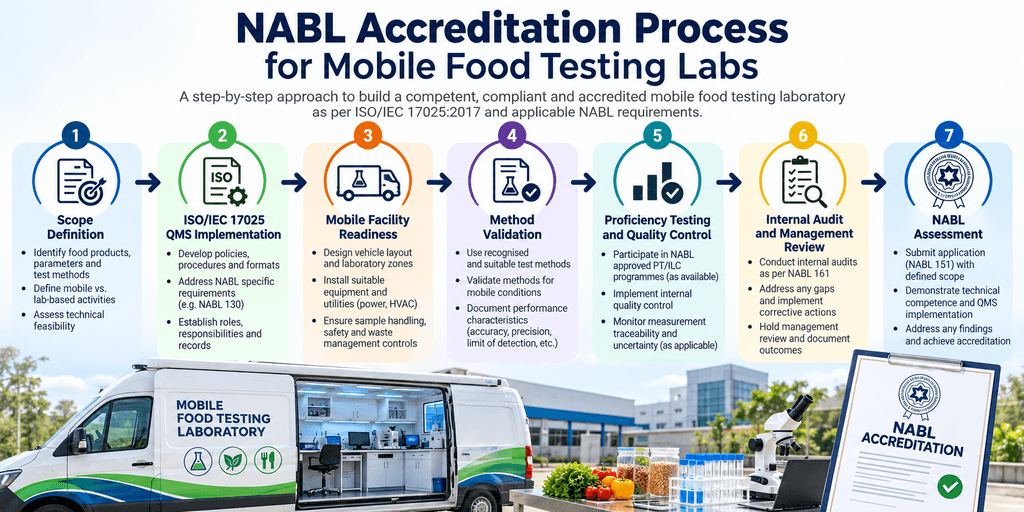
What makes NABL Mobile Food Testing Labs possible?
NABL provides accreditation to testing laboratories against ISO/IEC 17025 and its current FAQ specifically states that site facilities and mobile laboratories can seek accreditation. This means a mobile operating model is not automatically excluded simply because testing is performed away from a conventional permanent laboratory. The laboratory must, however, demonstrate competence and control over the mobile activities within its defined scope.
The critical question is therefore not simply, “Can a laboratory operate from a vehicle?”
The better question is: Can the laboratory consistently demonstrate valid results from its mobile testing activities under controlled conditions?
That distinction is fundamental.
Mobile laboratory versus ordinary sample collection
A sample collection vehicle and a mobile testing laboratory are not necessarily the same thing.
A collection vehicle may collect samples and transport them to a permanent laboratory. A mobile laboratory may actually perform specified testing activities at the mobile facility or at the testing site.
The management system, equipment, personnel, methods and reporting arrangements must clearly establish what activities are performed where.
NABL’s site/mobile criteria require arrangements covering mobile operations, including procedures, responsibilities, supervision, equipment verification and precautions associated with mobile testing.
Why is mobile food testing an emerging opportunity in India?
India has a large and geographically distributed food ecosystem.
Food manufacturers, processors, dairy units, restaurants, institutional kitchens, agricultural markets, warehouses, exporters and food businesses may operate far from major laboratory centres.
A mobile laboratory can potentially reduce the distance between the sample and the testing capability.
Consider a food-processing cluster located several hours from the nearest suitable laboratory. Instead of sending every sample to a distant facility, a suitably designed mobile operation could perform selected tests closer to the source.
Potential applications can include:
- Food manufacturing clusters
- Dairy and beverage operations
- Institutional kitchens
- Large catering operations
- Food parks
- Agricultural and wholesale markets
- Storage and distribution facilities
- Export-oriented food businesses
- Food safety surveillance programmes
- On-site quality-control programmes
The commercial model should be built around the laboratory’s actual technical scope rather than the assumption that a mobile unit can perform every laboratory test.
What does NABL accreditation mean for a mobile food testing laboratory?
NABL accreditation is a formal recognition of the competence of a conformity assessment body for a defined scope. NABL states that testing laboratories are accredited against ISO/IEC 17025.
For a mobile laboratory, the accreditation question therefore centres on the defined activities, facilities, personnel, equipment, methods and controls used to produce technically valid results.
Key Areas to Control
A mobile food testing laboratory should establish documented arrangements for:
- Defined Scope of Testing
Clearly identify the food products, characteristics, parameters, methods and locations applicable to the mobile operation. - Personnel Competence
Personnel performing tests must have appropriate education, training, experience and demonstrated competence. - Equipment Suitability
Instruments must be suitable for the intended measurements and maintained and verified as required. - Environmental Conditions
Temperature, humidity, cleanliness, vibration, contamination and other relevant conditions must be controlled where they can affect results. - Method Validity
The laboratory must use appropriate and technically valid test methods. - Sampling Controls
Where sampling is part of the laboratory’s responsibility, the sampling process must be controlled and documented. - Measurement Traceability
Relevant measurement equipment and reference standards must be appropriately controlled. - Quality Control
Internal quality controls, proficiency testing or suitable inter-laboratory comparisons must be addressed as applicable. - Records and Reporting
Test records and reports must provide sufficient evidence that the work was performed correctly. - Mobile-Operation Controls
The laboratory should have procedures covering deployment, equipment checks, transportation, power supply, environmental controls, contamination risks and other mobile-specific issues.
Which NABL documents should a mobile food testing lab study?
A common mistake is to start with a long list of documents without first establishing which ones actually apply.
For a mobile food testing laboratory, the starting point should be ISO/IEC 17025:2017 and the applicable NABL documents and policies for testing laboratories.
NABL’s published documents include several particularly relevant references.
NABL 130 — Site Testing and Site Calibration
NABL 130 is especially relevant because it addresses site/mobile operations. Its published requirements include documented arrangements for site/mobile activities, separate identification of tests or calibrations that can be performed at site/mobile facilities, management-system arrangements, supervision, test procedures and equipment verification.
This is one of the most important documents to examine before designing a mobile laboratory model.
NABL 151 — Application Form for Testing Laboratories
NABL’s current accreditation-document listing identifies NABL 151 as the application form for testing laboratories.
The applicant should use the current applicable version rather than relying on an old application template.
NABL 160A — Management System Document / Quality Manual
NABL currently lists NABL 160A as its guide for preparing management-system documentation/quality manuals for testing and calibration laboratories.
The mobile laboratory’s quality documentation should clearly integrate mobile activities rather than treating the vehicle as an uncontrolled extension of the permanent laboratory.
NABL 161 — Internal Audit and Management Review
NABL 161 provides guidance relating to internal audit and management review for conformity assessment bodies.
Before applying, the laboratory should have evidence that its management system is functioning, not merely documented.
NABL 163 — Proficiency Testing
NABL’s published accreditation documents include NABL 163 on participation in proficiency testing activities.
Where suitable PT programmes exist for the proposed food-testing scope, the laboratory should plan participation appropriately. Where conventional PT availability is limited, the applicable NABL provisions should be assessed for suitable alternatives.
What about NABL 112 and NABL 143?
This distinction matters.
NABL 112 is a specific criterion for medical laboratories, so it should not be presented as the primary accreditation criterion for a food testing laboratory.
Similarly, NABL 143 addresses calibration and measurement capability and measurement uncertainty in calibration. It is not the principal document defining accreditation of a food-testing laboratory.
For a mobile food testing operation, the relevant NABL requirements should be selected according to the actual conformity-assessment activity, discipline and scope.
What tests can a mobile food testing laboratory perform?
There is no sensible universal list of “mobile food tests”.
The feasible scope depends on the method, instrumentation, environmental conditions, sample preparation requirements, safety controls and the ability to maintain technically valid results in the mobile environment.
A practical starting strategy is to divide potential testing into three categories:
| Category | Mobile suitability | Typical consideration |
|---|---|---|
| Rapid/on-site tests | Potentially high | Compact equipment and controlled procedures |
| Routine analytical tests | Test-specific | Requires validation, equipment and environmental control |
| Complex laboratory tests | Often challenging | May require specialised infrastructure or permanent facilities |
The correct approach is to perform a technical feasibility assessment before finalising the scope.
For example, a laboratory may find that some physicochemical or rapid screening tests are technically suitable for mobile deployment, while sophisticated microbiological, chromatographic or confirmatory analyses may require more extensive infrastructure.
The answer must come from the validated method and risk assessment—not from the fact that an instrument physically fits inside a vehicle.
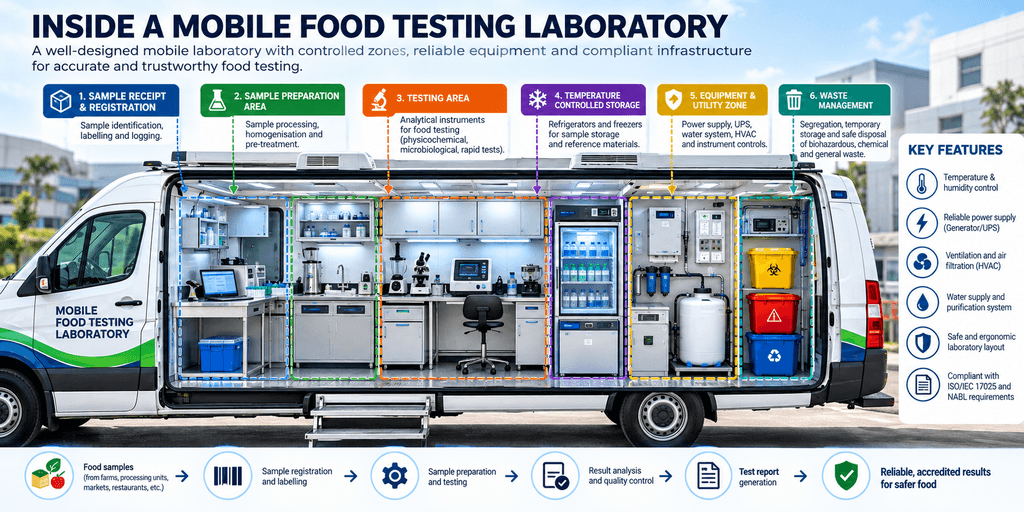
What infrastructure does a mobile food testing lab need?
A professional mobile laboratory requires considerably more planning than installing a few instruments in a van.
Vehicle and Laboratory Layout
The layout should address:
- Clean and potentially contaminated areas
- Sample receipt and identification
- Sample preparation
- Testing areas
- Chemical storage
- Waste management
- Equipment placement
- Electrical safety
- Ventilation
- Temperature control
- Water supply, where required
- Emergency arrangements
- Access and movement of personnel
Equipment
Each instrument should be evaluated for:
- Intended use
- Measurement range
- Accuracy and precision requirements
- Environmental operating conditions
- Calibration/verification requirements
- Transport sensitivity
- Power requirements
- Maintenance
- Software/data integrity
- Reference materials and controls
Equipment should not simply be “calibrated once”.
Mobile operations need a defined approach for equipment condition and verification before and, where appropriate, after movement or deployment.
Sample Integrity
Sample integrity becomes particularly important when the laboratory moves between locations.
The system should control:
- Sample identification
- Labelling
- Chain of custody where applicable
- Preservation
- Storage temperature
- Holding time
- Sample preparation
- Disposal
- Retention requirements
A technically perfect test cannot compensate for a compromised sample.
How does FSSAI fit into the mobile laboratory model?
FSSAI plays a separate but important role.
FSSAI states that it recognises and notifies NABL-accredited food laboratories for specified food-analysis purposes. Its published information identifies primary, referral and reference food laboratories within the food-testing framework.
Therefore, obtaining NABL accreditation should not automatically be described as equivalent to being an FSSAI-notified laboratory for every regulatory purpose.
The laboratory must examine the applicable FSSAI requirements and notification framework for the intended service.
This distinction is commercially important.
A mobile laboratory may provide testing services to food businesses under its accredited scope, but regulatory acceptance of a particular report depends on the applicable legal and regulatory framework and the laboratory’s status for that purpose.
How can a laboratory prepare for NABL accreditation?
A practical implementation roadmap is:
Step 1: Define the Business Model
Decide whether the mobile unit will:
- Conduct testing independently;
- Operate as part of an existing permanent laboratory;
- Collect and screen samples before confirmatory testing elsewhere; or
- Provide a defined combination of mobile and permanent laboratory services.
Step 2: Freeze the Proposed Scope
Identify:
- Product categories
- Parameters
- Test methods
- Detection/measurement capability
- Sample types
- Locations
- Reporting requirements
Do this before purchasing major equipment.
Step 3: Conduct a Gap Assessment
Compare the proposed system against:
- ISO/IEC 17025:2017
- Applicable NABL criteria
- NABL 130 for site/mobile operations
- Applicable food-testing requirements
- Applicable FSSAI requirements
- Relevant statutory and safety requirements
Step 4: Build the QMS
Develop the required policies, procedures, formats and records.
Important documents should address:
- Impartiality
- Confidentiality
- Personnel competence
- Equipment management
- Method selection and validation
- Sampling
- Sample handling
- Technical records
- Quality control
- Nonconforming work
- Corrective action
- Complaints
- Internal audit
- Management review
- Proficiency testing
- Mobile deployment controls
Step 5: Validate the Mobile Operation
Conduct practical trials under realistic operating conditions.
Do not validate only inside a workshop. Test the system under representative deployment conditions.
Step 6: Complete Internal Audit and Management Review
The laboratory should generate objective evidence that the QMS is implemented and effective.
Step 7: Apply to NABL
Use the current NABL application process and ensure that the proposed scope accurately represents the competence being claimed.
Step 8: Prepare for Assessment
The team should be able to demonstrate both the documented system and actual technical competence.
What are the biggest risks for mobile food testing labs?
The opportunity is significant, but the accreditation model has technical risks.
Common weaknesses include:
- Buying equipment before defining the scope
- Treating the vehicle as the laboratory without adequate environmental control
- Poor sample identification
- Inadequate temperature monitoring
- Uncontrolled equipment movement
- Weak method validation
- Inadequate technical records
- Insufficient personnel competence
- No practical mobile-operation trials
- Confusing NABL accreditation with FSSAI notification
- Using the NABL symbol or accreditation claim outside the accredited scope
The last point deserves particular attention. Accreditation claims must follow NABL’s applicable policy on the use of the NABL symbol and claims of accreditation.
Is a mobile food testing laboratory a good business opportunity?
The opportunity should be evaluated as a technical-business model rather than simply as a new laboratory format.
A mobile laboratory can potentially create value through:
- Faster access to testing
- Reduced sample transportation for suitable tests
- Cluster-based testing services
- Contract testing
- Food-safety surveillance support
- Quality-control programmes
- On-site screening
- Support to geographically distributed food businesses
However, the business case should be built around utilisation, test volume, personnel costs, vehicle and equipment maintenance, calibration, consumables, quality-control requirements and the proportion of tests that genuinely benefit from mobile deployment.
The strongest model may be a hybrid laboratory: mobile capability for selected tests and sampling, supported by a permanent laboratory for tests requiring more extensive infrastructure.
Frequently Asked Questions (FAQ)

1. Can a mobile laboratory get NABL accreditation in India?
Yes. NABL’s current FAQ states that site facilities and mobile laboratories can seek accreditation. The laboratory must demonstrate competence for a defined scope and comply with ISO/IEC 17025 and applicable NABL requirements. For mobile/site operations, NABL 130 is particularly relevant to documented procedures, supervision, equipment verification and mobile-operation controls.
2. Is NABL accreditation mandatory for every mobile food testing laboratory?
NABL accreditation is not automatically a universal legal requirement merely because a laboratory is mobile. However, accreditation can be highly relevant where customers, regulators, contracts or specific regulatory programmes require competent accredited testing. FSSAI separately recognises and notifies food laboratories under its applicable framework.
3. Can a mobile food laboratory become FSSAI recognised?
Potentially, but NABL accreditation and FSSAI recognition/notification are distinct regulatory steps. FSSAI publishes information on recognised and notified food laboratories. A mobile laboratory should verify the current FSSAI requirements and the precise status needed for the intended regulatory testing services.
4. Does ISO/IEC 17025 apply to mobile food testing laboratories?
Yes, where the mobile operation is seeking NABL accreditation as a testing laboratory. NABL accredits testing laboratories against ISO/IEC 17025. The mobile nature of the operation adds specific operational controls rather than replacing the core competence requirements of the standard.
5. Is NABL 112 applicable to a mobile food testing laboratory?
Generally, no. NABL 112 is a specific criterion for medical laboratories. Food testing laboratories should identify the applicable NABL requirements for testing laboratories and the relevant food-testing discipline. NABL 130 is particularly relevant when the testing activity is performed through site/mobile arrangements.
6. Can all food tests be performed inside a mobile laboratory?
No. Suitability is test-specific. The laboratory must consider method requirements, equipment capability, environmental conditions, sample preparation, contamination control, safety and quality-control requirements. A mobile laboratory should define a technically justified scope rather than assuming that every test can be transferred into a vehicle.
Final Takeaway
NABL Mobile Food Testing Labs represent a potentially valuable new service model for India’s food-testing ecosystem, particularly where selected testing activities can be technically controlled outside a conventional permanent laboratory.
The opportunity should, however, begin with the accreditation scope—not with the vehicle.
Define the tests. Confirm the methods. Assess the mobile environment. Establish equipment and sample controls. Build the ISO/IEC 17025 management system. Address NABL’s site/mobile requirements. Then determine the applicable FSSAI regulatory pathway.
For laboratories planning this model, a structured feasibility and NABL gap assessment can prevent significant investment in equipment or infrastructure that later proves unsuitable for the intended scope.
Prgenix can support laboratories and organisations with NABL accreditation planning, ISO/IEC 17025 implementation, QMS documentation, technical readiness, internal audit preparation and accreditation support.
Explore NABL Accreditation Consulting →
Disclaimer: This article is for informational purposes and does not constitute legal advice. For tailored guidance, consult Prgenix.
About the Author: Reviewed by V. Pathak, Lead Compliance Consultant at Prgenix, with extensive experience in NABL accreditation, ISO/IEC 17025 implementation, laboratory quality systems and regulatory compliance.