A laboratory preparing for NABL accreditation cannot treat internal audit as a routine paperwork exercise. A properly planned internal audit should test whether the laboratory’s documented QMS is actually implemented in day-to-day work.
This NABL Internal Audit Checklist is designed for Indian testing and calibration laboratories working towards or maintaining accreditation under ISO/IEC 17025:2017. It covers management-system requirements, technical operations, records, equipment, personnel, methods, measurement uncertainty, quality control, reporting and corrective action.
The checklist is based on the principles contained in ISO/IEC 17025:2017 and NABL’s published guidance, particularly NABL 161, Guide for Internal Audit and Management Review for Conformity Assessment Bodies. NABL 161 was amended in January 2026 and states that the audit programme should cover each management-system element, all activities, personnel, procedures and test methods at least once each year.
Key Takeaways
- Internal audit is a required part of an ISO/IEC 17025 laboratory’s management system.
- NABL 161 requires the audit programme to cover the relevant management-system elements and laboratory activities throughout the year.
- An internal audit should examine implementation, not merely the existence of documents.
- Technical competence must be included in the audit programme according to the laboratory’s scope and activities.
- Every NC should have objective evidence, correction/corrective action, root-cause evaluation where applicable and effectiveness verification.
- Internal-audit results should feed into management review and continual improvement.
- The latest NABL documents should always be checked before an accreditation or surveillance assessment.
What should a NABL Internal Audit Checklist cover?
A NABL Internal Audit Checklist should systematically verify the laboratory against applicable ISO/IEC 17025:2017 requirements, NABL requirements, the laboratory’s management-system documents and its actual technical operations.
NABL 161 specifically states that internal audits are intended to verify continuing compliance with the defined management system and applicable standard requirements. It also requires the audit programme to cover the management-system elements, activities, personnel, procedures and test methods at least once a year.
The practical principle is simple: audit the system as it operates, not just the system as it is documented.
For example, if a procedure says that temperature records must be reviewed daily, the auditor should not simply check that the procedure exists. The auditor should sample actual temperature records and verify whether the required review was performed.
How often should a NABL internal audit be conducted?
NABL 161 requires internal audits to be conducted periodically according to a predetermined schedule and procedure.
For the audit programme, each relevant element or activity of the management system should be checked at least once a year. NABL 161 also states that all activities, personnel, procedures and test methods should be covered.
A large laboratory does not necessarily need to audit everything in one week. It can divide the programme across the year, provided the complete applicable system and activities are covered.
A practical annual programme could look like this:
| Period | Suggested Audit Focus |
|---|---|
| Q1 | QMS, impartiality, confidentiality, document control, records |
| Q2 | Personnel, equipment, facilities, environmental conditions |
| Q3 | Sampling, testing/calibration methods, validation/verification, MU |
| Q4 | Quality control, PT/ILC, reporting, complaints, NC/CAPA and follow-up |
The laboratory should adapt the programme to its scope, size, risks and operational complexity.
What should you check before starting the internal audit?
A common audit mistake is starting with the checklist without first establishing the audit criteria.
Before the audit, the Quality Manager or designated audit coordinator should identify:
- Current ISO/IEC 17025:2017 requirements applicable to the laboratory.
- Current NABL requirements and applicable specific criteria.
- Current NABL scope of accreditation or proposed scope.
- Quality Manual or management-system document.
- Approved SOPs and procedures.
- Current test/calibration methods.
- Equipment master list and calibration status.
- Personnel competence and authorisation records.
- Previous internal-audit reports.
- Previous NABL assessment findings.
- Complaints and customer feedback.
- PT/ILC participation and results.
- Previous NCs and corrective actions.
- Management-review decisions.
- Changes introduced since the previous audit.
NABL’s current published document list includes NABL 160A, Guide for Preparing Management System Document/Quality Manual for Testing/Calibration Laboratories, issued in January 2026, and NABL 161, which provides guidance for internal audit and management review.
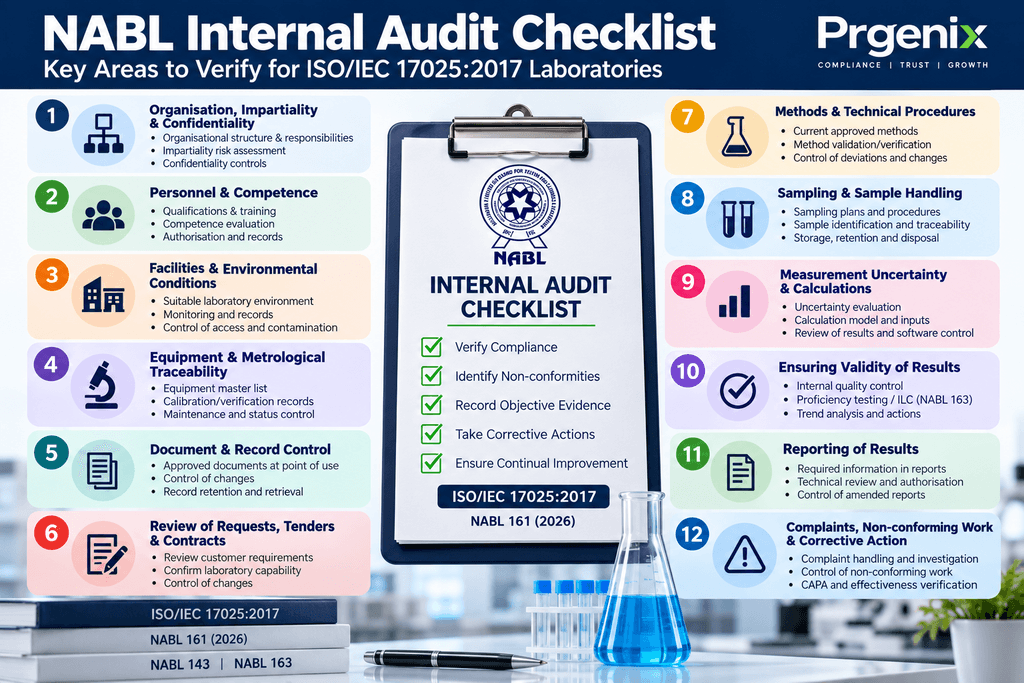
Complete NABL Internal Audit Checklist
The following checklist can be used as a practical starting point. The laboratory should customise it to its actual scope and applicable requirements.
1. Organisation, Impartiality and Confidentiality
Check whether:
- The laboratory’s legal identity and organisational structure are defined.
- Responsibilities and authorities are documented.
- Personnel understand their responsibilities.
- Risks to impartiality have been identified.
- Conflicts of interest are identified and controlled.
- Commercial, financial or other pressures do not compromise technical decisions.
- Confidential information is appropriately controlled.
- Customer information is protected.
- Personnel understand confidentiality obligations.
- Changes in organisational structure are controlled.
Audit evidence: organisation chart, responsibility matrix, impartiality risk assessment, declarations, confidentiality undertakings and relevant records.
2. Personnel and Competence
Verify:
- Job descriptions are available.
- Qualification and experience requirements are defined.
- Competence requirements are established for each technical activity.
- Training records are maintained.
- Competence evaluations have been completed.
- Personnel performing specific activities are authorised.
- Ongoing competence is monitored.
- Training effectiveness is evaluated.
- Temporary or external personnel are appropriately controlled.
Do not stop at checking training certificates. Interview the employee and examine actual work records.
3. Facilities and Environmental Conditions
Verify that:
- Laboratory environmental conditions are suitable for the work.
- Temperature, humidity, cleanliness or other critical conditions are monitored where required.
- Environmental limits are defined.
- Monitoring equipment is suitable and calibrated/verified where applicable.
- Environmental excursions are recorded.
- The laboratory has defined action when environmental conditions may affect results.
- Access to restricted areas is controlled.
- Work areas prevent contamination or interference where applicable.
4. Equipment and Metrological Traceability
Check:
- Equipment master list.
- Unique identification of equipment.
- Equipment status labels.
- Calibration certificates.
- Verification records.
- Intermediate checks where required.
- Maintenance records.
- Breakdown and repair records.
- Equipment acceptance records.
- Out-of-service controls.
- Impact assessment after equipment failure.
- Metrological traceability of measurements.
For calibration laboratories, the audit should also examine the applicable NABL requirements concerning calibration and measurement capability and measurement uncertainty.
NABL 143, for example, addresses Calibration and Measurement Capability and Measurement Uncertainty in calibration. It should be considered where applicable to the laboratory’s calibration activities.
5. Document and Record Control
Verify:
- Only approved documents are available at points of use.
- Obsolete documents are prevented from unintended use.
- Changes to documents are controlled.
- External documents are identified and controlled.
- Records are legible and retrievable.
- Electronic records are appropriately protected.
- Record retention periods are defined.
- Corrections to records are traceable.
- Access rights are controlled where electronic systems are used.
6. Review of Requests, Tenders and Contracts
Check whether the laboratory:
- Reviews customer requirements before accepting work.
- Confirms that it has the required capability.
- Identifies the requested method.
- Identifies sampling requirements where applicable.
- Identifies reporting requirements.
- Resolves differences between customer requirements and laboratory capability.
- Retains evidence of the review.
- Controls changes to agreed requirements.
7. Methods and Technical Procedures
Verify:
- Current approved methods are available.
- Method versions are controlled.
- Standard methods are followed correctly.
- Non-standard methods are appropriately controlled.
- Laboratory-developed methods are validated where required.
- Standard methods are verified where applicable.
- Deviations from methods are authorised and technically justified.
- Method changes are reviewed before implementation.
A strong audit should trace one complete sample from receipt through testing, calculation, technical review and final report.
8. Sampling and Sample Handling
Where sampling is within scope, check:
- Sampling plans.
- Sampling procedures.
- Sampling personnel competence.
- Sampling conditions.
- Sample identification.
- Sample transport requirements.
- Chain of custody where applicable.
- Sample receipt records.
- Sample storage.
- Sample preparation.
- Sample retention/disposal.
- Deviations or abnormalities.
For testing laboratories, sample traceability should be demonstrable from receipt to final report.
9. Measurement Uncertainty and Calculations
For applicable activities, verify:
- Measurement uncertainty has been evaluated.
- Significant uncertainty contributors have been considered.
- The calculation model is technically justified.
- Input data are controlled.
- Calculations are reviewed.
- Software or spreadsheets used for calculations are appropriately controlled.
- Reported uncertainty is consistent with the laboratory’s technical requirements.
- Personnel understand the uncertainty evaluation.
Do not accept a generic uncertainty spreadsheet merely because it produces a numerical value. The auditor should determine whether the model represents the actual measurement process.
10. Ensuring Validity of Results
Check the laboratory’s quality-control arrangements, including where applicable:
- Internal quality-control samples.
- Control charts.
- Replicate testing.
- Reference materials.
- Blanks.
- Duplicates.
- Recovery studies.
- Interlaboratory comparisons.
- Proficiency testing.
- Trend analysis.
- Defined acceptance criteria.
- Actions when QC results are outside limits.
NABL’s published requirements include a separate policy on participation in proficiency-testing activities, NABL 163. The laboratory should therefore ensure that its PT/ILC programme and follow-up actions are appropriately controlled.
11. Reporting of Results
Audit whether reports contain the required information and are technically reviewed before issue.
Check:
- Correct laboratory identification.
- Customer identification.
- Sample identification.
- Method identification.
- Test/calibration results.
- Units.
- Dates where applicable.
- Appropriate statements and qualifications.
- Authorisation.
- Corrections or amended reports.
- Electronic report controls where applicable.
A useful audit technique is to select three recently issued reports and trace each report back to the original worksheet and sample record.
12. Complaints, Non-Conforming Work and Corrective Action
Verify that the laboratory has an effective process for:
- Receiving complaints.
- Evaluating complaints.
- Investigating complaints.
- Recording decisions.
- Controlling non-conforming work.
- Assessing impact of non-conforming work.
- Taking correction where necessary.
- Performing root-cause analysis where appropriate.
- Implementing corrective action.
- Checking effectiveness.
- Retaining evidence.
A corrective action should not simply say “staff trained”. The audit should ask: What caused the problem, why was the existing control ineffective, and what evidence proves the problem will not recur?
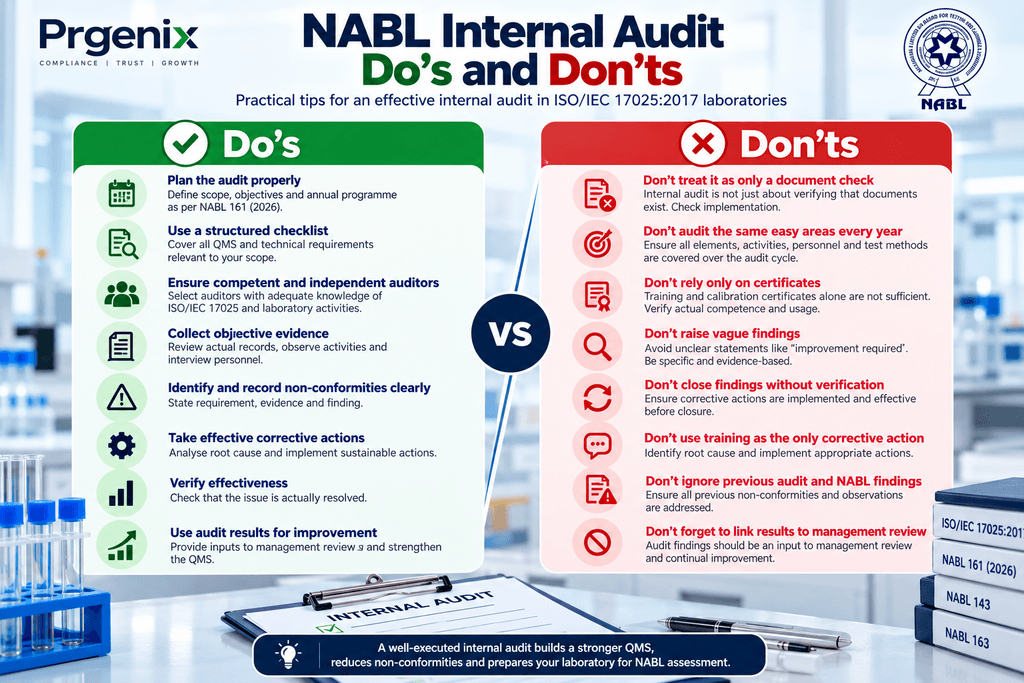
What Should an Internal Auditor Record?
Every finding should be supported by objective evidence.
A useful finding format is: Requirement → Evidence → Finding → Classification → Action → Verification
For Example:
Requirement: Approved procedure requires daily temperature monitoring.
Evidence: Temperature records for selected dates were reviewed. Required review signatures were missing on sampled records.
Finding: The laboratory did not consistently implement its documented monitoring and review process.
The exact classification terminology should follow the laboratory’s documented procedure and applicable NABL requirements.
How do you close NABL internal-audit findings?
Use a controlled CAPA process rather than simply marking findings as “closed”.
A practical sequence is:
- Record the finding with objective evidence.
- Determine immediate correction, where required.
- Assess the extent of the problem.
- Identify the root cause where appropriate.
- Define corrective action.
- Assign responsibility and target date.
- Implement the action.
- Collect supporting evidence.
- Verify effectiveness.
- Formally close the finding.
- Escalate significant systemic issues into management review.
This creates a clear audit trail from NC identification to verified improvement.
What are the most common mistakes in a NABL internal audit?
Several weaknesses repeatedly reduce the value of laboratory internal audits.
First, the audit becomes a document checklist rather than an implementation audit. Second, auditors verify certificates but do not interview personnel or examine actual technical records.
Other common weaknesses include:
- Auditing the same easy areas every year.
- Not covering every test method.
- Ignoring technical activities.
- Using outdated NABL documents.
- Raising vague findings.
- Failing to record objective evidence.
- Closing NCs without effectiveness verification.
- Treating training as the automatic corrective action.
- Not linking audit results to management review.
- Ignoring previous NABL assessment findings.
NABL 161 specifically emphasises competent auditors who understand both auditing techniques and the technical requirements of the activities being audited.
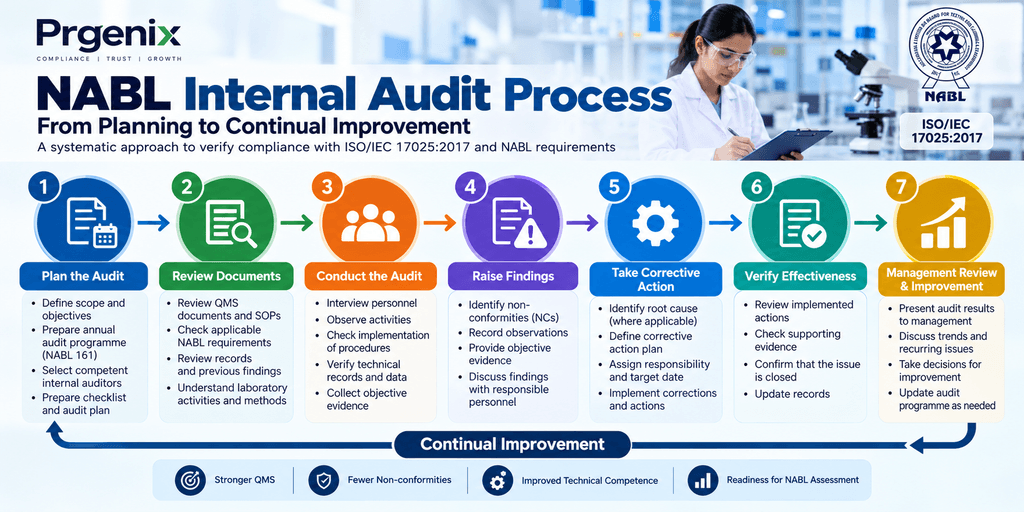
How can a laboratory prepare for a NABL assessment using the checklist?
Use the internal audit as a simulated NABL assessment.
A practical three-stage approach is:
Stage 1 — Document Review: Verify the current QMS documents, procedures, forms, methods and records.
Stage 2 — Implementation Audit: Interview personnel, observe activities and sample actual records.
Stage 3 — Technical Traceability: Select representative samples, equipment and reports and trace them through the complete testing/calibration process.
Before the NABL assessment, confirm that previous internal-audit NCs, corrective actions and management-review actions have been properly addressed.
The objective is not to produce a “zero finding” audit at any cost. The objective is to identify weaknesses while the laboratory still has time to correct them.
Free NABL Internal Audit Checklist — Suggested Template
A practical Excel or Word checklist should contain these columns:
| Sl. No. | Audit Area | Requirement / Question | Objective Evidence | Conformity | NC / Observation | Corrective Action | Responsibility | Target Date | Closure / Effectiveness |
|---|---|---|---|---|---|---|---|---|---|
| 1 | Impartiality | Are impartiality risks identified and controlled? | Risk register | ||||||
| 2 | Personnel | Are personnel competent and authorised? | Training/competence records | ||||||
| 3 | Equipment | Is equipment calibrated/verified as applicable? | Certificates/records | ||||||
| 4 | Methods | Are current approved methods being used? | Method/worksheet | ||||||
| 5 | Sample Handling | Is sample traceability maintained? | Receipt/register | ||||||
| 6 | Measurement | Is uncertainty evaluated where applicable? | MU file | ||||||
| 7 | QC | Are QC activities planned and reviewed? | QC records | ||||||
| 8 | Reporting | Are reports reviewed and authorised? | Test reports | ||||||
| 9 | NC/CAPA | Are non-conforming work and corrective actions controlled? | CAPA records | ||||||
| 10 | Management Review | Are internal-audit results used as an input? | MRM records |
This table can be expanded according to the laboratory’s discipline, scope and applicable technical requirements.
Frequently Asked Questions

Q1. Is internal audit mandatory for NABL accreditation?
Answer: For laboratories operating under ISO/IEC 17025:2017, internal audit is part of the management-system requirements. NABL 161 provides guidance for planning and conducting internal audits and requires the audit programme to cover applicable management-system elements and laboratory activities throughout the year.
Q2. How often should a NABL internal audit be conducted?
Answer: NABL 161 states that internal audits should be conducted periodically according to a predetermined schedule and procedure. Its guidance says the audit programme should cover each element or activity of the management system at least once a year, including applicable activities, personnel, procedures and test methods.
Q3. Who can conduct an ISO 17025 internal audit?
Answer: Internal auditors should be competent for the audit they perform. NABL 161 states that auditors should understand the technical requirements of the activities being audited, be trained in auditing techniques and understand the applicable ISO standard and NABL accreditation requirements.
Q4. Does a NABL internal audit need to cover technical activities?
Answer: Yes. A meaningful audit should cover more than QMS documentation. NABL 161 states that the audit programme should cover applicable activities, personnel, procedures and test methods. Technical implementation should therefore be examined according to the laboratory’s scope and applicable requirements.
Q5. What records should be maintained after a NABL internal audit?
Answer: A laboratory should retain evidence of its audit programme, audit plan, auditors, areas audited, objective evidence, findings, corrective actions and follow-up or effectiveness verification as applicable. The records should demonstrate that the audit was properly planned, conducted, reported and followed through.
Q6. Can one checklist be used for every NABL laboratory?
Answer: A master checklist can be used, but it should be customised to the laboratory’s scope. Testing and calibration laboratories have different technical activities, risks, methods and equipment, so the checklist should reflect the laboratory’s actual operations and applicable NABL requirements.
Final Practical Advice
A good NABL Internal Audit Checklist is more than a list of ISO clauses. It is an audit trail connecting requirements to actual laboratory practice.
For every important requirement, ask three questions:
- What does the procedure require?
- What is actually happening?
- What objective evidence proves it?
If the answers do not match, the internal audit has found something valuable.
ISO/IEC 17025:2017 remains the current ISO standard for testing and calibration laboratories, and NABL continues to accredit testing and calibration laboratories against ISO/IEC 17025. NABL’s published 2026 documents and amendments should therefore be checked before each audit programme is finalised.
For laboratories preparing for NABL accreditation, surveillance or reassessment, Prgenix provides structured NABL accreditation consulting, QMS implementation, internal audit, training, CAPA and assessment-readiness support.
Request a NABL Internal Audit / Gap Assessment →
Disclaimer: This article is for informational purposes and does not constitute legal or accreditation advice. For tailored guidance, consult Prgenix.
About the Author: Reviewed by V. Pathak, Lead Compliance Consultant at Prgenix, with experience in NABL accreditation, ISO/IEC 17025:2017 implementation, laboratory QMS, internal audits and regulatory compliance.