India’s Digital Personal Data Protection (DPDP) Act, 2023 is no longer a distant regulation—it’s a ticking clock. With the Data Protection Board of India expected to begin enforcement between November 2026 and March 2027, Edutech, Healthtech, and Fintech companies that process personal data at scale are in the compliance hot seat.
If you’re a founder, compliance officer, CTO, or DPO at an Indian startup in these sectors, this guide is built for you. We’ll walk through a practical, sector-wise DPDP Act compliance checklist mapped to actual statutory requirements—and show you how to operationalize it without burning your engineering or legal bandwidth.
Want a ready-to-use compliance framework? We’ve built a https://prgenix.com/shop/dpdp-compliance-checklist-template-mapped-to-act-requirements/ that covers all sections below with actionable task lists, audit trails, and sector-specific addendums.
Why Edutech, Healthtech & Fintech Are Priority Sectors?
The DPDP Act applies to all entities processing digital personal data within India. However, Edutech, Healthtech, and Fintech face heightened scrutiny because they process sensitive personal data at volume and fall under additional sectoral regulators:
| Sector | Data Type | Additional Regulator | DPDP Risk Level |
|---|---|---|---|
| Edutech | Student PII, academic records, behavioral data, parental data | UGC, AICTE, NCPCR | High |
| Healthtech | Health records, diagnostics, telemedicine data | MCI/NMC, ICMR, MoHFW | Critical |
| Fintech | Financial data, KYC, biometrics, transaction history | RBI, SEBI, IRDAI | Critical |
These sectors also process data belonging to children and vulnerable groups (Edutech especially), which triggers Chapter IV of the DPDP Act – arguably the most stringent section.
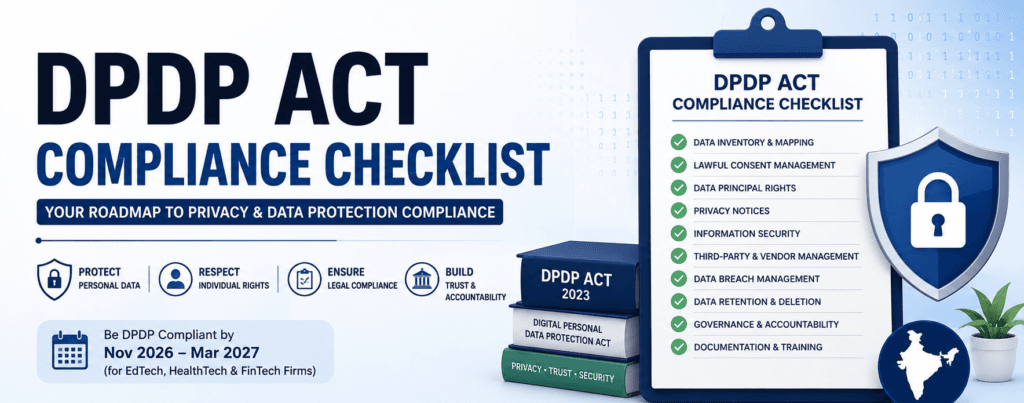
DPDP Act 2023: Core Compliance Pillars
Before diving into sector-specific checklists, understand the seven statutory pillars every organization must address:
1. Lawful Basis for Processing (Section 4 & 5)
- Obtain verifiable consent before processing personal data
- Consent must be free, specific, informed, unconditional, and unambiguous
- Maintain granular consent records with timestamps
2. Data Principal Rights (Section 12-14)
- Right to access, correction, erasure, and grievance redressal
- Must provide easy-to-use mechanisms (not just email)
- Response timeline: 72 hours for grievances, reasonable time for other requests
3. Data Fiduciary Obligations (Section 8-11)
- Purpose limitation and data minimization
- Maintain accurate and updated data
- Implement reasonable security safeguards
- Notify the Board and affected Data Principals of personal data breaches
4. Children’s Data & Consent Managers (Section 9-10)
- Verifiable parental consent for children (under 18)
- No tracking, behavioral monitoring, or targeted advertising at children
- Consent Managers must be registered with the Board
5. Cross-Border Data Transfers (Section 16)
- Government will notify permitted countries for data transfers
- Until then, assess transfer mechanisms carefully
6. Significant Data Fiduciaries (Section 10)
- Designate a Data Protection Officer (DPO)
- Conduct Data Protection Impact Assessments (DPIA)
- Appoint an independent data auditor
- Maintain periodic compliance audits
7. Penalties (Section 33)
- Breach of children’s data: ₹200 crore
- Failure to implement security safeguards: ₹250 crore
- General non-compliance: ₹50-150 crore
Sector-Wise DPDP Compliance Checklist

🎓 EDUTECH COMPLIANCE CHECKLIST
Edutech platforms collect massive amounts of student data—names, addresses, academic performance, biometric attendance, behavioral analytics, and often parental financial data for fee payments.
Immediate Actions (Q3 2026)
- [ ] Audit all data collection points: Registration forms, LMS interactions, proctoring software, payment gateways
- [ ] Map data flows: Identify where student data originates, where it’s stored, and which third parties process it (AWS, payment providers, analytics tools)
- [ ] Age-gating implementation: Verify user age at onboarding; route minors to parental consent workflow
- [ ] Parental consent mechanism: Build verifiable consent flow (OTP to parent mobile, document upload, or digital signature)
- [ ] Consent management platform: Deploy granular consent toggles for marketing, analytics, and third-party sharing
Technical & Policy Actions (Q4 2026)
- [ ] Privacy policy overhaul: Rewrite in clear, plain language (Section 6); include specific purposes for each data type
- [ ] Data retention schedules: Define and automate deletion timelines for inactive student accounts
- [ ] Student rights portal: Self-service dashboard for access, correction, and deletion requests
- [ ] Vendor DPA agreements: Ensure all third-party processors (cloud, CRM, analytics) sign Data Processing Agreements
- [ ] Security hardening: Encrypt data at rest and in transit; implement role-based access control (RBAC)
Governance (Q1 2027)
- [ ] Appoint DPO: If classified as Significant Data Fiduciary (likely for platforms with >5M users)
- [ ] DPIA for new features: Any feature involving facial recognition, behavioral tracking, or third-party sharing
- [ ] Incident response plan: 72-hour breach notification workflow to Board and affected users
Edutech-Specific Risk: Proctoring software that captures video/audio may be classified as surveillance under DPDP. Ensure explicit consent and data deletion post-exam.

🏥 HEALTHTECH COMPLIANCE CHECKLIST
Healthtech processes sensitive health data—the most protected category under DPDP. Combined with the Digital Information Security in Healthcare Act (DISHA) and ICMR guidelines, compliance is multi-layered.
Immediate Actions (Q3 2026)
- [ ] Data classification: Categorize health records, diagnostic images, doctor-patient chat logs, and wearable data
- [ ] Consent layer for health data: Separate, explicit consent for each purpose (consultation, research, insurance sharing)
- [ ] Anonymization protocols: For analytics and AI training, implement irreversible anonymization (not just pseudonymization)
- [ ] Telemedicine audit: Review video consultation recordings storage and retention against DPDP + Telemedicine Guidelines 2020
Technical & Policy Actions (Q4 2026)
- [ ] End-to-end encryption: For all health data, including backups
- [ ] Access logs: Immutable audit trails for who accessed which patient record when
- [ ] Data localization: Ensure primary health data storage remains in India (pending government notifications)
- [ ] Breach notification system: Automated alerts for unauthorized access; 72-hour reporting workflow
- [ ] Patient rights portal: Allow patients to download their complete health record in machine-readable format
Governance (Q1 2027)
- [ ] DPO appointment: Mandatory for hospitals, diagnostic chains, and health aggregators
- [ ] DPIA for AI/ML models: Any diagnostic AI must assess bias, accuracy, and data privacy risks
- [ ] Business Associate Agreements (BAA): With labs, pharmacies, and insurance partners
- [ ] Staff training: All healthcare staff with data access must complete DPDP awareness certification
Healthtech-Specific Risk: Wearable data (heart rate, sleep patterns) is personal data under DPDP. If linked to identity, it requires full compliance – not just fitness app terms.

💰 FINTECH COMPLIANCE CHECKLIST
Fintech is already heavily regulated by RBI, SEBI, and IRDAI. DPDP adds a parallel compliance layer that often overlaps – but has distinct requirements.
Immediate Actions (Q3 2026)
- [ ] Reconcile RBI KYC vs. DPDP consent: RBI mandates data collection; DPDP mandates consent. Document the legal basis for each data element
- [ ] Consent for credit scoring: Explicit, granular consent before pulling bureau data or alternative data (SMS, app usage)
- [ ] Biometric data handling: Aadhaar eKYC data must not be stored beyond regulatory requirements; implement automatic purging
- [ ] Third-party sharing audit: Map all data shared with NBFCs, insurers, wealth managers, and marketing partners
Technical & Policy Actions (Q4 2026)
- [ ] Consent dashboard: Allow users to view and withdraw consent for specific services (loans, insurance, investments)
- [ ] Data minimization in onboarding: Remove fields not required by RBI/SEBI regulations
- [ ] Transaction data retention: Define retention periods per RBI guidelines; auto-delete after period expiry
- [ ] Cross-border transfer assessment: If using foreign cloud providers (AWS, Azure), ensure data residency compliance
- [ ] API security: Secure all open banking/data sharing APIs with OAuth 2.0 + consent tokens
Governance (Q1 2027)
- [ ] DPO appointment: All RBI-regulated entities with payment systems must designate a senior DPO
- [ ] DPIA for new lending products: Especially those using alternative data (social media, device fingerprinting)
- [ ] Incident response: Coordinate with RBI’s Cyber Security Framework + DPDP breach notification
- [ ] Periodic audits: Independent data auditor review every 12 months for Significant Data Fiduciaries
Fintech-Specific Risk: “Alternative data” (SMS parsing, contact book access) for credit underwriting is under DPDP scrutiny. Ensure explicit consent with clear purpose specification—or risk ₹200 crore penalties.

Compliance Timeline: November 2026 to March 2027
| Phase | Timeline | Focus Area |
|---|---|---|
| Phase 1: Discovery | July – Sept 2026 | Data mapping, gap analysis, vendor audit |
| Phase 2: Implementation | Oct – Dec 2026 | Technical changes, policy updates, consent flows |
| Phase 3: Testing | Jan – Feb 2027 | DPIA, penetration testing, staff training |
| Phase 4: Go-Live | March 2027 | Full compliance, audit readiness, documentation |
Pro Tip: Don’t wait for the Board’s exact enforcement date. The DPDP Act is already law; penalties apply from Day 1 of enforcement.
Common Compliance Gaps to Avoid
Based on early DPDP readiness assessments across Indian startups, these are the top 5 gaps:
- Bundled Consent: Asking for broad consent at signup for all purposes. DPDP requires purpose-specific, granular consent.
- No Consent Withdrawal Mechanism: Users must be able to withdraw as easily as they gave consent. Hidden “email us to delete” doesn’t cut it.
- Ignoring Children’s Data: Platforms with users aged 13-17 often skip parental consent—this is a ₹200 crore mistake.
- Vendor Blind Spots: Using US/EU SaaS tools without Data Processing Agreements or residency assessments.
- No Breach Playbook: Most startups have security tools but no 72-hour notification workflow to the Data Protection Board.

How to Accelerate Compliance: Tooling & Templates
Building a DPDP compliance program from scratch is resource-intensive. Most Edutech, Healthtech, and Fintech startups don’t have dedicated 10-person legal teams.
That’s why we built the – DPDP Compliance Checklist Templates mapped to act requirements.
What’s Inside:
- ✅ Section-by-section checklist mapped to DPDP Act 2023 clauses (Sections 4-33)
- ✅ Sector-specific addendums for Edutech, Healthtech, and Fintech
- ✅ Task assignment matrix with owner, deadline, and evidence fields
- ✅ Audit trail templates for Board inspections
- ✅ Consent flow wireframes and privacy policy templates
- ✅ DPIA template aligned with Data Protection Board expectations
- ✅ Breach notification templates (internal + Board format)
Who is It For:
- Founders and CEOs preparing for investor due diligence
- Compliance officers building their first privacy program
- CTOs and engineering leads implementing technical controls
- DPOs documenting accountability for Board audits
Final Thoughts
The DPDP Act isn’t just another regulation to checkbox – it’s a fundamental shift in how Indian digital businesses handle personal data. For Edutech, Healthtech, and Fintech, the stakes are highest because the data is most sensitive and the regulators are most active.
Start now. Map your data. Fix your consent flows. Document everything. And use proven frameworks to move faster without missing critical requirements.
The companies that treat DPDP compliance as a competitive advantage (trust, transparency, user control) will win in the post-2027 Indian digital economy. Those that treat it as a cost center may not survive the penalties.
Have questions about DPDP compliance for your specific sector? Book a free 30 minutes consultation session with our DPDP experts or reach out through our contact page. We actively respond to implementation queries from Indian startup teams.