For many Indian small businesses, the first question about the Digital Personal Data Protection Act is simple: what will DPDP compliance actually cost?
The answer is not a single government fee or fixed consultancy price. The DPDP Act Compliance Cost for Small Business depends on what personal data your organisation collects, why it collects it, where it stores it, which vendors process it and how mature your existing controls are.
A small retailer, SaaS startup, diagnostic centre, HR consultancy and online education company can therefore have very different compliance requirements.
This guide explains what a small Indian business should budget for, how long implementation can take, what activities actually consume money and manpower, and where businesses commonly overspend.
The discussion reflects the Digital Personal Data Protection Act, 2023 and the Digital Personal Data Protection Rules, 2025 notified by the Ministry of Electronics and Information Technology (MeitY). The Rules provide for phased commencement, so businesses should plan ahead rather than wait for every provision affecting them to become operational.
What is the DPDP Act Compliance Cost for Small Business?
There is no government-prescribed standard price for DPDP compliance. For a small business, the practical cost usually consists of internal staff time, privacy documentation, data mapping, process changes, security improvements, vendor reviews, employee training and, where required, external professional support.
The cost is therefore determined by the complexity of the organisation rather than simply its employee count.
For example, a 20-person SaaS company processing thousands of customer records may require considerably more work than a 50-person offline business that processes limited personal data.
What determines your actual cost?
The main cost drivers are:
- Number and types of personal-data processing activities
- Number of websites, applications and databases
- Customer, employee and vendor data handled
- Third-party processors and cloud platforms
- Existing privacy and information-security controls
- Data retention and deletion practices
- Consent and notice mechanisms
- Employee awareness and training
- Incident-response capability
- Complexity of contracts and vendor arrangements
A useful principle is: do not budget DPDP compliance by headcount alone. Budget it by data-processing complexity.
How Much Should a Small Business Budget for DPDP Compliance?
There is no statutory tariff for DPDP implementation. Any commercial price quoted by a consultant is therefore a professional-service price, not a government-mandated DPDP fee.
For internal planning, a small organisation can divide expenditure into three broad levels.
| Compliance Situation | Typical Work Involved | Relative Budget |
|---|---|---|
| Basic readiness | Data inventory, privacy notice, policies, basic rights process, staff awareness | Low |
| Structured implementation | Gap assessment, RoPA/data mapping, policies, vendor review, consent processes, incident response and training | Medium |
| Complex implementation | Multiple applications, extensive vendor ecosystem, technical remediation, DPIA-type risk assessments, extensive evidence and independent audit | Higher |
These are planning categories, not official market prices or government fee bands.
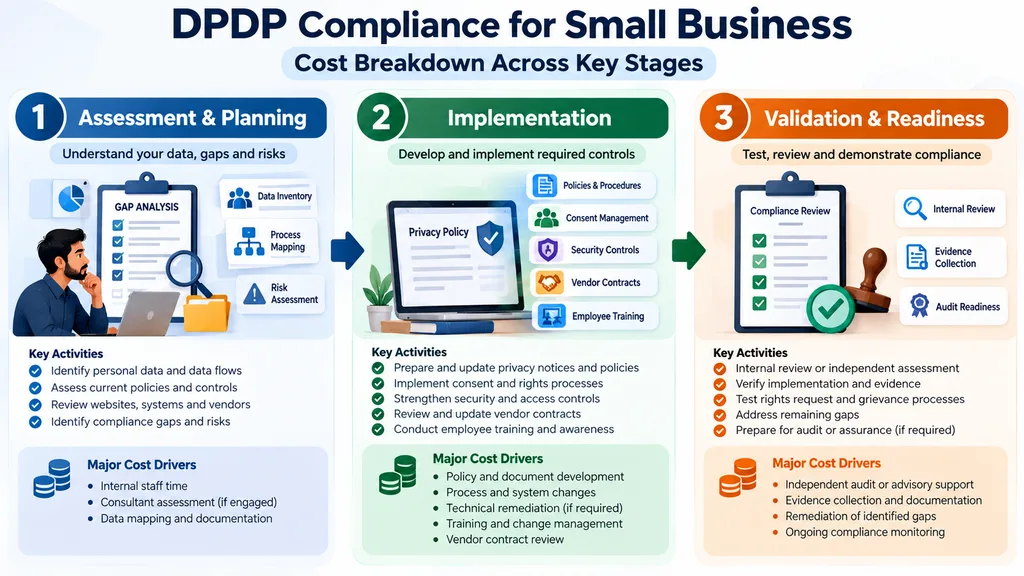
Where Does the Money Actually Go?
A realistic DPDP budget should account for:
1. Assessment and Gap Analysis
An initial assessment identifies what personal data is collected, how it is processed and where the organisation currently falls short.
2. Documentation
This can include privacy notices, internal policies, data-retention rules, grievance processes, incident-response procedures, consent mechanisms and vendor requirements.
3. Data Mapping
Think of this as creating a map of your personal-data journey: collection → use → sharing → storage → retention → deletion.
4. Technical Remediation
Some organisations may need improvements to access controls, authentication, logging, backup practices, deletion mechanisms or other security controls.
5. Vendor Management
Your business may rely on payroll software, CRM platforms, cloud services, marketing tools, accountants or other processors. Their role in your data flows needs to be understood and appropriately governed.
6. Training
Employees need to understand what personal data they handle and what they should do when someone requests access, correction, withdrawal of consent or raises a complaint.
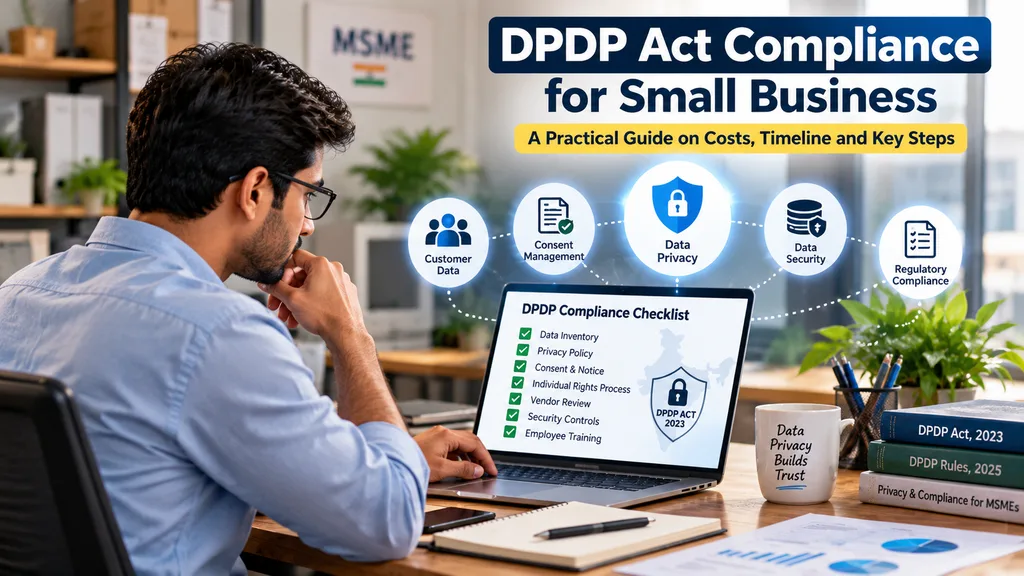
Can a Small Business Become DPDP Compliant Without Spending a Fortune?
Yes, particularly when the organisation already has basic information-security and process controls.
The mistake is to start by purchasing expensive technology.
DPDP compliance is not simply a software purchase. A small business should first understand its processing activities and obligations, then determine which controls are actually necessary.
A Practical Low-Cost Starting Approach
Start with these seven activities:
- Identify personal data collected from customers, employees and other individuals.
- Document why each category of data is processed.
- Review website forms, applications and offline forms.
- Prepare clear privacy notices.
- Establish processes for handling Data Principal requests and grievances.
- Review vendors that process personal data on your behalf.
- Train employees on privacy and incident handling.
Only after completing this assessment should the organisation decide whether additional technology or specialist support is necessary.
Think of it like an ISO audit: you should identify the gap before buying the solution.
How Long Does DPDP Compliance Take for a Small Business?
A straightforward small business can often establish a basic compliance framework within several weeks. A more complete implementation can take several months where data mapping, contracts, technical remediation, multiple applications or extensive vendor reviews are involved.
The final timeline depends on the starting position of the organisation.
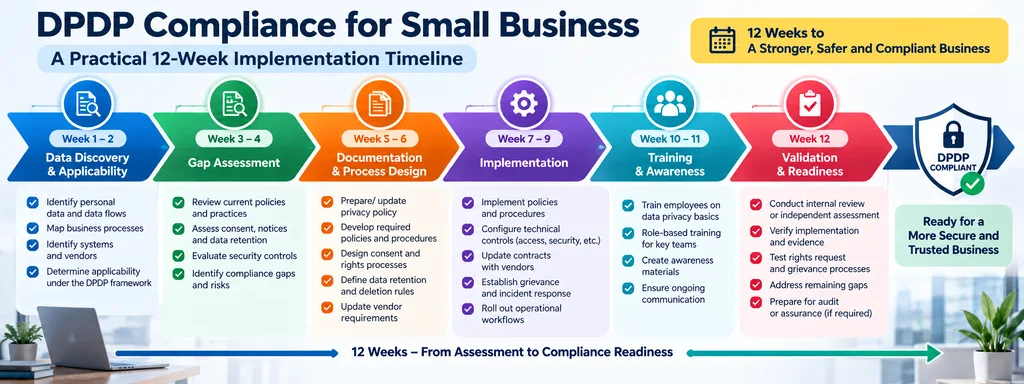
A Practical Implementation Timeline
Week 1–2: Applicability and Discovery
- Identify business processes involving personal data.
- Identify categories of Data Principals.
- Identify systems, applications and vendors.
- Establish responsibility for privacy compliance.
Week 3–4: Gap Assessment
Review:
- Privacy notices
- Consent mechanisms
- Data retention
- Access controls
- Vendor arrangements
- Grievance handling
- Security safeguards
- Incident-response processes
Week 5–7: Documentation and Process Design
Develop or update the required policies, notices, registers, procedures and operational controls.
Week 8–10: Implementation
Train personnel, implement workflows, address identified technical gaps and collect evidence.
Week 11–12: Validation
Conduct an internal review or independent compliance assessment and close remaining gaps.
This 8–12 week model is a practical planning example, not a statutory deadline. Organisations with complex environments may need substantially longer.
Prgenix currently describes its own DPDP implementation methodology as a time-bound, evidence-driven process and advertises a 90-day implementation/certification pathway for suitable organisations.
What Should be Included in a Small Business DPDP Compliance Checklist?
A useful checklist should cover governance, legal/process controls and technical safeguards.
Governance
- Identify the organisation’s role as a Data Fiduciary where applicable.
- Assign internal responsibility for privacy compliance.
- Maintain appropriate records of processing activities.
- Establish escalation and accountability mechanisms.
Privacy and Individual Rights
- Clear privacy notices
- Consent mechanisms where consent is the applicable basis
- Consent withdrawal process
- Mechanism for exercising applicable Data Principal rights
- Grievance redressal process
- Appropriate retention and erasure processes
The final Rules specifically emphasise clear, standalone and understandable notices, including information about the personal data collected, purposes of processing and mechanisms for withdrawing consent and exercising rights.
Security
- Access control
- Authentication
- Reasonable security safeguards
- Backup and recovery
- Logging and monitoring where appropriate
- Incident management
- Data deletion controls
The objective is not to buy every security product available. Controls should be proportionate to the organisation’s processing activities and risks.
Third Parties
Prepare a list of external organisations that receive or process personal data.
For example:
- Cloud service providers
- Payroll platforms
- CRM providers
- Email marketing platforms
- IT support providers
- SaaS applications
- Consultants and contractors
Then determine what contractual and operational controls are required.
Does the DPDP Act Apply to Small Businesses and MSMEs?
The fact that a business is an MSME or startup does not, by itself, mean that it can ignore the DPDP framework. The key question is whether the organisation processes digital personal data within the scope of the Act.
A small organisation may process personal data through something as simple as:
- Website enquiry forms
- WhatsApp/customer communications
- Employee records
- Recruitment applications
- Customer databases
- CCTV systems connected to digital systems
- Billing software
- Email databases
- Mobile applications
The organisation should therefore assess its actual processing activities instead of assuming that “small business” means “low compliance obligation”.
The DPDP Rules 2025 were notified by MeitY on 13 November 2025. The notification provides different commencement periods for different Rules, including provisions taking effect immediately, after one year and after eighteen months.
That phased approach gives organisations an opportunity to prepare, but it should not be mistaken for a reason to postpone governance work.
What is the Cheapest Way to Become DPDP Compliant?
The cheapest sustainable approach is usually risk-based implementation, not purchasing a large compliance package.
A small business can control cost by following this sequence:
Step 1: Start with a Data Inventory
List every major source of personal data.
Step 2: Eliminate Unnecessary Collection
If information is not needed for a legitimate business purpose, question why it is being collected.
Step 3: Fix Privacy Notices and Forms
Make notices understandable and consistent with the applicable DPDP requirements.
Step 4: Establish Operational Processes
Create simple workflows for rights requests, grievances, consent withdrawal and data deletion where applicable.
Step 5: Review Vendors
Do not overlook third-party SaaS platforms. A business can have excellent internal policies while its vendors create significant exposure.
Step 6: Strengthen Security Proportionately
Address obvious weaknesses first, such as excessive access privileges, weak account controls or poor data-retention practices.
Step 7: Test the System
Ask a practical question: “If a customer raises a privacy request tomorrow, can our organisation demonstrate exactly what happens from receipt to closure?”
If the answer is no, the compliance system is not operational yet.
DPDP Compliance Cost vs. Cost of Doing Nothing
A useful management decision is not simply “How much will compliance cost?”
Ask instead: “What would it cost us if our processes failed when a customer, employee, enterprise client or regulator questioned our data practices?”
For a small organisation, the commercial consequences can include additional remediation, contractual disputes, customer concerns, delayed enterprise onboarding and regulatory exposure.
The DPDP Act contains a statutory penalty framework, including potentially substantial penalties for specified breaches. The actual consequence depends on the applicable provision and circumstances; businesses should therefore avoid relying on generic internet claims about a fixed “DPDP fine”. The authoritative source remains the Act and applicable Rules published by MeitY.
For this reason, compliance expenditure should be viewed as a governance and risk-management investment rather than merely a documentation expense.
Key Takeaways
DPDP compliance for a small business does not have a fixed government price.
Your cost depends mainly on the complexity of your personal-data processing, existing controls, technology environment, vendors and level of external support required.
A sensible implementation sequence is: Data inventory → Gap assessment → Documentation → Process implementation → Security improvements → Training → Internal validation.
Many straightforward small-business environments can establish a basic framework within weeks, while more complex organisations may require several months.
The best way to control cost is to identify the actual compliance gaps before buying technology or commissioning extensive documentation.
Frequently Asked Questions

Q1. Is DPDP compliance mandatory for small businesses in India?
Answer: The DPDP framework applies according to its scope and the processing of digital personal data, rather than simply the size of an organisation. Small businesses and MSMEs should assess their actual processing activities and applicable obligations instead of assuming that they are exempt because of their size.
Q2. How much does DPDP compliance cost for an MSME?
Answer: There is no fixed statutory DPDP compliance fee for an ordinary business. Cost depends on data-processing complexity, systems, vendors, existing controls, documentation, technical remediation and whether professional assistance is required.
Q3. How long does DPDP compliance take?
Answer: A straightforward small-business implementation may be planned over approximately 8–12 weeks, while businesses with multiple systems, vendors or significant remediation requirements may require several months. This is a practical project estimate, not a statutory deadline.
Q4. Does every small business need a Data Protection Officer?
Answer: No. A Data Protection Officer is not automatically required for every small business. The requirement depends on the organisation’s classification and applicable obligations under the DPDP framework. Each organisation should assess whether the relevant conditions apply to it.
Q5. Does DPDP compliance require ISO 27001 certification?
Answer: No general requirement makes ISO/IEC 27001 certification mandatory for every organisation solely because it is subject to the DPDP Act. Organisations should implement appropriate security safeguards based on their processing activities, systems and applicable legal requirements.
Q6. Can a small business manage DPDP compliance without a consultant?
Answer: Yes. Organisations with straightforward operations may manage many activities internally. External consultants can be useful where the business needs independent assessment, data mapping, policy development, implementation support, vendor review, technical coordination or audit readiness.
If you are unsure what DPDP Act Compliance Cost for Small Business means for your specific organisation, do not start by buying a generic privacy package.
Start with a structured assessment of your data flows, existing controls and compliance gaps.
Prgenix can help you identify the actual work required, prioritise remediation and develop an evidence-based DPDP compliance roadmap suited to your organisation.
Explore Prgenix DPDP Audit & Certification Services
About the Author: Reviewed by V. Pathak, Lead Compliance Consultant, Prgenix, with expertise in Indian regulatory compliance, data-protection governance and management-system implementation.
Disclaimer: This article is for informational purposes and does not constitute legal advice. For tailored guidance, consult Prgenix.