This article translates law into an executable roadmap for DPDP compliance. It explains what the Digital Personal Data Protection (DPDP) Act 2023 and the DPDP Rules 2025 require, how organizations should operationalize breach reporting, what it means to be a Significant Data Fiduciary (SDF), and how to deliver data-principal rights (access, erasure, portability) in a defensible, auditable way.
Quick Legal Snapshot
- Primary law: Digital Personal Data Protection Act, 2023 — applies to processing of digital personal data within India and extraterritorially to data of Indian data principals.
- Operational rules: Digital Personal Data Protection Rules, 2025 — notified by MeitY (Nov 2025) and give operational timelines, breach protocols, and rights procedures. Many key provisions are being phased in (some rules come into force immediately; others after 12–18 months).
- Enforcer: Data Protection Board of India (DPBI) — receives breach notifications, adjudicates complaints, and can levy civil penalties.
- Penalties: Staggered, high-value regime — up to ₹250 crore for serious security failures; other caps (e.g., up to ₹200 crore for certain breach-notification/children-related failures) and lower caps for lesser violations. These are maximums — the Board will consider severity, recurrence, mitigation.
(Those are the foundation stones. The rest of the guide shows HOW to comply, not just what the law says.)
Significant Data Fiduciary (SDF)
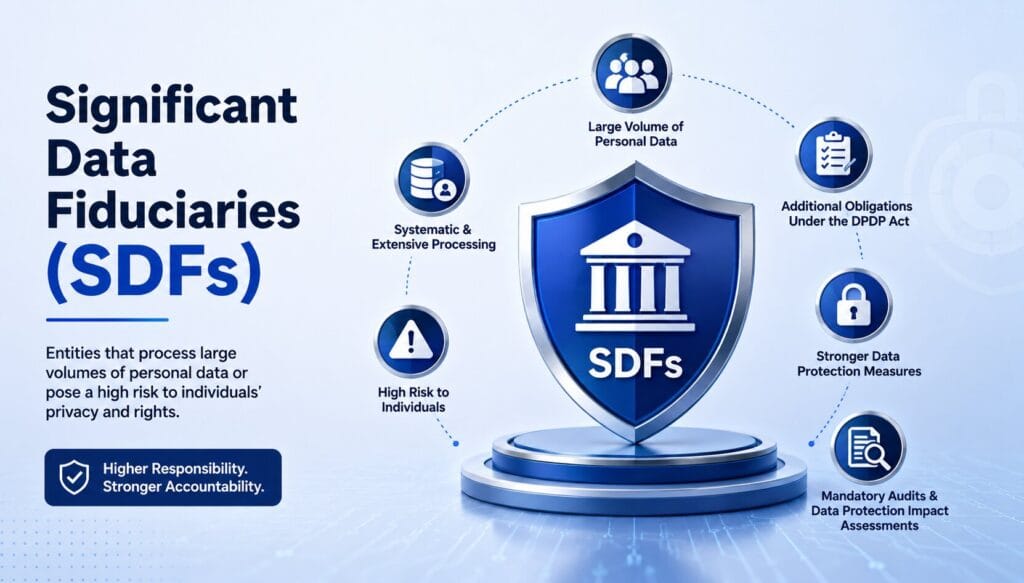
1. What is an SDF?
The Act allows the Central Government to notify certain data fiduciaries or classes of fiduciaries as Significant Data Fiduciaries (SDFs) based on factors such as volume and sensitivity of data processed, risk to data principals’ rights, potential impact on sovereignty or electoral democracy, and cross-border transfers. This is not voluntary — designation is by notification.
2. Core additional obligations (typical SDF requirements)
While exact obligations may vary with the notification, the Rules and guidance commonly require SDFs to:
- Appoint and publish a Data Protection Officer / contact and maintain a public grievance mechanism.
- Conduct DPIAs (Data Protection Impact Assessments) for high-risk processing and maintain written DPIA records.
- Undergo periodic independent audits (data protection audits) and submit significant findings to the Board within required timelines.
- Adopt stronger technical and organisational measures — encryption, access control, logging/retention, segregation of duties, secure SDLC, etc.
- Maintain higher transparency and accountability (e.g., publish processing notices, retention periods, categories of data, third-party disclosures).
Practical takeaway: If there’s any chance your organisation will be designated an SDF (large user base, healthcare/finance/telecom, election-related data, large-scale children’s data), start treating yourself as an SDF today: DPIAs, independent auditor relationships, tech hardening, and a 24/7 incident response capability.
Breach Reporting Protocols
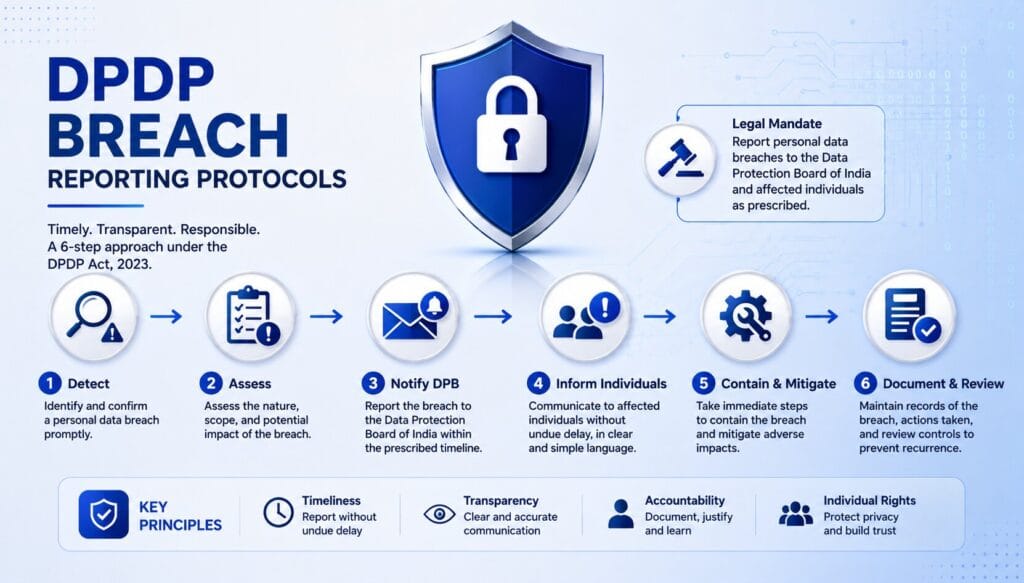
The Rules make breach reporting mandatory and fast. Practically, compliance is about detection, triage, containment, assessment, and timely notification. The Rules require immediate notification to affected Data Principals and a detailed report to the Board within 72 hours of becoming aware (subject to Board extensions); exact wording in guidance directs “without undue delay” for individuals and detailed follow-up to the DPBI within 72 hours.
1. Detection & Internal Escalation (Always On)
- Logging & monitoring: centralised logs, SIEM, EDR, user-behaviour analytics.
- Automated alerts + human triage: ensure alerts escalate to a named incident lead 24/7.
- Incident classification playbook: determine if event is a notifiable personal data breach (exposure of personal data that can cause harm, or likely to materially risk rights). (If in doubt, treat as notifiable.)
2. Immediate Containment (First 2–6 Hours)
- Segregate affected systems, revoke credentials, rotate keys, isolate network segments.
- Initiate forensic capture (disk images, volatile memory) and ensure chain-of-custody for evidence.
3. Triage: Scope, Data Types, & Harm Assessment (Within 24 Hours)
- Identify which data elements were involved (identifiers, financial, health, sensitive).
- Estimate number of affected individuals and potential harms (financial loss, identity theft, reputational, physical risk).
- Identify whether children’s data are involved — that triggers higher scrutiny/penalties.
4. Notification Obligations & Timings
- Notify affected Data Principals “without undue delay” — i.e., as soon as practical consistent with accurate information and mitigation steps. Public-facing communications and direct notices should be prepared quickly.
- Notify the Data Protection Board (DPBI) with a detailed report within 72 hours of the organisation becoming aware of the breach (the 72-hour window begins on awareness, not on when the breach occurred). The Board may permit a time extension in specific cases.
What to include in the 72-hour report (minimum):
- Date/time of detection and estimated breach window.
- Description of the nature and scope (data categories, number of principals affected).
- Likely root cause (initial findings).
- Mitigation steps already taken and planned (containment, communication, technical remediation).
- Contact point for further questions (DPO/contact details).
- Any regulatory or sectoral overlaps (RBI, IRDAI, CERT-In) and concurrent notifications.
5. Public Communications & Remediation
- Provide clear, plain-language notices to individuals: what happened, what data, what you’ve done, next steps, recommended actions for the data principal (password resets, credit monitoring).
- Offer remediation consistent with harm (covering costs where appropriate).
- Preserve forensic data to support subsequent Board inquiries.
6. Post-Incident: Learn & Harden
- Conduct a formal post-incident review (root cause analysis), update DPIA, revise controls, and where necessary, notify Board of remedial audit results.
Template — Short breach notification to DPBI (starter):
Subject: Data breach notification — [Organisation] — [Date detected]
- Brief description & estimated detection time.
- Data categories & estimated number of affected principals.
- Immediate containment steps taken.
- Current remediation & next actions.
- Contact: [DPO name, email, phone].
(Submit fuller report within 72 hours with forensics and mitigation plan.)
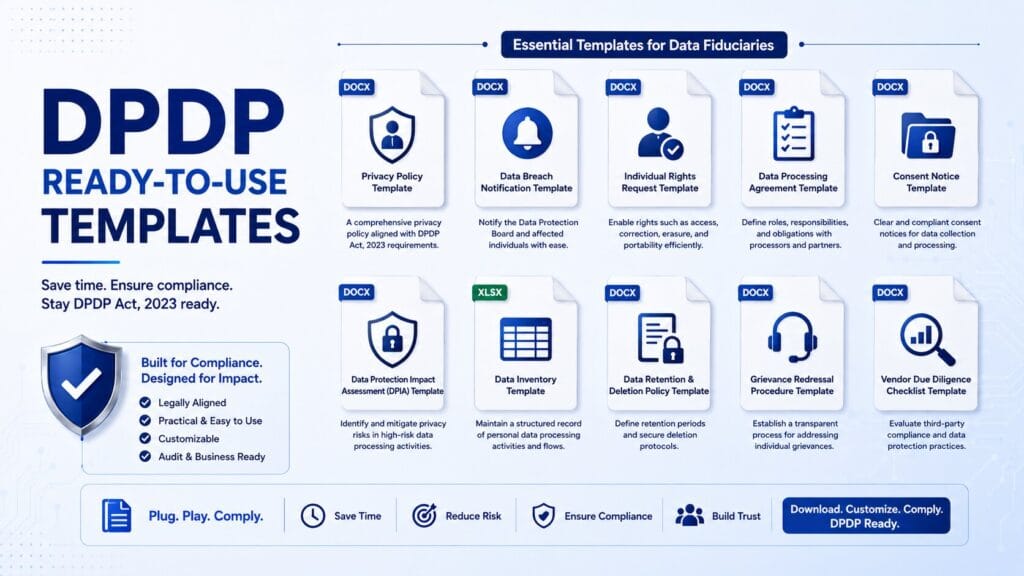
(Full template and checklist included at the end of this article.)
Rights Enablement
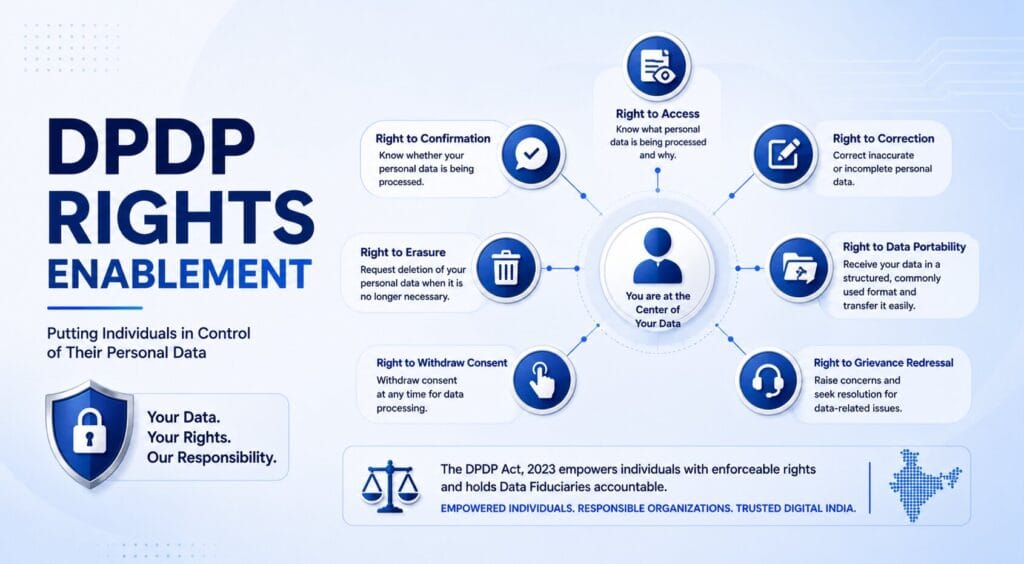
The Act and the Rules give data principals actionable rights. The Rules set specific operational expectations and a maximum response timeline — broadly 90 days to respond to rights requests (the Rules specify deadlines and require clear grievance redressal processes).
1. Core Rights and What They Require You to Deliver
- Right of access: provide a portable, intelligible summary of what personal data you hold about a principal, categories, purpose, third-party disclosures, retention period, and copy of the data.
- Right to correction/rectification: update inaccurate or incomplete personal data on request, and notify earlier recipients where necessary.
- Right to erasure (right to be forgotten): delete personal data when lawful basis no longer exists or retention period lapses, subject to statutory exceptions (e.g., legal obligations, court orders, public interest).
- Right to data portability: provide a data principal their data in a structured, commonly used, machine-readable form to enable transfer to another fiduciary (the Rules give practical instructions).
- Right to withdraw consent: where processing is based on consent, allow an easy withdrawal mechanism and stop processing as required.
2. How to Operationalise Rights — Step-by-Step
- Single-entry intake channel: web form, email, or portal with identity verification checkpoint. Provide standard acknowledgement within 24–48 hours.
- Authenticate requestor: strong authentication proportional to sensitivity (2FA, government ID + OTP, account-level verification). For portability/access, keep a record of the authentication method.
- Automated vs manual fulfilment: build automated APIs for common requests (access, portability) to scale; use manual review for sensitive cases (erasure involving third-party disclosures, litigation holds).
- Log & track each request: unique ticket ID, SLA countdown, escalation path to legal/DPO. The Rules require grievance redressal and timeliness; maintain evidence for Board audits.
- Exceptions & redaction: establish legal exceptions and redaction rules (do not disclose third-party data without consent, preserve public interest exceptions). Document decisions.
- Notification to downstream recipients: if you rectify/erase data, send notice to controllers/processors who previously received it when appropriate.
- Retention & deletion proof: maintain deletion logs, hashes, and certificates of destruction — these are crucial if the Board audits your compliance.
3. Timeframes & SLAs
- Acknowledge quickly (recommended 24–48 hours).
- Substantive response within the Rules’ upper limit (90 days) — shorter internal SLAs (7–30 days depending on complexity) are recommended to ensure you don’t miss the regulated deadline. Document any lawful reason for a longer response.
Practical Compliance Roadmap
Phase A — Rapid Foundations (0–3 Months)
- Data map: create a data inventory (what, where, why, retention, flows, third-party recipients).
- Gap analysis: map current controls to Act/Rules obligations (consent mechanics, DPIA, breach response, rights processes, DPO).
- Governance: appoint a DPO (if required or as best practice), set up privacy steering committee, publish privacy notice.
Phase B — Implement Controls (3–9 Months)
- DPIA program for high-risk processing; document impact and mitigation (especially for SDF candidates).
- Incident response & SOC capabilities: logging, SIEM, playbooks, tabletop exercises; breach notification templates.
- Consent & UX changes: standalone, modular consent notices; proof-of-consent logs; consent manager where needed.
- Vendor contracts: update processor agreements to include DPDP-specific obligations (audits, sub-processor lists, data return/destruction clause).
Phase C — Operational Maturity (9–18 Months)
- Independent audits (especially if notified as SDF).
- Automated rights-fulfilment APIs and a customer portal for access/portability/erasure.
- Continuous monitoring & reporting to the Board (where required) and to senior management. Maintain evidence trails for any Board inquiry.
Technology & Controls Checklist
- Data discovery & cataloguing tools (sensitive-data tagging)
- Role-based access control + least privilege + periodic access reviews
- Encryption at rest & in transit; key management & rotation
- Secure backups & immutable logging (with retention policy)
- Endpoint detection & response (EDR) + SIEM + anomaly detection
- Incident response orchestration & forensic readiness (forensic images, chain-of-custody)
- Consent management platform (CMS) and audit logs
- Rights request portal + identity-proofing mechanisms
- Vendor risk management & processor audit rights
(Implement with measurable KPIs — detection time, time-to-containment, rights SLA compliance rate.)

Penalties & Enforcement
- The DPBI can levy large penalties. Failure to maintain reasonable security safeguards can attract fines up to ₹250 crore; failure to notify the Board/affected principals or breaches relating to children can attract fines up to ₹200 crore; other contraventions have lower caps. Enforcement will consider mitigating steps and remediation taken.
Avoidance Strategy: focus on prevention (controls, DPIAs, encryption), fast detection & transparent remediation (documented forensics, timely DPBI notification), and good-faith cooperation — these materially reduce enforcement risk.
Ready-to-Use Templates
A. Short breach notification to affected Data Principals (consumer-facing)
Subject: Important — [Organisation] data security event and recommended steps
Dear [Name],
We are writing to inform you that on [date/time] we discovered [brief description of incident]. The incident may have exposed the following personal information: [list categories — e.g., name, email, phone, partial PAN].
What we have done: [containment steps; password reset; blocked access; forensic steps].
What you should do: [change passwords, monitor statements, contact us at X; free credit-monitoring if offered].
Contact: [DPO or support email/phone].
We apologise and will update you as we learn more.
— [Signature]
B. Internal incident playbook checklist (first 72 hours)
- Detection logged — assign incident ID.
- Activate IR team (DPO, CISO, Legal, Comms, Forensics).
- Contain & collect evidence — preserve logs & images.
- Initial scope assessment (data categories, affected count).
- Notify Board per rules (prepare 72-hour report).
Board Interactions & Audit-Readiness
- Maintain Evidence Bundles: DPIAs, audit reports, deletion logs, breach forensic reports, rights-request logs, consent records. The Board will expect clear chain-of-evidence.
- Proactive Engagement: if you identify systemic shortcomings, consider voluntary submission of an audit plan or remediation roadmap to the Board — cooperation reduces enforcement risk.
Final Practical Checklist
- Complete a full data inventory + map all third-party flows.
- Run DPIAs for all high-risk processing and prioritise remediation.
- Implement or sharpen incident response (detection → 72-hour reporting) and conduct tabletop exercises.
- Build a rights request portal and implement authentication workflows; set internal SLAs to meet 90-day regulatory maximums.
- Update contracts with processors / sub-processors & ensure audit rights.
- If you qualify or could be notified as SDF, prepare for independent audits and public transparency obligations.
- Designate a DPO (or privacy lead), publish contact details, and create an executive privacy dashboard.
References & Useful Primary Documents
- The Digital Personal Data Protection Act, 2023 — official Gazetted text (MeitY).
- Digital Personal Data Protection Rules, 2025 — official notification (PIB).
- PIB press release summarising Rules (Nov 14–17, 2025).
- Practical guidance & implementation frameworks — KPMG, EY, Grant Thornton briefings and legal analyses.
Start with three things this week: (1) run a data inventory and map the top 5 high-risk processing activities, (2) validate your incident response playbook with a 90-minute tabletop exercise, and (3) ensure you can produce proof of consents, DPIAs, and a deletion log on demand. Those steps will materially reduce regulatory exposure while you implement the rest of the program.
Need enterprise grade DPDP Audit & Certification service by Prgenix – #1 DPDP Audit & Certification service provider & DPDP Consultant contact us today.