Getting NABL accreditation is a major milestone for a laboratory. But the accreditation certificate is not the end of the compliance journey. Maintaining NABL Accreditation means continuing to demonstrate technical competence, impartiality, valid measurement processes, competent personnel, effective quality management and conformity with applicable NABL requirements.
For an Indian testing or calibration laboratory, the real challenge starts after accreditation: keeping the system alive when workloads increase, staff change, equipment is replaced, methods are updated and customers demand faster reports.
This guide explains what happens after NABL accreditation, what laboratories need to monitor continuously, how surveillance and reassessment work, and how to build a practical annual compliance system without turning the QMS into paperwork for paperwork’s sake.
Key Takeaways
- NABL accreditation requires ongoing conformity; it is not a one-time certification exercise.
- NABL’s current FAQ states that accreditation certificates are valid for four years, with annual surveillance and reassessment every two years.
- NABL 131 requires accredited CABs to maintain conformity with applicable standards, NABL criteria, policies and terms and conditions at all times.
- Internal audits and management reviews should be treated as management tools, not merely assessment formalities.
- PT/ILC participation, equipment calibration, measurement uncertainty, personnel competence and document control need continuous attention.
- Significant changes affecting accreditation must be communicated to NABL in accordance with current NABL requirements.
- The laboratory must use the NABL symbol and claim of accreditation carefully and only within its accredited scope.
What is Maintaining NABL Accreditation?
Maintaining NABL Accreditation means continuously demonstrating that the laboratory remains competent and compliant with the applicable accreditation requirements after accreditation has been granted.
For laboratories accredited to ISO/IEC 17025:2017, this means keeping the management system and technical operations effective in practice. NABL 131 specifically requires accredited CABs to carry out their activities in conformity with the applicable standard, NABL-specific criteria, policies and requirements at all times.
In practical terms, accreditation maintenance means the laboratory must continue to prove that its results are technically valid, traceable where applicable, produced by competent personnel and supported by controlled processes and records.
What Happens After NABL Accreditation?
After accreditation, the laboratory enters a continuing assessment cycle rather than simply receiving a certificate and operating independently.
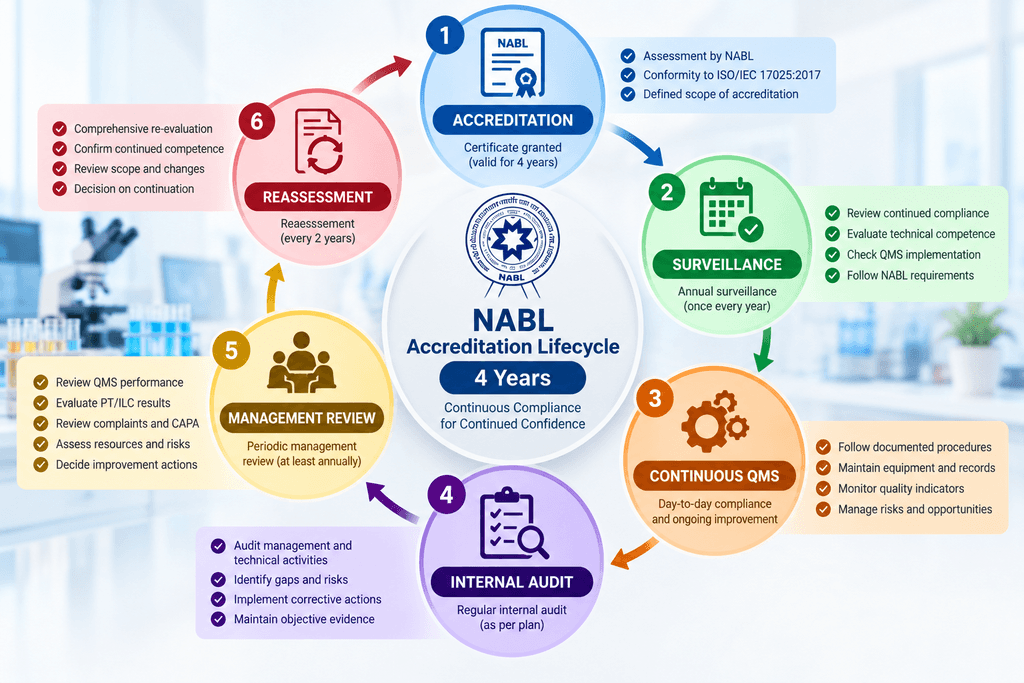
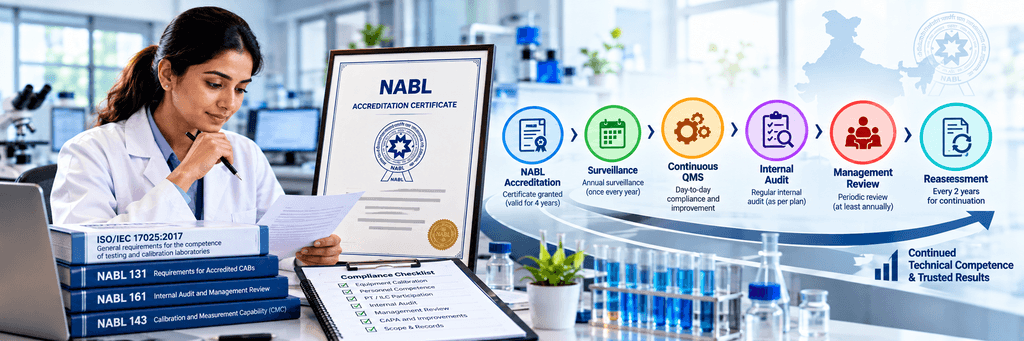
NABL’s current FAQ states that accreditation certificates are valid for four years. NABL conducts annual surveillance to evaluate continued compliance, while reassessment takes place every two years.
The exact assessment arrangements can depend on the accreditation scheme and applicable NABL requirements. Therefore, laboratories should always work from the latest NABL documents applicable to their scope.
A useful way to view the cycle is:
| Activity | What the laboratory should do |
|---|---|
| Daily operations | Follow approved methods, procedures and technical controls |
| Monthly/periodic | Review equipment, environmental conditions, records and quality indicators |
| PT/ILC programme | Participate according to applicable requirements and analyse outcomes |
| Internal audit | Audit the QMS and technical activities systematically |
| Management review | Evaluate QMS performance and decide improvement actions |
| Surveillance | Demonstrate continued conformity to NABL |
| Reassessment | Demonstrate continued competence for continuation of accreditation |
| Scope changes | Obtain appropriate approval/action before making unsupported accreditation claims |
The important point is simple: the laboratory should be assessment-ready throughout the accreditation cycle, not only when NABL announces an assessment.
How Should a Laboratory Maintain ISO/IEC 17025 Compliance?
Maintaining NABL Accreditation starts with keeping ISO/IEC 17025:2017 requirements embedded into normal laboratory operations.
1. Keep the Quality Management System Active
A common post-accreditation failure is allowing the QMS to become a document repository.
The laboratory should routinely review:
- Quality Manual and management-system documents
- SOPs and work instructions
- Forms and records
- Risk and opportunity controls
- Impartiality and confidentiality arrangements
- Corrective action records
- Complaints and feedback
- Internal audit findings
- Management review decisions
- Changes in applicable requirements
NABL’s current document list includes NABL 160A, the 2026 guide for preparing management system documentation for testing and calibration laboratories.
The practical test is simple: if an assessor asks a technician to demonstrate a process, the actual practice should match the approved procedure and the resulting records.
2. Control Equipment, Calibration and Traceability
Equipment status is one of the most visible indicators of technical control.
A laboratory should maintain an equipment master list covering, as applicable:
- Identification number
- Location
- Manufacturer and model
- Calibration status
- Calibration due date
- Intermediate checks
- Maintenance history
- Breakdown and repair records
- Acceptance criteria
- Impact assessment after significant malfunction
For calibration laboratories, measurement uncertainty and calibration capability require particular attention. NABL 143 establishes NABL’s policy concerning Calibration and Measurement Capability (CMC), evaluation of uncertainty and reporting of measurement uncertainty in calibration.
NABL 142 also addresses metrological traceability of measurement results.
Do not treat calibration certificates as the whole control system. The laboratory must also demonstrate that equipment remains suitable for its intended use between calibrations where applicable.
How Important are Internal Audits and Management Review?
They are central to maintaining NABL Accreditation.
NABL 161 is specifically identified by NABL as its guide for internal audit and management review for conformity assessment bodies, including laboratories. The current NABL document list shows Issue 06 with Amendment 02 dated 21 January 2026.
Internal Audit
An effective internal audit should examine both management-system and technical activities.
For example, instead of auditing only whether an SOP exists, the auditor should trace a sample from:
Customer request → sample receipt → identification → test method → equipment → analyst → calculations → QC → review → report → record retention.
This approach exposes gaps that document-only audits often miss.
Management Review
Management review should answer practical questions:
- Are customer complaints increasing?
- Are PT/ILC results satisfactory?
- Are equipment failures affecting turnaround time?
- Are staff competent for their assigned activities?
- Are internal audit findings being closed effectively?
- Are risks or opportunities changing?
- Are resources adequate?
- Are there changes in standards, regulations or NABL requirements?
- Is the accredited scope still appropriate?
The output should include decisions, responsibilities, timelines and resource requirements.
What About Proficiency Testing and Inter-Laboratory Comparisons?
PT and ILC activities provide objective evidence that laboratory results remain reliable.
NABL’s current document catalogue lists NABL 163 as the Policy for Participation in Proficiency Testing Activities.
A laboratory should maintain a documented PT/ILC plan covering relevant accredited activities. The plan should not be created simply because an assessment is approaching.
Where a PT result is unsatisfactory or raises concern, the laboratory should investigate the cause and determine whether there is any impact on previously reported results or the effectiveness of the method.
Possible causes can include:
- Analyst competency
- Equipment performance
- Calibration or traceability
- Reagents or reference materials
- Sample preparation
- Environmental conditions
- Calculation or transcription errors
- Method implementation
The laboratory should document the investigation and corrective action rather than simply filing the PT report.
What Changes Must Be Reported to NABL?
This is one of the most important post-accreditation responsibilities.
Laboratories frequently change personnel, equipment, premises, ownership structures, organisational arrangements or accredited activities. Some changes can affect the laboratory’s ability to meet accreditation requirements.
The current NABL 131 states that accredited CABs must inform NABL without delay, including within the specified 15-day requirement, about significant changes relevant to accreditation. These include changes relating to legal or organisational status, resources, premises, scope, major operational changes and other factors that may affect conformity.
A practical change-control trigger list should therefore include:
| Change | Compliance Action |
|---|---|
| New critical equipment | Assess suitability, calibration and validation/verification needs |
| Major equipment replacement | Evaluate effect on methods and results |
| New test method | Review validation/verification and scope implications |
| New technical personnel | Competence evaluation and authorisation |
| Key personnel change | Review responsibilities and NABL notification requirements |
| Change of premises | Evaluate accreditation implications before implementation |
| Scope expansion | Follow applicable NABL scope-extension process |
| Scope reduction | Update controlled information and customer communication |
| Ownership/legal change | Review NABL notification requirements |
| Major shutdown | Assess accreditation implications |
| New subcontractor | Evaluate applicable NABL requirements before use |
The laboratory should never assume that a change is “internal” merely because management considers it operational.
How Should NABL Scope and Reports Be Controlled?
NABL accreditation applies to the defined scope, not automatically to everything a laboratory does.
This distinction is critical for maintaining NABL Accreditation.
For example, if a laboratory is accredited for specific chemical tests but also performs other non-accredited tests, its marketing material, quotations and reports must not create the impression that every test is NABL accredited.
NABL 133 governs the use of the NABL symbol and claims of accreditation. It states that NABL accreditation claims must not be used for parameters or activities outside the accredited scope and that accredited CABs must avoid misleading claims.
Before issuing reports, laboratories should verify:
- Is the test within the current accredited scope?
- Is the method covered?
- Is the applicable parameter/matrix combination covered?
- Is the report format controlled?
- Is the NABL symbol being used correctly?
- Are non-accredited activities clearly distinguished where applicable?
- Is the report reviewed and authorised by competent personnel?
This simple verification can prevent a significant number of avoidable compliance problems.
How Can a Laboratory Stay Ready for NABL Surveillance?
The best strategy is to run a 12-month NABL compliance calendar.
Recommended Annual Cycle
Quarter 1: Review accreditation scope, applicable NABL documents, equipment status, competency requirements and PT/ILC plan.
Quarter 2: Conduct internal audit covering management and technical requirements. Analyse findings and complete corrective actions.
Quarter 3: Conduct management review, evaluate KPIs, complaints, PT/ILC results, risks, resources and improvement opportunities.
Quarter 4: Perform a readiness review against the current accreditation scope, surveillance expectations and outstanding actions.
Throughout the year, monitor:
- Calibration due dates
- Intermediate equipment checks
- Environmental monitoring
- Method verification/validation
- Personnel competency
- PT/ILC participation
- Internal audit actions
- Complaints
- Nonconformities
- Corrective actions
- Document revisions
- Regulatory changes
- NABL notifications and amendments
NABL 131 also requires accredited CABs to keep themselves updated with the latest NABL documents and relevant information published by NABL.
That means monitoring the NABL website should be part of the laboratory’s controlled compliance process.
What Happens If a Laboratory Stops Maintaining Compliance?
Accreditation status is not guaranteed merely because the certificate has not yet expired.
NABL’s requirements provide for adverse decisions where a CAB does not maintain applicable standards, NABL criteria or terms and conditions. The possible consequences can include actions affecting the accreditation status or scope, depending on the circumstances and applicable NABL procedure.
The current NABL framework also includes NABL 216 for procedures concerning adverse decisions.
The correct response to a nonconformity is therefore not to prepare documents immediately before an assessment. The laboratory should identify the root cause, implement corrective action, verify effectiveness and retain objective evidence.
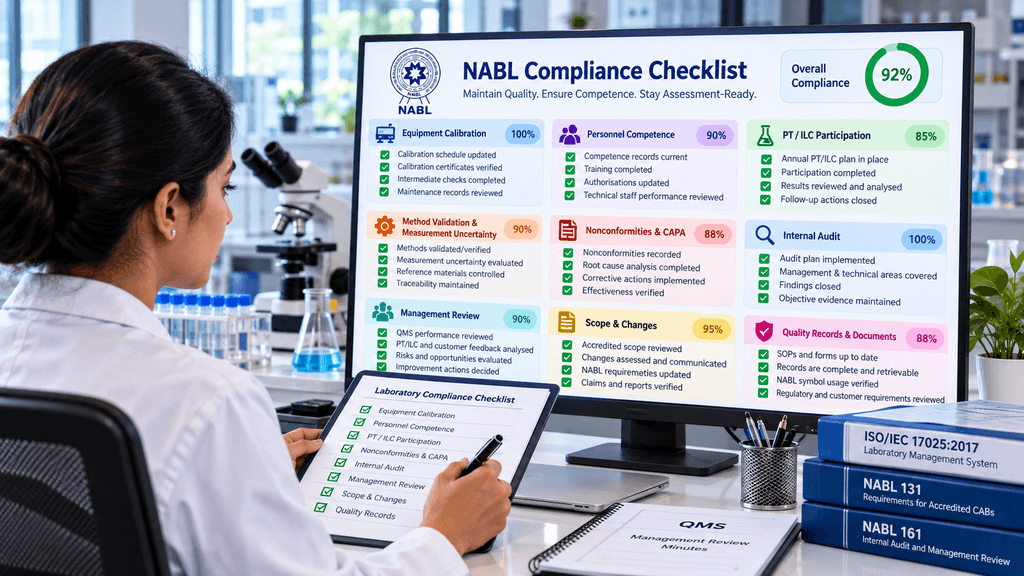
Maintaining NABL Accreditation: Practical Compliance Checklist
Use this checklist as a monthly or quarterly management tool:
- Current NABL documents available and implemented
- Accreditation certificate and scope reviewed
- ISO/IEC 17025 requirements integrated into operations
- Equipment calibration status current
- Intermediate checks completed where applicable
- Environmental conditions monitored
- Reference materials and reagents controlled
- Personnel competence records current
- Authorisation records current
- Method validation/verification records maintained
- Measurement uncertainty evaluated where applicable
- Metrological traceability maintained
- PT/ILC participation planned and reviewed
- Complaints and feedback reviewed
- Nonconformities and CAPA tracked
- Internal audit completed as planned
- Management review completed
- Changes affecting accreditation assessed
- NABL notifications made where required
- Reports and NABL symbol usage reviewed
- Scope-extension requirements assessed before new claims
- Surveillance/reassessment dates tracked
What About Food Testing Laboratories and Other Regulatory Requirements?
NABL accreditation and regulatory recognition are related but should not be treated as identical.
For example, FSSAI states that it recognises and notifies NABL-accredited food laboratories for specified purposes under the food safety regulatory framework. FSSAI’s current laboratory information also shows continuing notifications of NABL-accredited laboratories.
Therefore, a food testing laboratory may need to maintain both its NABL accreditation requirements and applicable FSSAI requirements.
The same principle applies to laboratories working under other regulatory or customer-specific frameworks: maintaining NABL Accreditation does not eliminate separate statutory or contractual obligations.
How Can Prgenix Help With NABL Compliance Maintenance?
Maintaining NABL Accreditation becomes easier when compliance is managed as a planned annual programme rather than as an assessment emergency.
Prgenix can support laboratories with activities such as:
- NABL compliance gap assessments
- ISO/IEC 17025:2017 implementation and maintenance
- Internal audit support
- Management review preparation
- CAPA and nonconformity closure
- PT/ILC planning
- Measurement uncertainty and technical documentation support
- Equipment and calibration compliance planning
- Scope-extension readiness
- NABL surveillance and reassessment preparation
- QMS documentation review and controlled updates
- Ongoing NABL compliance support
For organisations handling personal data as part of laboratory, HR, customer or diagnostic operations, data-protection compliance should also be evaluated separately under India’s Digital Personal Data Protection framework. MeitY published the Digital Personal Data Protection Rules, 2025 and the related enforcement timeline in November 2025.
The objective should be straightforward: keep the laboratory technically competent, operationally controlled and continuously ready for assessment.
NABL Accreditation Consulting →

Q1. Is NABL accreditation permanent?
Answer: No. NABL accreditation requires continued conformity. NABL’s current FAQ states that accreditation certificates are valid for four years, with annual surveillance and reassessment every two years. Laboratories must continue meeting applicable ISO, NABL and scheme-specific requirements throughout the accreditation period.
Q2. How often does NABL conduct surveillance?
Answer: NABL’s current FAQ states that annual surveillance is conducted at intervals of one year to evaluate continued compliance with the applicable standard, NABL-specific criteria and policies. The exact assessment arrangements can depend on the applicable accreditation scheme and current NABL requirements.
Q3. Is internal audit required after NABL accreditation?
Answer: Internal auditing remains an important part of maintaining an effective management system. NABL publishes NABL 161, which covers internal audit and management review for conformity assessment bodies including laboratories. The audit should cover relevant management-system and technical activities.
Q4. Can a NABL-accredited laboratory add new tests without approval?
Answer: A laboratory should not assume that a new test automatically becomes part of its accredited scope. Accreditation applies to the defined scope. Scope additions should be handled through the applicable NABL process before the laboratory makes a NABL accreditation claim for the additional activity.
Q5. What happens if a laboratory changes its equipment or premises?
Answer: The laboratory should evaluate whether the change affects its ability to meet accreditation requirements and determine whether NABL notification or further assessment is required. NABL 131 addresses significant changes involving resources, premises, scope and other factors relevant to accreditation.
Q6. How can a laboratory prepare for NABL reassessment?
Answer: A laboratory should prepare continuously by maintaining its QMS, conducting internal audits, closing CAPA, monitoring equipment and personnel competence, participating in PT/ILC, reviewing management-system performance and tracking current NABL requirements. Reassessment should verify an operating system rather than trigger last-minute document preparation.
Conclusion
Maintaining NABL Accreditation is an ongoing discipline. The laboratory must continuously demonstrate that its people, equipment, methods, records and management system remain competent and controlled.
The most effective approach is to build NABL compliance into the laboratory’s normal operating calendar: monitor equipment, maintain competence, participate in PT/ILC, conduct internal audits, hold meaningful management reviews, control changes and keep the accredited scope accurate.
For laboratories that want structured support for NABL compliance maintenance, surveillance readiness, reassessment preparation or scope extension, [NABL Accreditation Consulting → /nabl-accreditation-consulting/] can provide a practical compliance framework tailored to the laboratory’s scope and operating model.
Disclaimer: This article is for informational purposes and does not constitute legal advice. For tailored guidance, consult Prgenix.
About the Author: Reviewed by V. Pathak, Lead Compliance Consultant at Prgenix, with experience in NABL accreditation, ISO/IEC 17025:2017 implementation, laboratory quality management systems and regulatory compliance.