For an Indian diagnostic or medical laboratory preparing for NABL accreditation, knowing ISO 15189 alone is not enough. The laboratory also needs to understand the NABL-specific requirements and guidance that apply during accreditation.
The NABL 112 Specific Criteria Medical Labs framework is centred on two important documents: NABL 112A, Specific Criteria for Accreditation of Medical Laboratories, and NABL 112B, Guidance Document: Medical Laboratories.
NABL currently identifies medical laboratories as being accredited against ISO 15189, while NABL 112A and 112B provide the specific criteria and guidance relevant to the medical laboratory accreditation process.
This article explains what 112A and 112B mean, how they differ, what a laboratory should prepare, and where medical laboratories commonly need stronger evidence before a NABL assessment.
Key Takeaways
- NABL 112A contains specific accreditation criteria for medical laboratories.
- NABL 112B provides practical guidance, including guidance for preparing the accreditation scope.
- Medical laboratories are accredited against ISO 15189, not ISO/IEC 17025.
- The accreditation scope must clearly identify disciplines, examinations, methods and applicable technical details.
- Pre-examination, examination and post-examination processes all need controlled implementation.
- Personnel competence, equipment, IQC, EQA/PT, reporting, risk management and records are critical assessment areas.
- Laboratories should implement requirements and generate objective evidence before applying for assessment.
What is NABL 112 Specific Criteria for Medical Labs?
NABL 112A is the NABL document titled “Specific Criteria for Accreditation of Medical Laboratories”. It establishes specific criteria applicable to medical laboratories seeking NABL accreditation, while NABL 112B provides supporting guidance for implementation and scope preparation.
NABL’s current accreditation framework identifies ISO 15189 as the standard for medical laboratory accreditation. NABL separately identifies NABL 112A and 112B as the relevant medical laboratory documents.
This distinction matters because laboratories sometimes prepare a medical laboratory QMS using ISO/IEC 17025:2017 templates. That approach can create unnecessary gaps or inappropriate controls.
NABL 112A vs NABL 112B
| Document | Purpose | How a laboratory should use it |
|---|---|---|
| NABL 112A | Specific criteria for accreditation of medical laboratories | Treat as an accreditation requirement document |
| NABL 112B | Guidance for medical laboratories | Use as implementation and scope-preparation guidance |
| ISO 15189 | International requirements for quality and competence of medical laboratories | Establish the core QMS and technical framework |
| NABL 100B | Accreditation process and procedure | Understand the NABL application and assessment process |
| NABL 153 | Application form for medical testing laboratories | Use the applicable NABL application documentation |
NABL’s published documents page currently lists NABL 112A as Issue 01 dated 18 December 2024 and NABL 112B as Issue 01 dated 18 December 2024, with NABL 112B showing an amendment dated 4 November 2025. Laboratories should always work from the latest document versions published by NABL.
What does NABL 112A require from a medical laboratory?
NABL 112A should not be treated as merely another checklist. It should be translated into laboratory processes, responsibilities, records and objective evidence.
The requirements cover areas such as impartiality, confidentiality, organisational arrangements, personnel, facilities, equipment, examination processes, quality assurance and reporting.
1. Impartiality Must be Demonstrable
A medical laboratory must protect the integrity of examination activities from conflicts of interest and undue influence.
For example, pressure on laboratory personnel to suppress an adverse result, bypass a procedural step or accelerate reporting without appropriate controls can create an impartiality risk.
A practical implementation should include:
- Impartiality policy.
- Conflict-of-interest declarations.
- Impartiality risk assessment.
- Defined responsibilities and authorities.
- Escalation mechanisms.
- Periodic review of identified risks.
NABL 112A specifically discusses risks such as undue pressure on analysts or technicians and the need for ongoing or periodic identification of impartiality risks.
2. Confidentiality and Patient Information Require Control
Medical laboratories handle highly sensitive patient information. Confidentiality therefore needs to be built into operational controls, not merely stated in a policy.
Controls can include:
- Authorised access to laboratory information systems.
- Password and user-access management.
- Controlled report release.
- Confidentiality commitments for personnel.
- Secure storage of physical records.
- Controlled transmission of electronic reports.
- Defined retention and disposal arrangements.
Where digital personal data is processed, laboratories should also evaluate their obligations under India’s Digital Personal Data Protection Act, 2023 and the applicable rules and directions under the current DPDP framework.
The DPDP framework should complement, not replace, the confidentiality and information-management requirements applicable to the medical laboratory.
What should be covered in the medical laboratory QMS?
A practical NABL implementation should connect the ISO 15189 requirements, NABL 112A criteria and laboratory operations.
Think of the QMS as the laboratory’s operating system. A procedure alone does not demonstrate conformity; the laboratory needs evidence that personnel actually follow the procedure and that the process produces controlled results.
Personnel Competence
The laboratory should establish competence requirements for each relevant role and maintain evidence such as:
- Educational qualification.
- Experience.
- Job description.
- Training records.
- Competence assessment.
- Authorisation records.
- Continuing competence monitoring.
- Reassessment where required.
Competence should be linked to actual activities.
For example, training a technician on an analyser is not automatically evidence that the technician is competent to independently release patient results.
Facilities and Environmental Conditions
The laboratory should identify environmental conditions that can affect examination activities.
Depending on the discipline, controls may include:
- Temperature and humidity.
- Cleanliness.
- Biosafety controls.
- Prevention of contamination.
- Sample storage conditions.
- Controlled access.
- Segregation of incompatible activities.
- Waste management.
The control should be based on the examination process and associated risks rather than simply installing equipment because another laboratory has done so.
Equipment Management
Equipment should be identified, uniquely labelled where appropriate, maintained and controlled.
Typical evidence includes:
- Equipment master list.
- Equipment specifications.
- Installation and acceptance records.
- Calibration or verification records.
- Preventive maintenance records.
- Breakdown records.
- Equipment-use logs where applicable.
- Status identification.
- Authorisation for use.
The laboratory should also define what happens when equipment is found to be defective or outside specified acceptance criteria.
How should a medical laboratory prepare its NABL scope?
Scope preparation is one of the areas where NABL 112B becomes particularly useful.
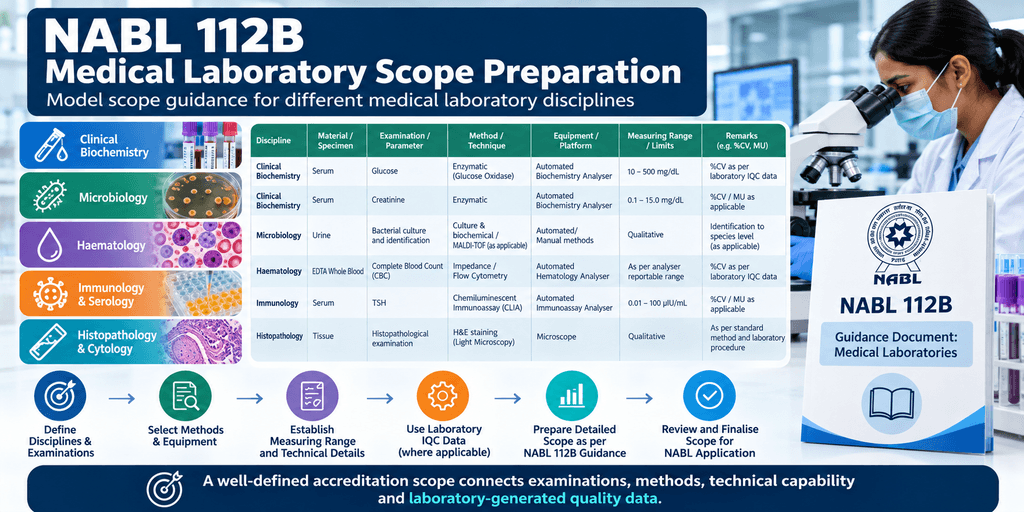
NABL 112B provides model scope guidance for different medical laboratory disciplines. It also indicates that IQC data should be considered when deriving applicable %CV and measurement uncertainty information, where relevant.
A scope should not simply say:
“Biochemistry Testing”
That is usually too broad to demonstrate exactly what the laboratory is seeking accreditation for.
The laboratory should map each proposed examination against relevant information such as:
- Discipline.
- Material or specimen.
- Component, parameter or characteristic.
- Examination/test performed.
- Method or technique.
- Equipment/platform, where applicable.
- Measuring range or relevant limits, where applicable.
- Applicable precision or uncertainty information.
NABL 112B also gives specific guidance for profiles and function tests. For example, profiles should be appropriately segregated into their component parameters rather than being treated as one undifferentiated examination.
This is a major reason laboratories should finalise their scope only after performing a detailed technical gap assessment.
What are the major technical controls before NABL assessment?
A laboratory should be able to demonstrate that its examination processes are technically controlled.
Pre-examination Process
The pre-examination chain can include:
- Test request.
- Patient identification.
- Patient preparation.
- Sample collection.
- Sample identification.
- Sample acceptance/rejection.
- Transportation.
- Sample receipt.
- Sample storage before examination.
A useful audit question is:
“Can the laboratory trace a patient sample from request through collection, examination and final report?”
If the answer depends on individual staff memory rather than controlled records, the process needs strengthening.
Examination Process
The laboratory should control:
- Examination methods.
- Method selection.
- Verification or validation as applicable.
- Reagents and consumables.
- Equipment.
- Internal quality control.
- Reference intervals where applicable.
- Calibration and traceability where applicable.
- Environmental conditions.
- Technical records.
Post-examination Process
Controls should extend beyond the analytical stage.
The laboratory should consider:
- Result review.
- Authorisation.
- Report generation.
- Critical-result communication.
- Report correction or amendment.
- Retention of records.
- Sample retention.
- Sample disposal.
- Referral laboratory results.
A technically correct test can still create a quality problem if the final report is released incorrectly or a critical result is not handled according to the laboratory’s defined process.
How do IQC, EQA and proficiency testing fit into NABL 112?
Quality control is not merely an activity performed before an assessment. The laboratory needs continuing evidence that its examination processes remain reliable.
Internal Quality Control
IQC should be planned and implemented according to the examination and associated risks.
The laboratory should establish appropriate:
- Control materials.
- Frequency.
- Acceptance criteria.
- Review process.
- Corrective action.
- Trend monitoring.
- Documentation.
NABL 112B specifically refers to laboratory-generated IQC data in the context of scope-related %CV and measurement uncertainty information where applicable.
EQA / PT
Participation in appropriate external quality assessment or proficiency testing programmes is an important element of demonstrating examination performance.
Where an appropriate PT/EQA programme is unavailable, the laboratory should have a documented approach for alternative evaluation of performance, consistent with applicable requirements and guidance.
The key point is simple:
Do not collect PT certificates only because an assessor is coming. Build an ongoing performance-monitoring system.
What documents should a medical lab prepare before NABL assessment?
A practical readiness checklist should cover at least the following areas:
| Area | Typical Evidence to Prepare |
|---|---|
| Organisation | Organisation chart, responsibilities, authorities |
| Impartiality | Risk assessment, declarations, controls |
| Confidentiality | Agreements, access controls, confidentiality procedure |
| Personnel | Qualifications, training, competence and authorisation |
| Facilities | Environmental monitoring and facility controls |
| Equipment | Master list, calibration/verification, maintenance |
| Methods | SOPs, verification/validation records |
| Pre-examination | Collection, identification, transport and acceptance controls |
| Examination | Technical procedures and records |
| IQC | QC plans, results, trends and corrective actions |
| EQA/PT | Participation records and evaluation |
| Reporting | Report formats, review, authorisation and amendments |
| Referral laboratories | Selection and monitoring records |
| Complaints | Complaint handling and investigation |
| Nonconforming work | Identification, evaluation and corrective action |
| Internal audit | Audit programme, reports and closure |
| Management review | Agenda, inputs, decisions and actions |
| Risk management | Identified risks, controls and monitoring |
| Improvement | Corrective actions and effectiveness evaluation |
This checklist should then be converted into a laboratory-specific implementation plan.
What is the difference between NABL 112 and ISO/IEC 17025?
This is a common source of confusion.
ISO/IEC 17025:2017 is the principal competence standard used by NABL for testing and calibration laboratories. ISO 15189 is the standard used by NABL for medical laboratories.
Therefore, a diagnostic laboratory seeking medical laboratory accreditation should not simply copy an ISO/IEC 17025 QMS and rename it.
NABL itself currently states that testing and calibration laboratories are accredited to ISO/IEC 17025, while medical laboratories are accredited to ISO 15189.
Similarly, NABL 143 is a policy concerning calibration and measurement capability and measurement uncertainty in calibration. It should not be confused with NABL 112A, which is the specific criteria document for medical laboratories.
How can a medical laboratory prepare for NABL assessment?
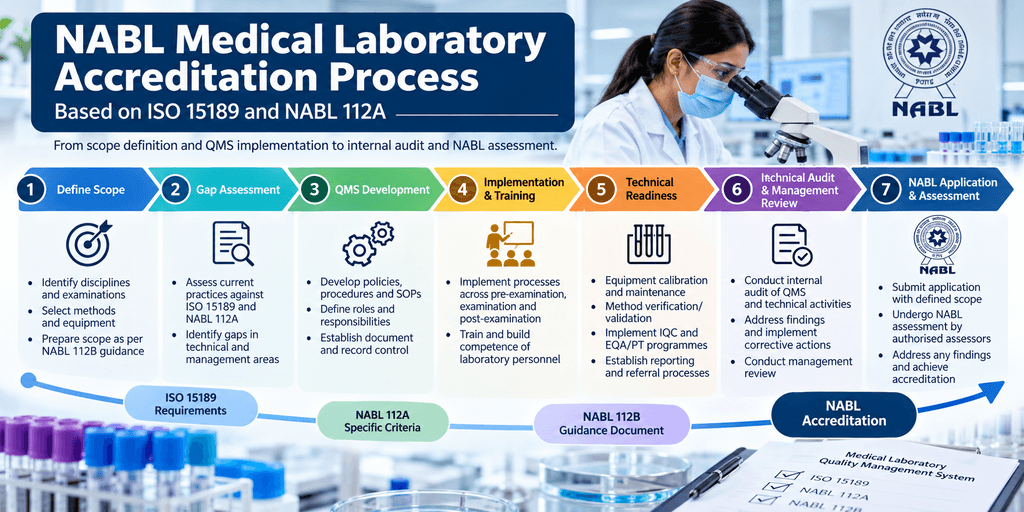
A practical implementation sequence is:
Step 1 — Define the Intended Scope
Identify disciplines, examinations, methods and technical capabilities.
Step 2 — Conduct a Gap Assessment
Map ISO 15189 and NABL 112A requirements against existing laboratory practices.
Step 3 — Develop the QMS
Prepare policies, procedures, SOPs, formats and controlled records.
Step 4 — Implement the System
Train personnel and start generating real operational evidence.
Step 5 — Establish Technical Controls
Complete method verification/validation, equipment controls, IQC and EQA/PT arrangements as applicable.
Step 6 — Conduct Internal Audit
Audit both the management system and technical activities.
Step 7 — Conduct Management Review
Review system performance, audit results, complaints, quality indicators, risks, PT/EQA, corrective actions and improvement opportunities.
Step 8 — Close Gaps
Complete corrective actions and verify their effectiveness.
Step 9 — Finalise the NABL Application and Scope
Ensure the submitted scope accurately represents the laboratory’s demonstrated competence.
Step 10 — Prepare for Assessment
Ensure personnel can explain and demonstrate their actual processes rather than merely showing documents.
Frequently Asked Questions (FAQ)

Q1: Is NABL 112A mandatory for medical laboratory accreditation?
Answer: NABL 112A is the NABL document specifying criteria for accreditation of medical laboratories. A medical laboratory applying for NABL accreditation should therefore evaluate its conformity against the applicable NABL requirements along with ISO 15189 and other relevant NABL documents.
Q2: What is NABL 112B used for?
Answer: NABL 112B is a guidance document for medical laboratories. It provides practical guidance, including model scope information and technical considerations, and should be used alongside NABL 112A rather than as a replacement for the accreditation criteria.
Q3: Are medical laboratories accredited under ISO/IEC 17025?
Answer: No. NABL currently identifies ISO 15189 as the accreditation standard for medical laboratories. ISO/IEC 17025 is used for NABL accreditation of testing and calibration laboratories. Medical laboratories should therefore establish their accreditation system around ISO 15189.
Q4: Does NABL 112B help with preparing the accreditation scope?
Answer: Yes. NABL 112B contains model scope information for medical laboratory disciplines and provides guidance on methodology, testing range and, where applicable, %CV and measurement uncertainty based on laboratory-generated information.
Q5: Is internal audit required before NABL assessment?
Answer: A laboratory should have an established internal audit process and objective evidence demonstrating that its management and technical activities have been evaluated. Internal audit is not simply a document exercise; findings should be addressed and corrective actions evaluated for effectiveness.
Q6: Can a laboratory apply for NABL accreditation before completing implementation?
Answer: The laboratory needs sufficient objective evidence to demonstrate competence and conformity for its proposed scope. Applying before the system is operational can result in findings and delays, so implementation and evidence generation should precede the assessment.
Conclusion: NABL 112 Specific Criteria Medical Labs
Understanding NABL 112 Specific Criteria Medical Labs requires more than downloading NABL 112A and 112B.
The practical requirement is to translate ISO 15189 and NABL’s specific criteria into a functioning laboratory management system, competent personnel, technically valid examination processes, reliable quality controls and complete objective evidence.
NABL 112A should be used to understand the applicable specific criteria, while NABL 112B should be used as supporting guidance, particularly when developing the accreditation scope and technical framework.
For laboratories preparing for accreditation, the most effective approach is to start with a detailed gap assessment, build the QMS around actual laboratory processes, generate implementation evidence and then conduct a rigorous pre-assessment before the NABL assessment.
Prgenix supports Indian laboratories with NABL accreditation consulting, QMS implementation, documentation, training, internal audit preparation, technical readiness and accreditation-readiness support.
Need help preparing your medical laboratory for NABL accreditation? Explore Prgenix’s NABL accreditation consulting services and build an assessment-ready system based on your actual laboratory scope and operations.
NABL ACCREDITATION & CERTIFICATION →
Disclaimer: This article is for informational purposes and does not constitute legal advice. For tailored guidance, consult Prgenix.
About the Author: Reviewed by V. Pathak, Lead Compliance Consultant at Prgenix, with expertise in NABL accreditation, laboratory quality management systems and regulatory compliance.