Food testing laboratories in India operate in a highly regulated environment. Customers, food manufacturers, exporters and regulators need confidence that laboratory results are technically valid, traceable and reliable.
NABL accreditation provides independent recognition of a laboratory’s competence against ISO/IEC 17025:2017. For laboratories seeking FSSAI recognition or notification, however, NABL accreditation is only part of the process. The laboratory must also address the applicable FSSAI requirements and, where applicable, the NABL-FSSAI integrated assessment route.
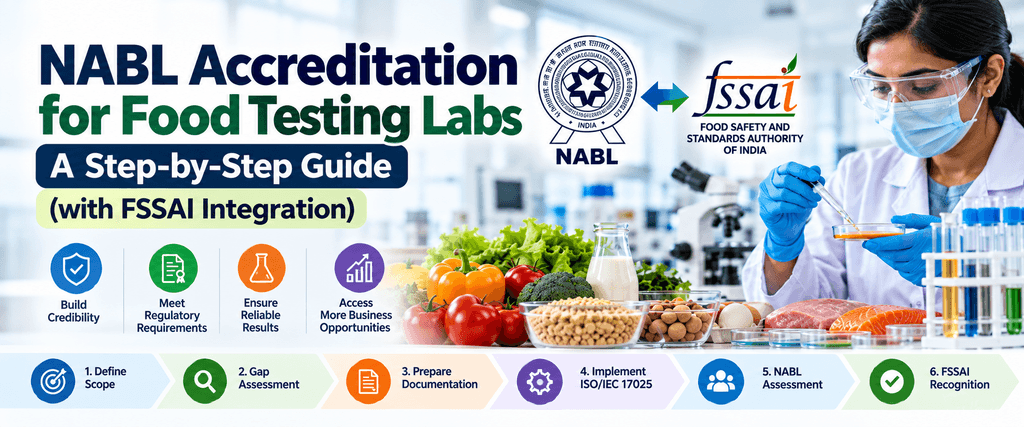
This guide explains how to plan NABL Accreditation for Food Testing Labs, how to develop the testing scope, prepare the QMS, establish technical competence, manage FSSAI requirements and avoid common mistakes during assessment.
Key Takeaways
- NABL accreditation for a food testing laboratory is based primarily on ISO/IEC 17025:2017 and applicable NABL requirements.
- FSSAI recognises and notifies NABL-accredited food laboratories under the Food Safety and Standards Act framework.
- Laboratories seeking FSSAI recognition should carefully plan the food category, product/matrix and test-parameter scope before applying.
- NABL 127 provides the procedure for integrated assessment involving regulatory bodies including FSSAI. NABL 154 is the application form for integrated assessment.
- Equipment calibration, method validation/verification, measurement uncertainty, traceability, proficiency testing and competent personnel are central technical elements.
- Internal audit and management review should be completed as part of the laboratory’s implementation and readiness programme.
What is NABL Accreditation for Food Testing Labs?
NABL accreditation for food testing labs is formal recognition of a laboratory’s technical competence to perform specified food testing activities in accordance with ISO/IEC 17025:2017 and applicable NABL criteria. For laboratories seeking regulatory recognition through FSSAI, the applicable integrated-assessment requirements must also be addressed.
The key point is that accreditation is granted for a defined scope. A laboratory is not simply “NABL accredited for food testing”. Its certificate identifies the specific activities, disciplines, products or groups and parameters for which competence has been assessed.
For example, a laboratory may have competence for microbiological testing of selected food products but not automatically for pesticide residue, heavy metals, aflatoxins or nutritional parameters.
FSSAI’s current food-laboratory framework includes primary food laboratories, referral food laboratories and National Reference Laboratories. FSSAI maintains published lists of recognised/notified laboratories.
Why Do Food Testing Laboratories Need NABL Accreditation?
NABL accreditation gives customers and regulators an independent basis for confidence in laboratory competence.
For a food laboratory, the practical benefits include:
- Demonstrating technical competence.
- Improving reliability and consistency of test results.
- Establishing controlled laboratory processes.
- Supporting regulatory and customer requirements.
- Improving traceability of measurements.
- Providing documented evidence of personnel competence.
- Creating a structured system for equipment, methods, records and quality control.
- Supporting FSSAI recognition/notification where the applicable requirements are met.
FSSAI states that it recognises and notifies NABL-accredited food laboratories for food analysis. Its published food-laboratory information also identifies the statutory framework under Section 43 of the Food Safety and Standards Act, 2006.
The important distinction is that NABL accreditation and FSSAI recognition are related but not identical concepts. A laboratory should therefore design its accreditation project around both requirements where FSSAI recognition is required.
How Do You Start NABL Accreditation for a Food Testing Lab?
The first step is not writing the Quality Manual. It is defining the intended scope.
Step 1: Define the Food Testing Scope
Prepare a detailed scope matrix covering:
| Area | What the laboratory should define |
|---|---|
| Food category/product | Milk, cereals, spices, edible oils, beverages, meat, processed foods, etc. |
| Parameter | Chemical, microbiological, physical or other applicable tests |
| Test method | Standard/reference method or validated laboratory method |
| Equipment | Instruments and supporting equipment required |
| Personnel | Technical personnel competent for the activity |
| Facility | Environmental and infrastructure requirements |
| QC | Positive/negative controls, blanks, reference materials, duplicates, etc. |
| PT/ILC | Appropriate proficiency testing or interlaboratory comparison |
| Reporting | Results, units, decision rules and applicable reporting requirements |
This scope exercise is critical because NABL assesses actual technical competence against the activities included in the application.
For laboratories seeking FSSAI integrated assessment, NABL 127 states that the application is considered for the relevant regulatory scope and refers to the prescribed NABL 154 application process. It also addresses the relationship between NABL accreditation and regulatory recognition/approval.
Step 2: Perform a Gap Assessment
Compare the laboratory’s current system against:
- ISO/IEC 17025:2017.
- Applicable NABL accreditation requirements.
- Applicable FSSAI requirements.
- Applicable food testing methods and regulatory specifications.
- Equipment and calibration requirements.
- Personnel competency requirements.
- PT/ILC requirements.
- Reporting and record-control requirements.
The gap assessment should produce an action plan rather than simply a list of missing documents.
A useful implementation tracker should identify the requirement, existing status, required action, responsible person, target date and evidence of closure.
What Documents Are Required for a Food Testing Laboratory?
A food laboratory normally needs both management-system documentation and technical documentation.
Management System Documentation
Typical documents include:
- Quality Policy and objectives.
- Impartiality and confidentiality arrangements.
- Document and record control procedure.
- Risk and opportunity management.
- Complaints and appeals process.
- Nonconforming work procedure.
- Corrective action procedure.
- Internal audit procedure.
- Management review procedure.
- Improvement and feedback processes.
- Personnel competence and training procedure.
- Purchasing and external-provider controls.
The documentation should reflect the actual laboratory operation. A large collection of generic SOPs does not demonstrate competence if laboratory staff do not implement them.
Technical Documentation
Depending on the scope, the laboratory may need:
- Sampling procedures where sampling is included in the scope.
- Sample receipt and acceptance procedure.
- Sample identification and traceability.
- Sample storage and preservation.
- Test methods and work instructions.
- Method verification or validation records.
- Measurement uncertainty evaluation where applicable.
- Equipment operation and maintenance records.
- Calibration certificates.
- Intermediate checks.
- Reference material records.
- Environmental monitoring records.
- Quality-control records.
- PT/ILC participation records.
- Raw data and worksheets.
- Test reports/certificates of analysis.
NABL 160A is now listed by NABL as the guide for preparing management-system documentation/quality manuals for testing and calibration laboratories.
How Should Equipment and Calibration Be Prepared?
Food testing laboratories frequently face assessment findings because equipment exists physically but the laboratory cannot demonstrate adequate control of its measurement capability.
Prepare an equipment master list containing:
- Equipment identification number.
- Manufacturer and model.
- Serial number.
- Location.
- Measurement range/capability.
- Calibration requirement.
- Calibration frequency.
- Acceptance criteria.
- Maintenance requirements.
- Intermediate checks, where applicable.
- Current calibration status.
Calibration alone is not enough. The laboratory should establish metrological traceability appropriate to the measurement.
NABL separately publishes policies concerning metrological traceability and measurement uncertainty, including NABL 142 and NABL 141. These should be reviewed where relevant to the laboratory’s activities.
Do not automatically apply calibration requirements to every item in the same manner. A refrigerator, incubator, analytical balance, pH meter, HPLC, GC-MS and microbiological equipment may require different control strategies based on their intended use and effect on results.
How Should Food Test Methods Be Validated or Verified?
A laboratory must demonstrate that its selected methods are suitable for their intended purpose.
The approach depends on whether the laboratory uses a standard method within its intended application or develops/modifies a method.
The laboratory should establish appropriate evidence such as:
- Selectivity/specificity where relevant.
- Precision.
- Accuracy or trueness.
- Detection/quantification capability where applicable.
- Working range.
- Recovery.
- Robustness where relevant.
- Measurement uncertainty.
- Method verification records.
The laboratory should also control changes to methods.
For example, if a standard method specifies a particular extraction technique, instrument configuration or analytical condition, the laboratory should not casually modify the method and continue describing it as the same method without evaluating the impact.
For food testing, method selection must also be aligned with applicable FSSAI requirements, food standards and regulatory expectations.
How Does FSSAI Integration Work?
FSSAI integration is one of the most important aspects for a food testing laboratory seeking regulatory recognition.
NABL 127 specifically describes integrated assessment of testing laboratories seeking recognition/approval from regulatory bodies including FSSAI. The document states that accreditation by NABL and parallel regulatory recognition can be addressed through the integrated assessment approach.
NABL’s current General Information Brochure also identifies FSSAI among the regulatory bodies participating in its integrated assessment programme.
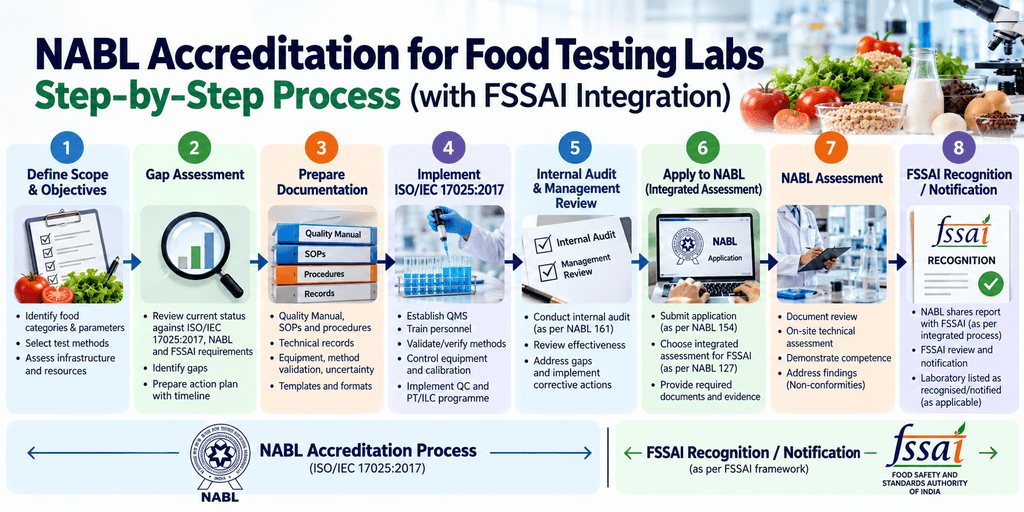
A practical sequence is:
- Define the intended FSSAI food-testing scope.
- Map products/categories and parameters.
- Establish the ISO/IEC 17025 management system.
- Establish technical competence.
- Complete method verification/validation.
- Establish calibration and traceability.
- Establish QC and PT/ILC arrangements.
- Conduct internal audit.
- Conduct management review.
- Apply through the applicable NABL integrated-assessment route.
- Undergo assessment and address findings.
- Complete the applicable NABL and FSSAI decision/recognition process.
FSSAI currently publishes lists of notified primary and referral food laboratories and periodically issues revised lists and notifications. Therefore, laboratories should verify the current regulatory position rather than rely on an old list or previous project documentation.
What Happens During the NABL Assessment?
Assessment is not merely a document review.
The assessment team may evaluate whether the laboratory can demonstrate actual technical competence through records, interviews, observation and technical activities within the applied scope.
Be prepared to demonstrate:
- Staff competency.
- Correct use of equipment.
- Traceability of measurements.
- Sample handling.
- Test execution.
- Quality-control practices.
- Method verification/validation.
- Raw-data integrity.
- Reporting practices.
- Environmental controls.
- PT/ILC performance.
- Handling of nonconforming work.
- Corrective actions.
The laboratory should conduct a realistic pre-assessment internally before inviting the external assessment.
NABL 161 provides guidance for internal audits and management reviews and notes that laboratories should conduct these activities according to predetermined programmes and procedures. The current NABL listing records amendments to NABL 161 in January 2026.
What Are the Most Common Preparation Mistakes?
Several mistakes repeatedly create unnecessary delays.
First, laboratories sometimes apply for an excessively broad scope without having sufficient technical evidence for every parameter.
Second, calibration certificates may be available but the laboratory may not have adequately established whether the calibration capability is suitable for the intended measurement.
Third, SOPs may be copied from another laboratory without matching the actual equipment, method, personnel or facility.
Fourth, PT participation may be treated as a formality instead of a technical quality-control activity.
Fifth, internal audit and management review may be completed only immediately before assessment. This leaves insufficient time to identify trends and implement corrective action.
Finally, laboratories sometimes treat FSSAI recognition as an automatic consequence of obtaining NABL accreditation. The applicable FSSAI recognition/notification requirements must be separately addressed.
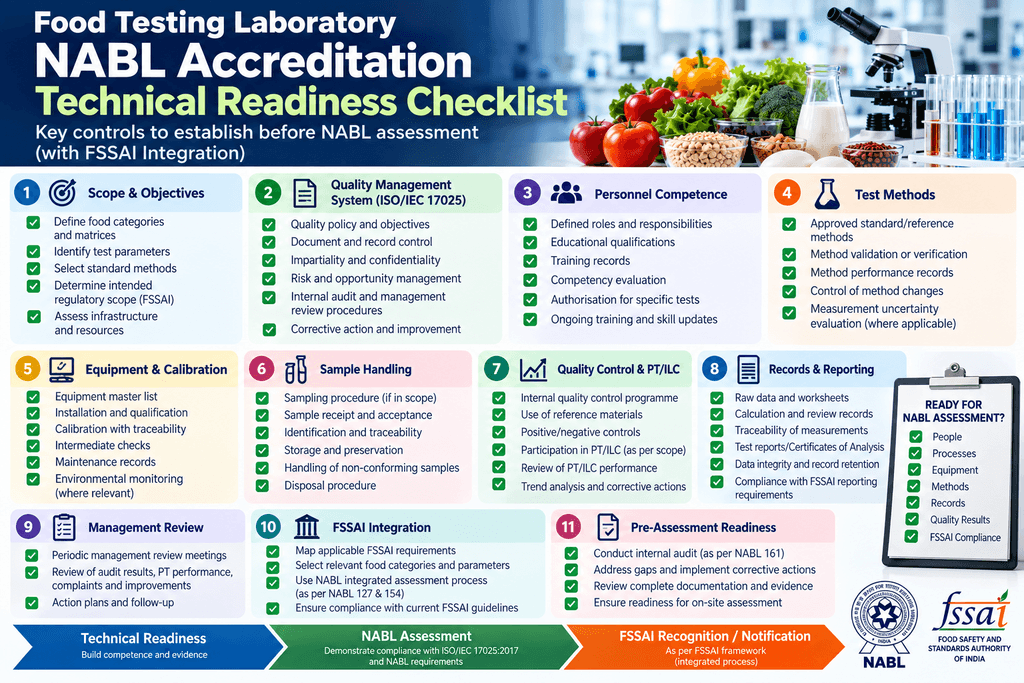
Food Laboratory NABL Accreditation Checklist
Before applying, laboratory management should be able to answer “yes” to most of the following:
| Readiness Area | Check |
|---|---|
| Scope | Product categories and parameters clearly defined |
| QMS | ISO/IEC 17025 system implemented |
| Personnel | Competency established and documented |
| Methods | Methods selected and controlled |
| Validation | Required validation/verification completed |
| Equipment | Equipment qualified and controlled |
| Calibration | Calibration and traceability established |
| QC | Internal quality-control programme implemented |
| PT/ILC | Applicable programme planned/participated |
| Records | Raw data and technical records controlled |
| Internal Audit | Completed against applicable requirements |
| Management Review | Completed with meaningful inputs and actions |
| FSSAI | Applicable food-category/regulatory requirements mapped |
| Application | NABL application and scope reviewed before submission |
This checklist should be treated as a readiness tool, not as a substitute for the applicable NABL documents and FSSAI requirements.
Which NABL Documents Should a Food Testing Laboratory Review?
A laboratory should always work from the latest documents published by NABL rather than relying on old consultant templates.
Particularly relevant documents include:
- NABL 100A – General Information Brochure.
- NABL 100B – Accreditation Process & Procedure.
- NABL 120 – Guidance for Classification of Product Groups in Testing & Calibration Field.
- NABL 127 – Integrated Assessment & Additional Requirements of Regulatory Bodies for Testing Laboratories.
- NABL 154 – Application Form for Integrated Assessment of Testing Laboratories.
- NABL 160A – Guide for Preparing Management System Document/Quality Manual for Testing/Calibration Laboratories.
- NABL 161 – Guide for Internal Audit and Management Review.
- NABL 163 – Policy for Participation in Proficiency Testing Activities.
- NABL 131 – Terms and Conditions for Obtaining and Maintaining NABL Accreditation.
NABL’s current accreditation-document register shows, among other updates, amendments to NABL 127 and NABL 154 in August 2026 and NABL 160A as the current guide for testing/calibration laboratory management-system documentation.
A useful caution: NABL 112 is specifically listed as the criteria for medical laboratories, while NABL 143 concerns calibration and measurement capability/measurement uncertainty in calibration. They should not be treated as the primary food-testing accreditation criteria.
Frequently Asked Questions

Q1. Is NABL accreditation mandatory for every food testing laboratory in India?
Answer: Not every laboratory performing food-related testing automatically has the same regulatory obligation. However, FSSAI’s framework recognises and notifies food laboratories through its regulatory process, with NABL accreditation under ISO/IEC 17025 forming a key part of the applicable framework. The exact requirement depends on the laboratory’s intended regulatory role and scope.
Q2. Can a laboratory get NABL accreditation without FSSAI recognition?
Answer: Yes. NABL accreditation and FSSAI recognition are distinct processes, although they can be connected through NABL’s integrated assessment mechanism. Obtaining NABL accreditation does not automatically mean that all applicable FSSAI recognition requirements have been satisfied.
Q3. What is the difference between NABL accreditation and FSSAI recognition?
Answer: NABL accreditation demonstrates laboratory competence against applicable accreditation requirements, principally ISO/IEC 17025:2017 for testing laboratories. FSSAI recognition or notification is a regulatory status under India’s food-safety framework. FSSAI maintains published lists of recognised and notified food laboratories.
Q4. How long does NABL accreditation for a food testing lab take?
Answer: There is no fixed accreditation timeline applicable to every laboratory. The duration depends on scope, QMS maturity, personnel competence, equipment readiness, method validation, PT/ILC arrangements, application quality and assessment findings. A new laboratory should therefore plan accreditation as a structured implementation project.
Q5. Does every food test require measurement uncertainty?
Answer: Not necessarily. Applicability depends on the testing activity, method and relevant accreditation requirements. The laboratory should determine where uncertainty evaluation is technically applicable and maintain an appropriate documented approach rather than using an indiscriminate generic calculation.
Q6. Can an in-house food laboratory obtain FSSAI recognition through integrated assessment?
Answer: NABL currently states that in-house testing laboratories of Food Business Operators, including manufacturers, processors and exporters, are not eligible for regulatory recognition/approval under the Integrated Assessment programme where the concerned regulatory body has this requirement. Eligibility should be verified against the latest applicable NABL and regulatory requirements.
Conclusion
NABL Accreditation for Food Testing Labs is not primarily a documentation exercise. The real objective is to demonstrate that the laboratory can consistently produce technically valid and reliable results for the exact food products and parameters included in its scope.
The most effective approach is to start with scope definition, then build the QMS, establish personnel and equipment competence, validate or verify methods, implement quality control, complete PT/ILC activities, conduct internal audit and management review, and finally proceed through the applicable NABL/FSSAI assessment route.
For laboratories planning accreditation or struggling with scope, documentation, technical implementation or assessment readiness, Prgenix can support the complete NABL implementation and accreditation programme.
Explore NABL Accreditation Consulting or contact Prgenix for a structured food laboratory gap assessment and accreditation roadmap.
Disclaimer: This article is for informational purposes and does not constitute legal advice. For tailored guidance, consult Prgenix.
About the Author: Reviewed by V. Pathak, Lead Compliance Consultant at Prgenix, with experience in NABL accreditation, ISO/IEC 17025 implementation, laboratory quality systems and regulatory compliance.