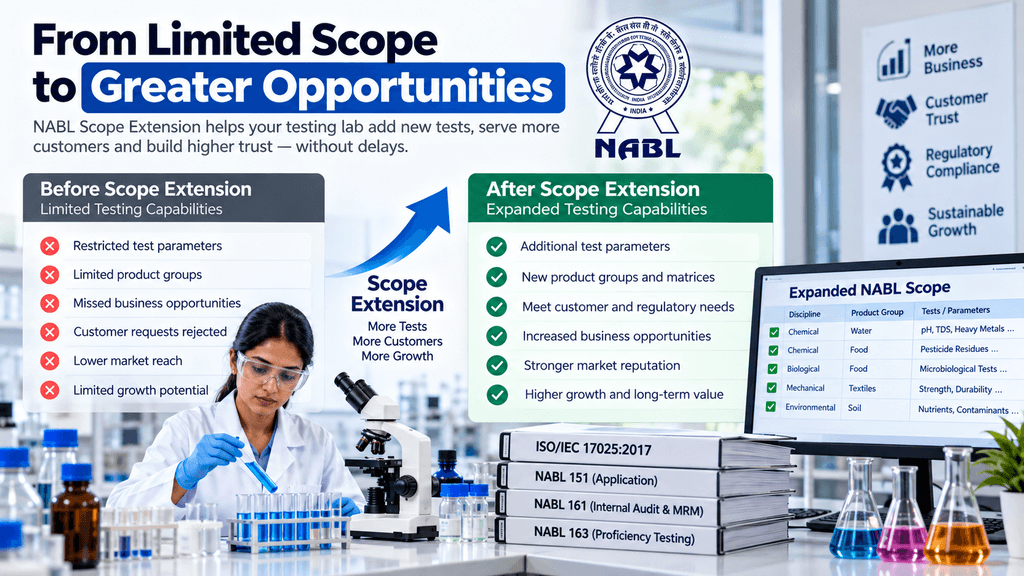
A testing laboratory may start with a limited NABL scope and later need to add new products, parameters, test methods or testing capabilities. This is where the NABL Scope Extension Process for Testing Labs becomes important.
Scope extension is not simply a matter of adding a test to the laboratory’s website or updating the test list. The laboratory must demonstrate that it has the required technical competence, equipment, personnel, methods, facilities, quality controls and supporting records for the proposed activity.
This guide explains how Indian testing laboratories can prepare for NABL scope extension, what commonly causes delays, and how to make the process more controlled and assessment-ready.
Key Takeaways
- NABL scope defines the specific testing activities for which the laboratory is accredited.
- Scope extension is also referred to by NABL as enhancement of scope.
- A laboratory should establish technical readiness before applying.
- New methods require appropriate verification or validation, as applicable.
- Equipment, calibration, personnel competence, environmental conditions and quality-control arrangements must support the proposed testing activity.
- PT/ILC participation or another appropriate approach may be necessary depending on the test and applicable requirements.
- The laboratory should never report a new test as NABL-accredited until the extended scope has been formally approved.
NABL accredits testing laboratories against ISO/IEC 17025. Its published accreditation framework covers testing disciplines including chemical, biological, mechanical, electrical, electronics, fluid flow, forensic, NDT, photometry, radiological and software & IT system testing.
What is the NABL Scope Extension Process for Testing Labs?
The NABL Scope Extension Process for Testing Labs is the controlled process through which an already accredited testing laboratory seeks accreditation for additional testing activities within or beyond its existing accredited scope.
In practical terms, the process can be viewed as:
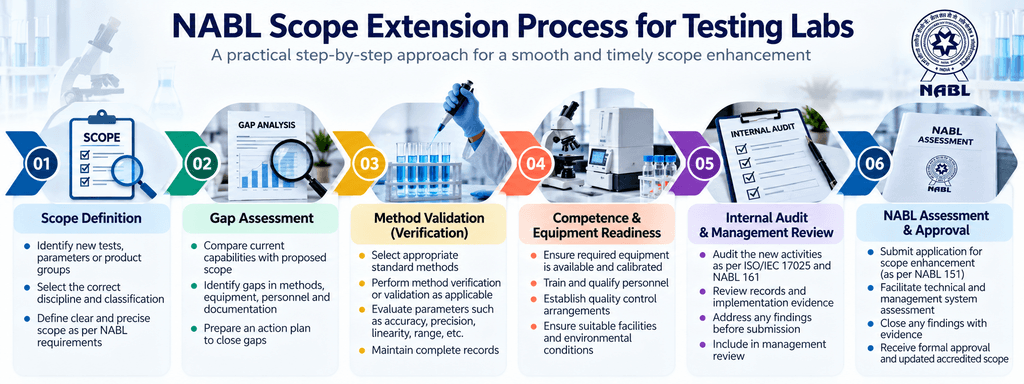
Identify → Assess readiness → Establish competence → Document evidence → Apply → Assessment → Close findings → Approval
The exact assessment route and documentation depend on the nature of the proposed extension, the discipline, product group and applicable NABL requirements.
NABL’s current information material specifically refers to this activity as “Enhancement of Scope” and provides for enhancement apart from scheduled reassessment.
What can be added to an NABL scope?
Depending on the applicable discipline and scope structure, a laboratory may seek additions such as:
- New product groups
- Additional test parameters
- Additional test methods
- Additional matrices or materials
- Additional ranges or capabilities
- New testing activities within an existing discipline
- Additional activities requiring a different technical competence
The proposed scope should be drafted carefully. A vague statement such as “chemical testing” is not sufficient. The scope needs to accurately communicate what the laboratory is competent and accredited to perform.
NABL itself explains that an accredited laboratory’s scope can be examined through details such as test parameters, methods and testing capabilities.
Why Do NABL Scope Extension Applications Get Delayed?
Most delays are not caused by the application form itself. They usually originate from technical and management-system readiness gaps discovered before or during assessment.
Common examples include:
- The proposed test method has not been properly verified or validated.
- Required equipment is unavailable or unsuitable.
- Calibration status is incomplete.
- Reference standards or reference materials are not adequately controlled.
- Analysts have not demonstrated competence for the new activity.
- Internal quality-control arrangements have not been established.
- PT/ILC arrangements have not been considered.
- Measurement uncertainty requirements, where applicable, have not been addressed.
- The Quality Manual and procedures do not reflect the proposed activity.
- Records are insufficient to demonstrate actual implementation.
The key principle is simple: Do not apply for a scope that exists only on paper. Apply for a scope that the laboratory can demonstrate in practice.
How Should a Testing Laboratory Prepare for Scope Extension?
Step 1: Define the Proposed Scope Precisely
Start with a scope-extension matrix.
| Item | Existing Scope | Proposed Extension | Readiness |
|---|---|---|---|
| Discipline | Chemical | Chemical | Confirm |
| Product group | Water | Food products | Gap assessment |
| Parameter | Existing parameters | New parameter | Technical review |
| Method | Existing method | New/updated method | Verification/validation |
| Equipment | Available | Additional equipment | Procurement/calibration |
| Personnel | Competent | New analyst | Training/competence |
| QC | Established | New QC plan | Required |
| PT/ILC | Existing | New activity | Availability check |
| Records | Existing | New records | Prepare |
This exercise prevents a common mistake: submitting a broad scope before the laboratory has established competence for every individual activity.
Step 2: Check the Applicable NABL Discipline and Product Group
NABL’s scope structure is organised around disciplines and groups. The laboratory should first determine exactly where the proposed activity belongs.
NABL provides NABL 120, Guidance for Classification of Product Groups in Testing & Calibration Field, as a relevant reference for classification. The laboratory should also review the latest applicable specific criteria and application requirements before finalising the scope.
Do not rely on an old scope template from another laboratory. Two laboratories performing apparently similar tests may require different scope descriptions depending on their products, methods and applicable discipline.
Step 3: Verify the Test Method
For every proposed test, identify:
- Applicable Indian Standard, ASTM, ISO, EN or other recognised method
- Edition/version of the method
- Laboratory’s authorised copy
- Method applicability
- Verification or validation requirements
- Critical equipment
- Reference materials
- Quality-control requirements
- Reporting requirements
If a laboratory has adopted a revised standard, it should also assess whether the change affects its existing competence and technical records.
A new method should not be treated as “implemented” merely because the laboratory has purchased the standard.
Step 4: Establish Technical Competence
ISO/IEC 17025 is fundamentally about competence as well as a management system.
For a new test, the laboratory should be able to demonstrate that competent personnel can actually perform the activity under controlled conditions.
Evidence may include:
- Education and technical qualifications
- Training records
- Method-specific training
- Supervised practice
- Competence evaluation
- Authorisation records
- Ongoing monitoring of competence
NABL’s assessment model is designed to evaluate the technical competence of conformity assessment bodies, including testing laboratories.
Step 5: Check Equipment and Calibration
Before applying, prepare an equipment-readiness review.
Ask:
- Is the required equipment available?
- Is it suitable for the proposed method?
- Is the equipment uniquely identified?
- Is calibration/verification current?
- Is traceability established where applicable?
- Are maintenance requirements defined?
- Are environmental conditions suitable?
- Are intermediate checks required?
- Are equipment records complete?
A laboratory should avoid purchasing equipment immediately before an assessment without sufficient implementation evidence.
The assessor needs to see more than an invoice. The laboratory should be able to demonstrate that the equipment is controlled and used competently for the proposed activity.
Step 6: Establish Method Verification or Validation
This is one of the most important technical readiness areas.
The laboratory should determine whether the method requires:
- Verification of a standard method; or
- Validation of a non-standard, laboratory-developed or modified method.
The technical evidence should be appropriate to the method and intended use.
Depending on the activity, characteristics may include:
- Precision
- Accuracy/trueness
- Selectivity
- Linearity
- Range
- Limit of detection
- Limit of quantification
- Recovery
- Robustness
- Measurement uncertainty
Not every characteristic applies identically to every test. The laboratory should therefore avoid using a generic validation template without technical justification.
What Documents Are Required for NABL Scope Extension?
There is no single universal document pack that applies identically to every testing laboratory. The required evidence depends on the proposed scope.
However, a practical scope-extension readiness file should generally contain:
Management System Documents
- Updated Quality Manual, where applicable
- Relevant procedures
- Work instructions/SOPs
- Document-control records
- Risk and opportunity records where applicable
- Records-management arrangements
- Complaint and nonconforming-work controls
NABL currently publishes NABL 160A, Guide for Preparing Management System Document/Quality Manual for Testing/Calibration Laboratories, which should be considered alongside the applicable NABL requirements and ISO/IEC 17025.
Technical Documents
- Proposed scope
- Test methods
- Method verification/validation records
- Measurement uncertainty evaluation where applicable
- Equipment records
- Calibration certificates
- Reference-material records
- Environmental-condition records
- Quality-control records
- Competence and authorisation records
- PT/ILC records or documented alternative arrangements where appropriate
- Test records/raw data
- Sample handling and traceability records
The current NABL application framework includes NABL 151, Application Form for Testing Laboratories, which should be checked for the current application requirements and revision status. NABL’s published document list currently shows an amended version of NABL 151.
How Do PT, ILC and Internal Quality Control Affect Scope Extension?
A laboratory should address external and internal quality assurance before requesting an extension.
For the proposed test, determine whether a suitable proficiency-testing programme is available.
If PT is available, participation should be planned in accordance with the applicable NABL requirements. Where formal PT is unavailable or unsuitable, the laboratory should evaluate appropriate alternative approaches to demonstrate validity of results.
NABL publishes NABL 163, Policy for Participation in Proficiency Testing Activities, as the relevant policy document.
Internal quality-control arrangements should also be operational.
Depending on the testing activity, this can include:
- Replicate testing
- Control samples
- Reference materials
- Control charts
- Duplicate analysis
- Recovery checks
- Blind samples
- Inter-laboratory comparisons
The important point is that these controls should generate actual records. A procedure without implementation evidence provides weak support during assessment.
What is the Practical NABL Scope Extension Workflow?
A testing laboratory can use the following sequence as its internal project plan:
1. Scope Identification
Define the exact products, parameters, methods and discipline.
2. Gap Assessment
Compare the proposed activity against ISO/IEC 17025 and applicable NABL requirements.
3. Resource Readiness
Check equipment, facilities, environmental conditions, personnel and reference materials.
4. Method Readiness
Complete method verification/validation and associated technical studies.
5. Quality-Control Readiness
Establish internal QC and address PT/ILC requirements.
6. Implementation
Perform sufficient routine testing and generate controlled records.
7. Internal Audit
Audit the new activity before submitting the scope-extension request.
8. Management Review
Ensure the new activity and its performance are considered within the laboratory’s management-system review process.
NABL 161 is specifically identified by NABL as its guide for internal audit and management review for conformity assessment bodies, including laboratories.
9. Application
Submit the scope-enhancement request and required information through the applicable NABL process.
10. NABL Assessment
Facilitate technical and management-system assessment as required.
11. Corrective Action
Address any findings with root-cause analysis and objective evidence.
12. Scope Approval
Use the extended scope only after the formal NABL decision/approval has been issued.
How Can You Avoid Delays During NABL Scope Extension?
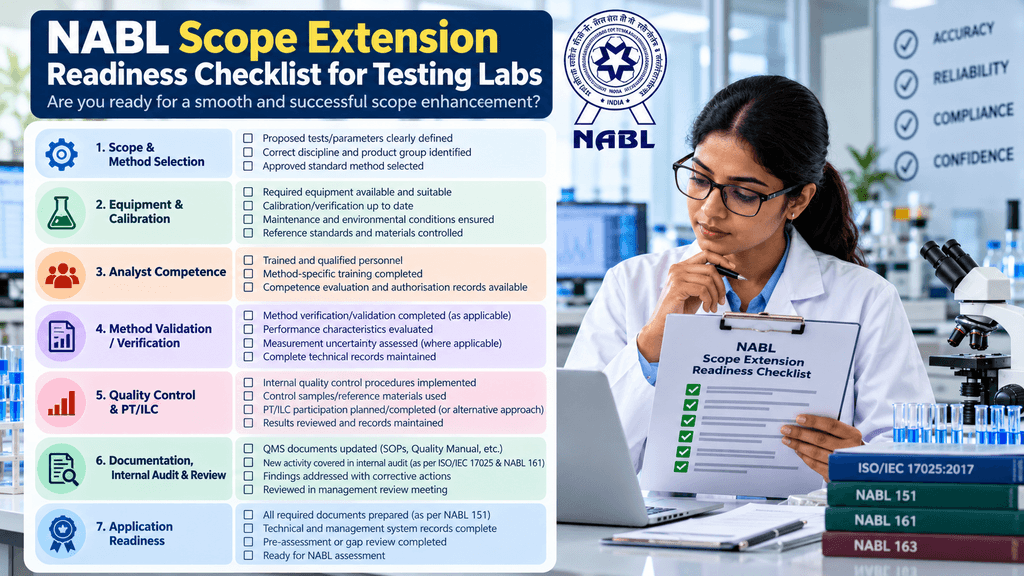
The most effective approach is to run a pre-assessment before submitting the application.
A simple readiness checklist is:
| Readiness Area | Minimum Question |
|---|---|
| Scope | Is every proposed activity clearly defined? |
| Method | Is the current method controlled and technically suitable? |
| Equipment | Is all required equipment available and controlled? |
| Calibration | Are relevant calibration/verification records current? |
| Personnel | Has competence been demonstrated? |
| Validation | Is verification/validation completed where required? |
| Uncertainty | Has applicable measurement uncertainty been evaluated? |
| QC | Is routine quality control implemented? |
| PT/ILC | Has external quality assurance been addressed? |
| Records | Are actual implementation records available? |
| Internal Audit | Has the extended activity been audited? |
| Management Review | Has performance of the new activity been reviewed? |
A useful rule for laboratory managers is:
If you cannot show objective evidence for a proposed test, consider the test not yet ready for scope extension.
What Does NABL Charge for Scope Enhancement?
NABL publishes applicable accreditation and scope-enhancement charges in its current NABL 100A General Information Brochure.
The applicable amount depends on the type and extent of the requested enhancement. NABL 100A specifically provides a fee category for enhancement of scope for testing laboratories, including extensions within existing disciplines and additional product groups.
Because NABL fee schedules and amendments can change, laboratories should verify the current NABL 100A before budgeting a scope-extension project rather than relying on an old quotation or consultant’s historical fee table.
Can a Laboratory Start Reporting the New Test as NABL Accredited?
No. A laboratory should clearly distinguish between: Testing performed by the laboratory and testing covered by its NABL accredited scope.
Until the additional activity is formally included in the laboratory’s accredited scope, the laboratory should not represent that particular test as NABL-accredited.
This distinction matters commercially as well as from a conformity-assessment perspective. Customers frequently check the published NABL scope to confirm whether a particular test, parameter, method or product group is actually covered. NABL’s own laboratory-search guidance directs users to the detailed accreditation scope for this purpose.
A Practical Example: Food Testing Laboratory Adding a New Parameter
Consider an FSSAI-related food testing laboratory that is already accredited for selected chemical tests and wants to add pesticide-residue testing.
The laboratory should not begin with the NABL application.
Instead, it should first assess:
- Applicable regulatory/customer requirements
- Correct discipline and product group
- Applicable test method
- Required instrumentation
- Reference standards and materials
- Analyst competence
- Method verification/validation
- Quality-control requirements
- PT availability
- Measurement uncertainty, where applicable
- Sample handling and storage
- Reporting requirements
- Internal audit readiness
Only after these elements are established should the laboratory finalise its proposed scope and proceed with the NABL process.
For laboratories working under regulatory programmes such as FSSAI, the applicable regulatory requirements should also be checked separately. NABL accreditation and regulatory recognition are related but are not automatically interchangeable.

Q1. What is NABL scope extension?
Answer: NABL scope extension, also called enhancement of scope, is the process through which an accredited laboratory seeks accreditation for additional testing activities. The laboratory must demonstrate technical competence and compliance with applicable ISO/IEC 17025 and NABL requirements before the additional activity is included in its accredited scope.
Q2. How long does NABL scope extension take?
Answer: There is no universal timeline for NABL scope extension. The duration depends on the proposed testing scope, technical readiness, documentation, assessment scheduling, findings and corrective-action closure. Completing method validation or verification, equipment readiness, competence assessment, QC and internal audit before applying can reduce avoidable delays.
Q3. Can a laboratory add a new test without purchasing new equipment?
Answer: A laboratory may be able to add a test without purchasing new equipment if its existing equipment is technically suitable for the proposed method and the laboratory can demonstrate adequate capability. Suitability, calibration, maintenance, environmental conditions and performance must be supported by objective evidence.
Q4. Is PT mandatory for a new NABL scope?
Answer: The laboratory must address applicable PT/ILC requirements for the proposed testing activity. Where a suitable formal PT programme is unavailable or unsuitable, the laboratory may need to use an appropriate alternative approach in accordance with applicable NABL requirements and its technical justification.
Q5. Can a laboratory report a new test as NABL accredited immediately after applying?
Answer: No. Applying for scope extension does not itself make the new test NABL accredited. The laboratory should only claim accreditation for activities that are formally included in its current NABL accredited scope.
Q6. Can a consultant help with NABL scope extension?
Answer: Yes. A consultant can assist with scope planning, gap assessment, documentation, technical readiness, training, internal audit and assessment preparation. The laboratory itself remains responsible for demonstrating technical competence, implementing its system and maintaining objective evidence for the proposed testing activities.
Final Checklist Before You Apply
Before submitting a NABL scope-extension request, ask your laboratory team:
- Is the proposed scope technically precise?
- Does the scope fit the correct NABL discipline/product group?
- Are all test methods current and controlled?
- Has method verification/validation been completed?
- Are equipment and calibration arrangements adequate?
- Are analysts competent and authorised?
- Are QC procedures implemented?
- Is PT/ILC addressed?
- Are technical records available?
- Has the new activity undergone internal audit?
- Has management reviewed the readiness and results?
- Are all relevant NABL documents and application requirements current?
If the answer to all of these is supported by objective evidence, the laboratory is in a much stronger position to proceed.
Need Help with NABL Scope Extension?
Scope extension should be treated as a technical competence project, not simply an application exercise.
Prgenix supports testing laboratories with NABL scope planning, ISO/IEC 17025 gap assessment, technical documentation, method verification/validation support, competence assessment, PT/ILC planning, internal audit, management review and NABL assessment readiness.
For professional support, explore NABL accreditation consulting and get your proposed scope reviewed before submission.
For organisations that also process employee, customer, patient or other personal data, Prgenix can separately support DPDP compliance assessment and implementation.
Disclaimer: This article is for informational purposes and does not constitute legal advice. For tailored guidance, consult Prgenix.
About the Author: Reviewed by V. Pathak, Lead Compliance Consultant at Prgenix, with experience in NABL accreditation, ISO/IEC 17025 implementation, laboratory quality systems and compliance consulting for Indian laboratories and organisations.